
A peptide research protocol is a written, repeatable procedure for receiving, dissolving, storing, verifying and using a peptide in a laboratory experiment. A good one names the sequence, solvent, pH, vessel, concentration, temperature and freeze-thaw count, so another lab can reproduce your result. This guide covers those elements, the supplies you need, the safety rules that apply, and the legal line that matters in the United States. It is for laboratory work only. It gives no human dosing, injection or self-treatment instructions.
TL;DR
- Peptide methods are sequence-dependent. Document the sequence, solvent, pH, vessel material, concentration, temperature, exposure time and freeze-thaw cycles, not just a product name.
- Store lyophilized material cold and dry. Dissolve it by sequence chemistry, not by copying one generic solvent.
- A certificate of analysis is one input to release control. A stated purity percentage does not tell you usable concentration, sterility or endotoxin clearance.
- In the US, a “research use only” label does not make a product lawful for human use. FDA looks at the whole presentation and intended use.
- Write sharps, PPE and decontamination steps into the protocol before the first vial is opened.
Table of Contents
- What a peptide research protocol has to contain
- Receiving and storing lyophilized peptides
- Reconstitution: the step most protocols get wrong
- Adsorption: the loss you do not see
- Verifying what is in the vial
- Biological samples need their own validation
- Choosing a method reference
- Lab safety belongs in the protocol
- The US legal line: research use only means research use
- Our perspective
- Where to source your research materials
- FAQ
- Sources
What a peptide research protocol has to contain
The most useful idea in the peer-reviewed literature is simple: peptide handling is sequence-dependent. Solubility, adsorption to surfaces, oxidation, concentration accuracy and stability can all change materially with amino-acid composition. The CPTAC recommendations were written for mass spectrometry-based assays, but the habits carry over to most bench work.
A protocol that another researcher can repeat records at least these items:
- Identity: the exact sequence, any modifications, supplier, lot number and the certificate of analysis for that lot.
- Receiving and storage: date received, storage temperature, desiccation, light protection.
- Solvent and pH: what you dissolved it in, in what order, and how you adjusted pH.
- Vessel and consumables: tube material, pipette tips, vial type.
- Concentration: how you set it and how you verified it.
- Exposure: time at room temperature, number of freeze-thaw cycles, aliquot size.
- Acceptance criteria: what a clear, usable solution looks like and what makes you discard a batch.
If your lab notebook says “peptide X, reconstituted, stored in fridge”, the experiment cannot be repeated. That is the failure most small labs hit first.
Receiving and storing lyophilized peptides
The CPTAC guidance splits storage by time. Up to three months, a concentrated liquid at 4 °C or a frozen solution at −20 to −80 °C is acceptable. From three months to a year, storage is generally frozen and depends on the peptide. Beyond a year, lyophilized material at −20 to −80 °C is the general recommendation. Storage decisions remain peptide-dependent, so treat these as starting points to test.
The same guidance flags repeated freeze-thaw cycles, air exposure, adsorption, evaporation, microbial degradation and chemical modification as recognized sources of error. In practice:
- Aliquot into single-use volumes so each tube is thawed once.
- Use amber or dark vessels for sequences that are photochemically active.
- Limit headspace and air exposure.
- Log every removal from the freezer.
For a deeper look at cold, dry storage of powders, see our guide on keeping lyophilized peptides cold and dry. If you need to separate chemical stability from sterility when choosing a temperature, our page on peptide storage temperature walks through the difference.
Reconstitution: the step most protocols get wrong
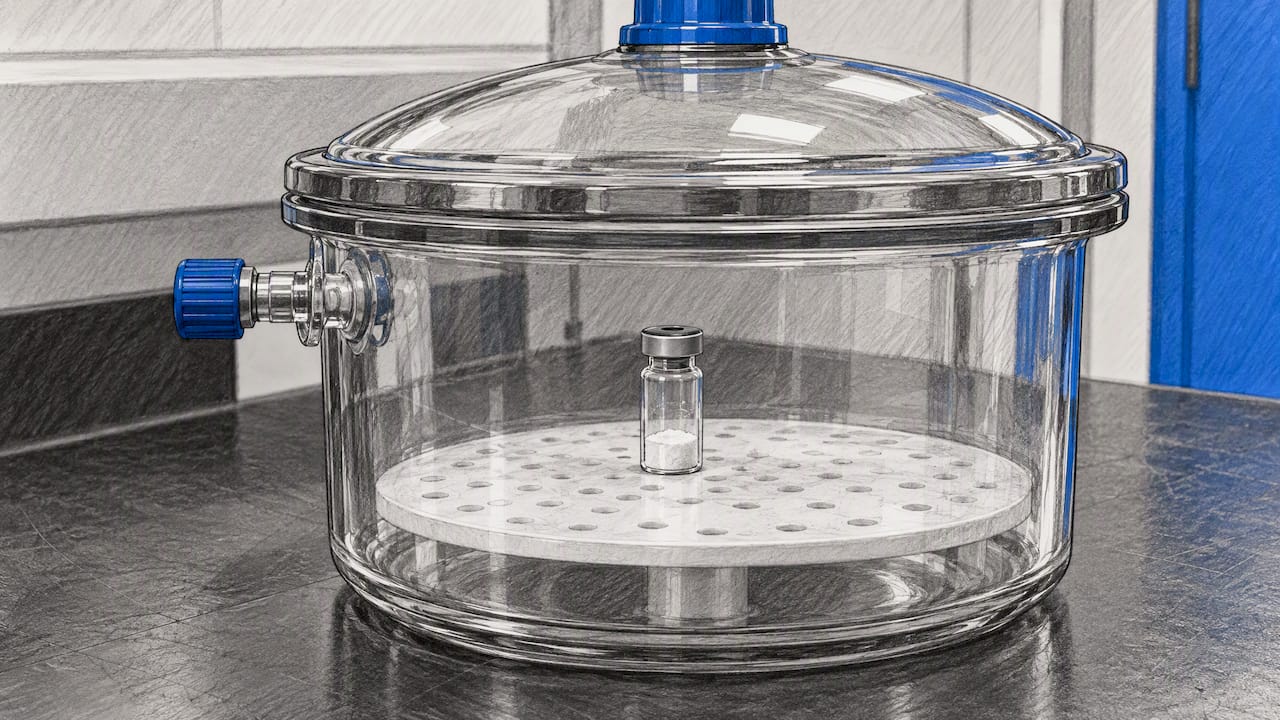
People search for “peptide reconstitution supplies” when they really need a sound dissolution method. The CPTAC authors recommend bringing lyophilized material to room temperature in a desiccator first, so condensation does not wet the powder. They also suggest testing a small aliquot where possible and dissolving according to the peptide’s chemistry.
Match the solvent to the sequence
Acidic, basic, neutral and highly hydrophobic peptides have different solvent preferences. The guidance notes that a starting analytical solvent may be 5% acetonitrile with 0.1 to 1% formic acid, with pH or organic-solvent adjustments if needed. It also cautions that PBS salts can hinder initial solubility, and that salt-containing formulation is better added after the peptide is fully dissolved.
A fully dissolved solution should be clear, without flecks or cloudiness. Cloudiness is a result to record, not something to filter away and ignore.
Our 6-step SOP for matching sequence features to solvents turns this into a checklist, and the step-by-step reconstitution guide covers the bench sequence in more detail.
A short reconstitution checklist
- Confirm the lot and certificate of analysis match the vial.
- Equilibrate the sealed vial to room temperature in a desiccator.
- Assess sequence charge and hydrophobicity to pick a starting solvent.
- Test a small aliquot before committing the whole vial.
- Dissolve, inspect for clarity, and adjust pH or organic content only as the chemistry requires.
- Add final buffer salts after complete dissolution.
- Aliquot, label with date, solvent and concentration, and freeze.
Supplies worth stocking
A realistic list for a small lab: a desiccator, calibrated pipettes with low-retention tips, low-binding tubes or vials chosen for the sequence, amber vials, high-purity water and solvents, pH adjustment reagents, labels, a freezer log, and a puncture-resistant sharps container. We carry ancillary research supplies in the shop. Check that each item suits your sequence before you standardize on it.
Adsorption: the loss you do not see
Peptides stick to tubes, pipette tips, autosampler vials and HPLC components. You can lose a meaningful share of the material before the experiment even starts, and a nominal concentration then misleads you. The CPTAC guidance recommends adding peptide directly to diluent, rinsing tips with peptide solution, using fresh tips for dilutions, selecting compatible vessel materials and checking recovery experimentally.
A simple recovery test: prepare the same dilution in two vessel types, measure both, and compare. Record the winner in the protocol. This costs an afternoon and saves weeks of irreproducible data.
Verifying what is in the vial
A defensible release workflow combines identity confirmation, purity measurement, concentration verification, stability testing and system-suitability checks. The CPTAC recommendations point to amino-acid analysis and UV-absorbance benchmarking for concentration, and LC-MS for stability and carryover. They also point to dilution and replicate experiments to characterize solubility and adsorption.
Two cautions follow from that:
- Purity is not concentration. A certificate showing high purity does not tell you how much active peptide is in a given volume. Verify it.
- Purity is not clinical readiness. A vendor’s stated 99%+ purity is not the same as a validated clinical product, sterility assurance, endotoxin clearance or evidence of human safety and efficacy.
When you buy, ask for lot-specific documentation: purity and identity results, and endotoxin data where relevant to your assay. Our page on peptide stability testing and ICH-style protocols explains how to extend verification to stability, and the laboratory standards overview covers wider best practice.
Biological samples need their own validation
A method that works on a pure standard may fail in plasma or tissue. An apelin study shows how far this can go: immediate cooling and centrifugation improved preservation, and acidification to pH 2.5 improved stability after sampling. Even so, an HPLC-MS/MS method did not detect circulating apelin in healthy volunteers, while a radioimmunoassay found 71 to 263 fmol/L in 10 healthy volunteers.
The lesson is not specific to apelin. Collection, preservation, extraction and detection each need validating for the analyte you study. Do not assume a published instrument method transfers to your peptide.
Choosing a method reference
When you need stepwise procedures rather than overviews, a methods book is often the best starting point. Springer’s Peptide Analysis Protocols is aimed at researchers who need practical information to begin developing analysis and purification methods. For antibody work, Peptide Antibodies: Methods and Protocols treats carrier conjugation, epitope and paratope prediction and assay validation as separate design decisions. They are laboratory methods references. They are not dosing guides, and they do not show that any research compound is safe, effective or approved for athletic, weight-loss, recovery or anti-aging use.
Lab safety belongs in the protocol
Safety is a system, not one sterile item. The CDC’s laboratory guidance calls for written controls covering sharps, PPE, hand hygiene, contamination prevention, aerosol minimization, surface decontamination and disposal. These matter even when the peptide is not infectious, because the work may involve biological specimens, cell culture, animals or hazardous solvents.
For needles and syringes used in a lab setting, the same guidance says to place used disposables immediately in puncture-resistant containers near the point of use, and not to recap or manipulate needles by hand. A CDC biosafety checklist adds that mouth pipetting is out and mechanical pipetting is the rule. Write these into your SOP, train everyone who touches the bench, and keep the training record.
The US legal line: research use only means research use
This is where many buyers get misled. FDA warning letters from 2024 and 2026 treated online peptide products marketed with human weight-loss, treatment or body-function claims as unapproved new drugs. The compounds named included semaglutide, retatrutide, cagrilintide, tirzepatide, mazdutide, survodutide and sermorelin.
The practical test is intended use, inferred from labeling, website content and promotion. A disclaimer does not cancel surrounding claims. So, as of October 2026, we keep this article to laboratory methods. If you are an athlete, want weight loss, or are pursuing recovery or anti-aging effects, the appropriate route is an FDA-approved product and a licensed clinician, not an online research-peptide protocol.
Our perspective
We see the same gap again and again. Labs buy a peptide, trust one number on a certificate, and skip the verification that would have told them the solution was off. The product is rarely the only variable. The protocol is.
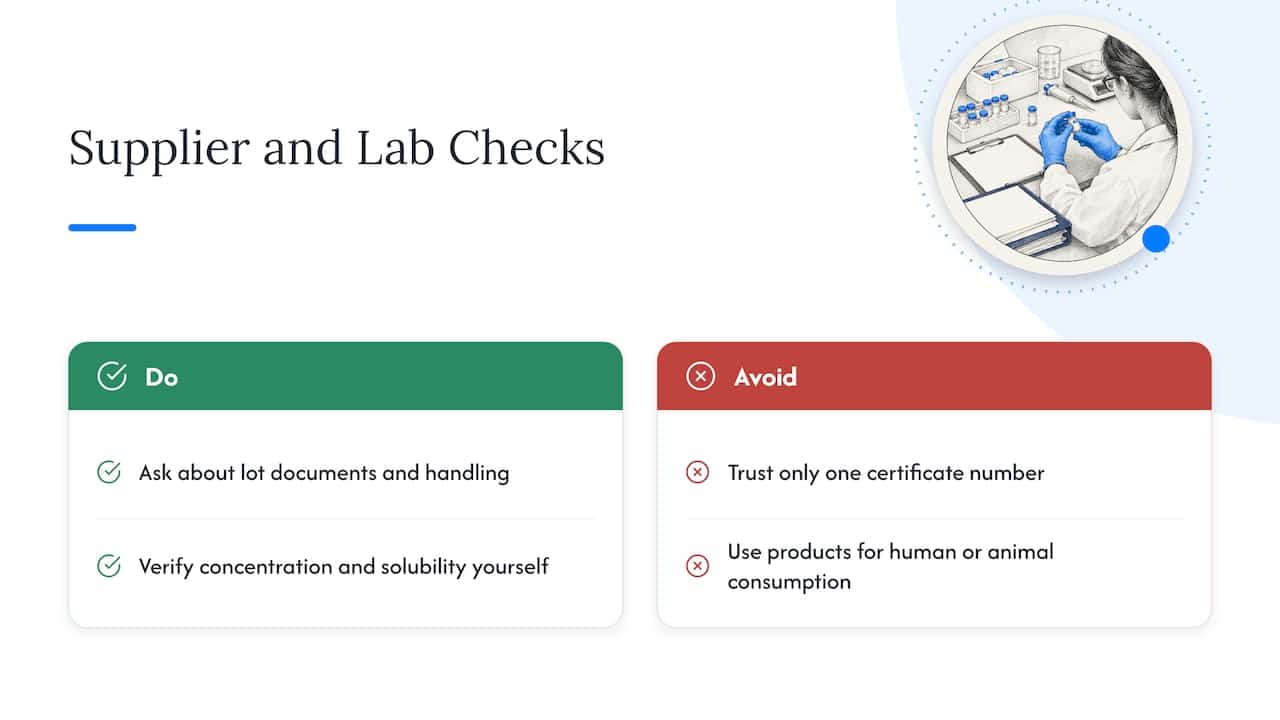
So we build around documentation. Every lot we sell is third-party batch tested for purity and identity, with a certificate of analysis and endotoxin data for each lot. We think that is the minimum a researcher should expect, and we also think you should still verify concentration and solubility for your own sequence and your own vessels. Our products are sold strictly for laboratory research use. They are not for human or animal consumption, and we will not write protocols that suggest otherwise.
When you contact support, which is available 24/7, ask about lot documents and handling before you ask about anything else. A supplier who answers those questions well is worth more than one who ships a day sooner.
— Data Peptides
Where to source your research materials
If your protocol is written and your acceptance criteria are set, you can browse our research peptide catalog, which spans categories such as weight loss, muscle growth, recovery, anti-aging, libido and ancillaries. Orders ship quickly and discreetly from our US facility. Each product page links to lot-specific documentation, and everything is for laboratory research only. Pricing is published on the individual product pages.
FAQ
Can I use a research peptide protocol to guide personal use?
No. Laboratory protocols describe how to handle and analyze materials, not how to use them on people. FDA has treated peptides marketed for human weight loss or body-function effects as unapproved new drugs, so talk to a licensed clinician about approved options.
How should I store a peptide after reconstitution?
It depends on the sequence. For up to three months, CPTAC guidance allows concentrated liquid at 4 °C or frozen solution at −20 to −80 °C. Aliquot into single-use volumes to avoid repeated freeze-thaw cycles, and test stability for your peptide.
Does a 99% purity figure mean my solution is the right concentration?
No. Purity describes the share of the material that is the target peptide, not how much peptide is in your vial or your solution. Verify concentration with methods such as amino-acid analysis or UV absorbance, and check recovery for adsorption losses.
Can I dissolve every peptide in PBS?
Not as a first step. The CPTAC guidance cautions that PBS salts can hinder initial solubility. Dissolve in a solvent matched to the sequence first, then add final buffer salts once the peptide is fully in solution.
Sources
- Recommendations for the generation, quantification, storage and handling of peptides used for mass spectrometry-based assays (PMC)
- On Methods for the Measurement of the Apelin Receptor Ligand Apelin (PMC)
- Peptide Analysis Protocols (Springer)
- Peptide Antibodies: Methods and Protocols (Springer Nature Link)
- Guidelines for Safe Work Practices in Human and Animal Medical Diagnostic Laboratories (CDC)
- Import Permit Program BSL-2 Inspection Checklist (CDC)
- FDA warning letter, 12/10/2024
- FDA warning letter, 03/31/2026
- FDA warning letter, 12/12/2025