

Peptide solubility is not a fixed property of a compound. It is the result of a sequence, a solvent, a pH, a temperature and a concentration meeting in one tube. To get a peptide into solution, work out its net charge, pick a starting solvent that matches it, test a small aliquot first, and record every condition you used. This guide walks through that process step by step, including what to do when the powder just sits there.
Everything here is written for laboratory research use only. Our products are sold for that purpose and no other.
TL;DR
- Sequence drives solubility. Net charge at neutral pH, the share of hydrophobic residues and peptide length are the three things to check first.
- Stay at least one to two pH units away from the peptide’s isoelectric point (pI), where precipitation is most likely.
- Test a small aliquot before committing the whole vial, and move from water to dilute acid or base, then to an organic co-solvent only if needed.
- Dissolution can be slow. Aggregates break down far more slowly than simple salts, so patience and gentle handling beat heat and force.
- Write down solvent, pH, concentration, time and appearance for every attempt. Solubility is only meaningful under stated conditions.
Table of Contents
- What solubility means for a peptide
- Step 1: Read the sequence before you touch the vial
- Step 2: Pick a starting solvent that matches the charge
- Step 3: Dissolve gently and give it time
- Step 4: Choose the buffer with care
- Troubleshooting: why won’t my peptide dissolve?
- Storage: protect what you dissolved
- What to record every time
- Our perspective
- Research peptides with documentation you can plan around
- FAQ
- Sources
What solubility means for a peptide
A peptide is a short chain of amino acids, and each residue brings its own chemistry. Some carry a charge at neutral pH (lysine, arginine, aspartate, glutamate). Some are polar but uncharged. Others, such as leucine, valine, isoleucine, phenylalanine and tryptophan, are hydrophobic and push away from water.
The balance of those residues decides how the whole chain behaves. Many peptide hormones are strongly hydrophilic, which is why they circulate dissolved in blood plasma. That is a fact about biology, though, not a promise about any particular lyophilized powder in a vial. A peptide with a run of hydrophobic residues can resist water almost completely, and two peptides of the same length can behave very differently.
It also helps to separate two ideas that get blurred:
- Thermodynamic solubility is the maximum concentration that stays dissolved at equilibrium under defined conditions.
- Practical dissolution is whether the powder went clear in the time you were willing to wait, at the concentration your assay needs.
For short peptides built from simple amino acids, solubility in water has been measured systematically, and the numbers vary a lot between even tiny di- and tripeptides. Longer, more complex sequences are harder to predict, which is why a small pilot test is standard practice.
Step 1: Read the sequence before you touch the vial
Before choosing a solvent, spend five minutes on paper or in a peptide property calculator.
- Count the charged residues. Assign +1 to each lysine, arginine and the free N-terminus. Assign -1 to each aspartate, glutamate and the free C-terminus (unless it is amidated, in which case it is neutral). Histidine is mostly neutral at pH 7 but picks up charge in acidic conditions.
- Add them up. A positive total means a basic peptide. A negative total means an acidic one. Near zero means neutral.
- Estimate hydrophobic content. A rough rule many labs use is that when hydrophobic residues make up around half or more of the chain, plain water is unlikely to be enough.
- Note the length. Very short chains are generally easier to dissolve, while long chains have more opportunity to fold, stack and aggregate.
- Flag troublemakers. Cysteine can form disulfide bonds. Methionine and tryptophan oxidize. Asparagine-glycine and aspartate-proline motifs can be chemically fragile. These do not just affect solubility, they affect whether the peptide you dissolve is still the peptide you ordered.
This is also where the certificate of analysis earns its keep. Your lot’s CoA should tell you the sequence identity, purity and the counterion (often trifluoroacetate or acetate). The counterion matters because it changes how much of the powder weight is actually peptide and can shift the pH of the solution you make. Our safety checks for research peptides explain what to confirm on a lot before it goes anywhere near an assay.
Step 2: Pick a starting solvent that matches the charge
The common laboratory approach is a ladder. Start with the gentlest option and climb only when you must. Always try this on a small amount first, not the whole vial.
| Peptide type | First try | If it stays cloudy | Last resort |
|---|---|---|---|
| Short (under about 5 residues) | Sterile water or buffer | Light sonication | Dilute acid or base |
| Basic (net positive) | Water or buffer | Small amount of dilute acetic acid, then dilute | Minimal organic co-solvent |
| Acidic (net negative) | Water or buffer | Small amount of dilute ammonium bicarbonate or base, then dilute | Minimal organic co-solvent |
| Neutral or very hydrophobic | Minimal organic solvent (such as DMSO or DMF, if compatible with your assay) | Add the aqueous phase slowly, drop by drop, while mixing | Denaturants, only if your application allows |
A few notes on this table.
Acid for basic peptides, base for acidic ones. Pushing the pH away from the pI increases the net charge, which increases repulsion between chains and attraction to water. Published guidance on formulation says that moving the pH one to two units away from the pI is standard practice, and that working right at the pI often leads to rapid precipitation.
Organic co-solvents go in first, water goes in second. For hydrophobic sequences, dissolve the powder completely in a small volume of organic solvent, then dilute into your aqueous buffer slowly with mixing. Pouring the aqueous phase in all at once can crash the peptide out of solution. Check that your assay tolerates the final co-solvent percentage, since cells and enzymes vary widely in what they can handle. Also be aware that DMSO can oxidize methionine and free cysteine, so it is a poor match for those sequences.
Avoid cross-contamination of the stock. Use a fresh sterile tip and a clean tube for each trial. A solubility test that contaminates the original vial costs you more than the test saves.
Step 3: Dissolve gently and give it time
When a peptide does not dissolve immediately, the instinct is to heat it, vortex hard or add more solvent. Resist all three as a first move.
- Allow the vial to reach room temperature before opening, so condensation does not add water to the powder.
- Swirl or gently invert rather than shaking. Foaming creates air-liquid interfaces, and peptides can aggregate at those surfaces.
- Try brief sonication in short bursts, with the tube on ice between bursts, to avoid warming the sample.
- Wait. Research on peptide assemblies shows that dissolving aggregates is a surprisingly slow, reaction-limited process that involves breaking hydrogen bonds between chains. Labs often assume it will be as fast as dissolving salt, and then conclude the peptide is insoluble when it simply needed more time.
- Warm only slightly, if at all. Mild warming can help some peptides, but heat speeds degradation for others. If your sequence has cysteine, methionine, tryptophan or deamidation-prone motifs, skip it.
A clear solution is the goal, but clear to the eye is not proof of a monomeric solution. Aggregation can begin before it becomes visible, and the solution can look entirely clear while soluble oligomers and subvisible particles are forming. If your work is sensitive to aggregation state, consider a filtration step compatible with your peptide, or an analytical check such as dynamic light scattering or HPLC, whichever your lab already uses.
Step 4: Choose the buffer with care
Buffers are not neutral bystanders. Phosphate, Tris, acetate and citrate each interact differently with peptides and with the ions in your solution.
Laboratory studies have found, for example, that Tris can interact with certain peptide backbones in ways that affect stability, and that acetate can induce precipitation in specific cases. The practical lesson is to screen two or three buffers at small scale when a peptide is borderline, rather than assuming your default buffer is fine.
Two other habits pay off:
- Check the final pH after adding the peptide. A peptide supplied as a salt can shift an unbuffered or weakly buffered solution by more than you expect.
- Mind the salt. High ionic strength can help some peptides and hurt others. If a peptide dissolved in water but crashed when diluted into saline or PBS, the salt is the first suspect.
Troubleshooting: why won’t my peptide dissolve?
Work through the list in order.
- Is it near its pI? Calculate it. If your solution pH is within one unit, shift the pH.
- Is it hydrophobic? If so, water alone will fail. Use the organic-first method above.
- Did it dissolve and then cloud? That points to aggregation, often triggered by dilution, concentration, temperature changes or the wrong buffer. Lower the concentration and try again.
- Is there a gel or film? Some sequences form beta-sheet structures and gel at higher concentrations. Dilute, adjust the pH, or use a solvent that disrupts hydrogen bonding, if your assay allows.
- Is it the right peptide? If a sequence that should be hydrophilic will not dissolve at all, go back to the CoA and the lot data. Identity and purity problems look like solubility problems.
- Is the concentration simply too high? Every peptide has a ceiling. Dissolving at a lower stock concentration and adjusting the dilution is usually easier than fighting the limit.
Storage: protect what you dissolved
Solubility and stability are linked. A peptide that dissolves well today can aggregate next week.
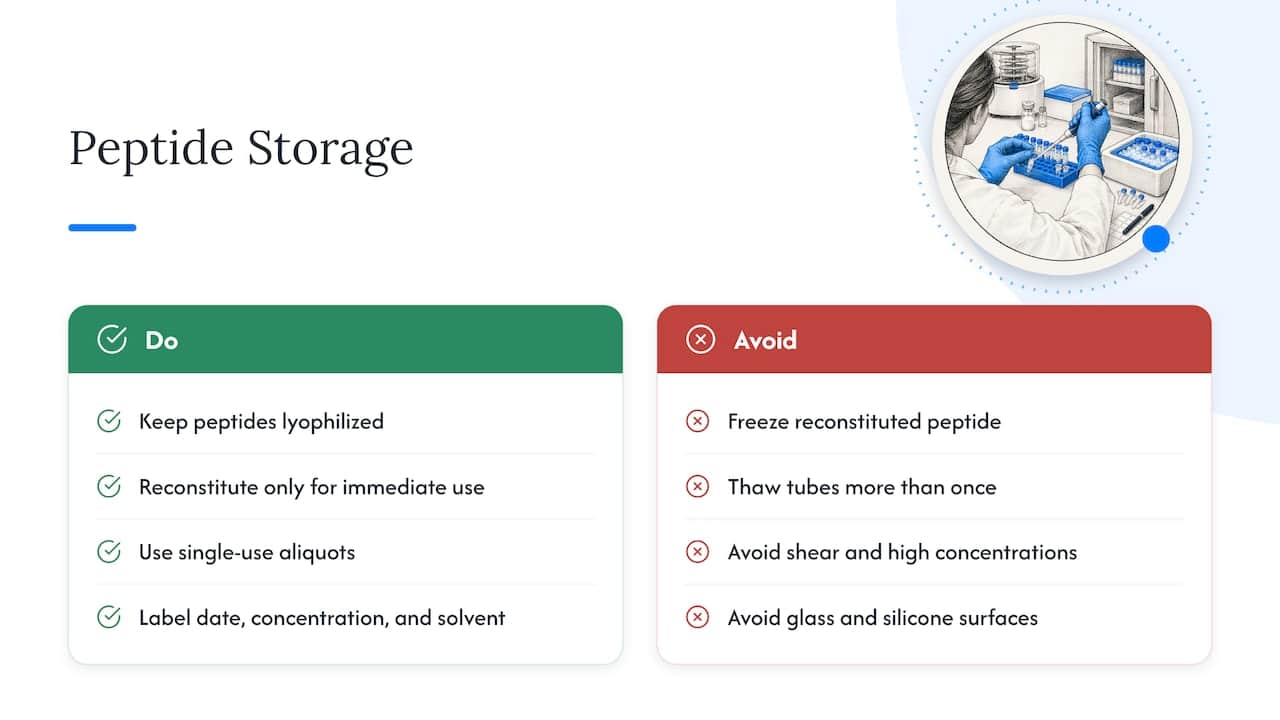
The safest default is to keep the peptide as a lyophilized powder and reconstitute only what you need for immediate use. Guidance from a peptide-storage reference notes that freezing reconstituted peptide is often counterproductive, because each freeze-thaw cycle brings ice crystal formation, pH shifts in phosphate buffers and concentrated solutes that can promote aggregation. If you must store solution, divide it into single-use aliquots so no tube is thawed twice, and label each with date, concentration and solvent.
Peptide stability work also flags that hydrophobic sequences, high concentration, shear, glass and silicone surfaces and freeze-thaw can all drive aggregation and adsorption. Low-binding tubes are a cheap fix for dilute solutions that seem to lose potency on the wall of the container.
What to record every time
Because solubility is only meaningful under defined conditions, a good record turns a one-off success into a reproducible method. For each peptide and lot, log:
- Lot number and CoA reference, including purity and counterion
- Amount of powder and the final volume
- Solvent, co-solvent percentage, buffer and measured pH
- Temperature, mixing method and time to clarity
- Appearance: clear, hazy, particulate or gel
- Any filtration or analytical check and its result
- Storage conditions and how long the solution was kept
This is the same discipline that sits behind sound procurement. If you are still deciding where to source material, our guides on buying research peptides online and on how research peptides are classified and regulated in the U.S. cover what documentation to expect.
Our perspective
Most solubility complaints we hear about are not really solubility problems. They are information problems. A researcher gets a vial, reads a generic instruction to “reconstitute with sterile water,” and finds it cloudy. Nobody told them the sequence is hydrophobic, or that the counterion shifts the pH, or that the lot’s documentation was thin.
That is why we put documentation first. Every lot we sell is third-party batch tested for purity and identity, with a certificate of analysis and endotoxin data for each lot. Those documents are the starting point for any solubility plan, because you cannot choose a solvent for a sequence you have not confirmed.
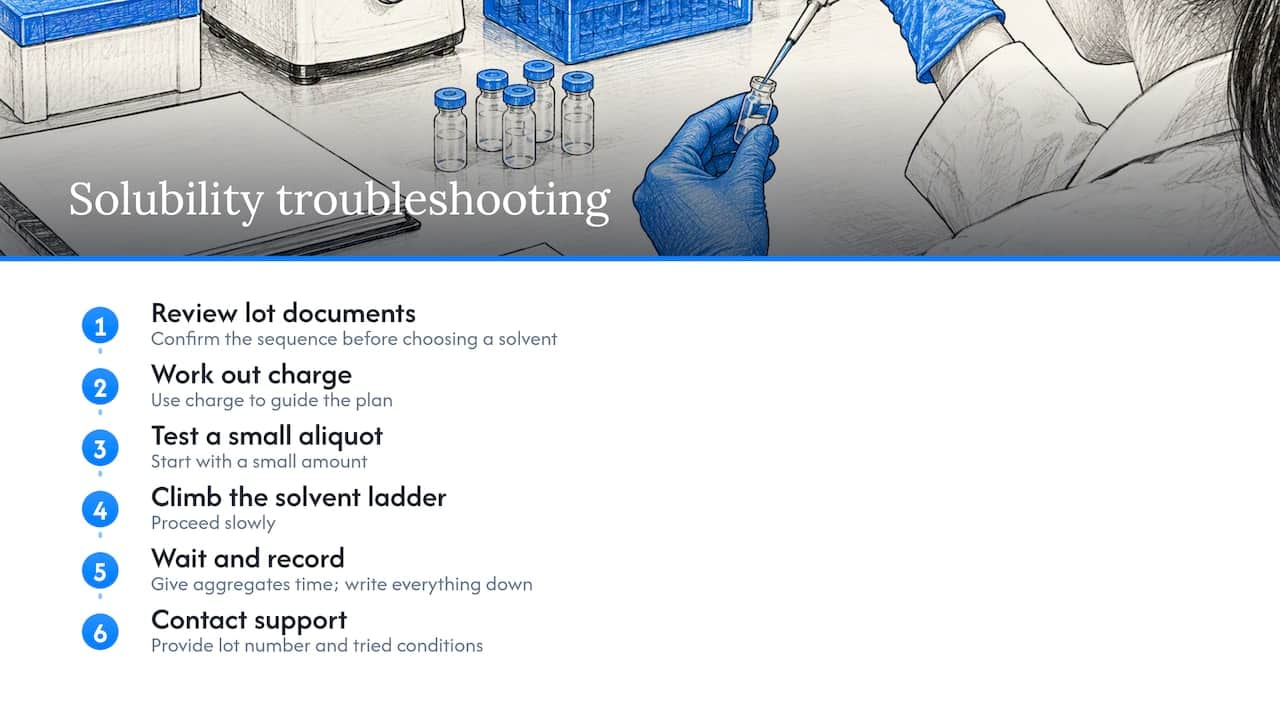
Our advice is simple. Work out the charge, test a small aliquot, climb the solvent ladder slowly, give aggregates time, and write everything down. If a peptide still misbehaves, contact our 24/7 support team with the lot number and the conditions you tried, and we will help you work through it.
We also want to be clear about the boundaries. Our peptides are for laboratory research use only. They are not approved drugs, and the FDA has warned that products labeled for research or not for human consumption are of unknown quality and may be harmful when used outside that setting. Do not use any research material for human or animal consumption.
— Data Peptides
Research peptides with documentation you can plan around
If you are building a solubility protocol for a new compound, start from a lot with full paperwork. Browse our research peptide catalog across weight loss, muscle growth, recovery, anti-aging, libido and ancillary supplies. Each lot ships with a certificate of analysis, and orders go out quickly and discreetly from our U.S. facility. For compound-specific pages, see products such as Ipamorelin or the CJC / IPA blend. For background on how different peptide classes are used in research, read Peptides Used For.
FAQ
Why won’t my peptide dissolve?
The usual causes are a hydrophobic sequence, a pH too close to the isoelectric point, a concentration above the peptide’s limit, or aggregation. Check the sequence and net charge, shift the pH away from the pI, and try a small organic co-solvent first for hydrophobic peptides. Give it time too, since breaking up aggregates is slow.
Are peptide hormones water soluble?
Most are hydrophilic, and that is why they dissolve in blood plasma without carrier proteins. That describes the class in general. A specific synthetic peptide in a vial can behave differently depending on its sequence, salt form and concentration, so test a small amount.
Should I use DMSO for every peptide?
No. Use it only when water, buffer or dilute acid or base fail, and only if your assay tolerates it. Keep the final percentage as low as possible, and avoid it for sequences rich in methionine or free cysteine, which are prone to oxidation.
Can I freeze a peptide after dissolving it?
You can, but it is not the best default. Each freeze-thaw cycle can promote aggregation, so store the peptide as lyophilized powder and reconstitute only what you need. If you must freeze, use single-use aliquots and never refreeze a thawed tube.
Sources
- Slow Dissolution Kinetics of Model Peptide Fibrils (PMC)
- Formulation pH and the isoelectric point (PMC)
- Buffer interactions with peptide backbones (Physical Chemistry Chemical Physics)
- Melting Properties of Peptides and Their Solubility in Water, Part 2 (ACS Publications)
- Classes of Hormones: Structure Determines Function (Biology LibreTexts)
- Peptide Stability and Forced Degradation Playbook (BiologicsGuide)
- Peptide Storage Temperature Guide
- FDA’s Concerns with Unapproved GLP-1 Drugs Used for Weight Loss