
Peptide lab safety comes down to three things: protecting the people who handle the material, protecting the material from degrading, and being able to prove what is in the vial. A lab that controls powder exposure, stores lyophilized peptide cold and dry, and works from batch-level documentation avoids most of the problems that ruin assays or hurt people. We supply lab-grade research peptides with third-party batch testing, Certificates of Analysis and endotoxin data for every lot, so the documentation step starts with the vial in your hands.
This guide is for people working with research peptides in a laboratory setting. Research peptides are sold for laboratory use only, not for human or animal consumption or medical treatment.
TL;DR
- Treat peptide powder as a chemical hazard: read the safety documentation, wear suitable PPE and use local exhaust or a fume hood for steps that can make airborne dust.
- Store lyophilized peptide dry, closed, labeled and cold, and limit freeze-thaw cycles and air exposure.
- In a U.S. workplace, OSHA’s Laboratory Standard requires a written Chemical Hygiene Plan, training and annual review.
- Verify each lot with a Certificate of Analysis: purity by HPLC, identity by mass spectrometry, and endotoxin data.
- Lab-safe handling does not make a peptide safe for people. Keep research material in research.
Table of Contents
- What peptides are, and what lab safety does not mean
- Protecting the people: exposure controls
- What the law expects of a U.S. lab
- Protecting the material: storage that keeps it intact
- Proving what is in the vial
- Our perspective
- Where to find research peptides with batch documentation
- FAQ
- Sources
What peptides are, and what lab safety does not mean
Peptides are short chains of amino acids that can act as biological messengers. Harvard’s School of Public Health notes that many synthetic peptides have had little or no rigorous clinical testing and have not been approved for human use.
That is why the phrase “lab safety” matters here. It describes how to handle a chemical responsibly at the bench. It says nothing about dosing a person. Our products are sold for laboratory research only, and every practice below assumes that setting.
Protecting the people: exposure controls
The working hazard with lyophilized peptide is a fine, light powder that can become airborne when you open a vial, weigh it or reconstitute it. Plan for that moment.
Use the hierarchy of controls
The NIOSH laboratory guidance for engineered nanomaterials ranks controls in a useful order: elimination or substitution, isolation, engineering controls, administrative controls, and PPE last. Local exhaust is valued because it captures emissions at their source. The same logic works for any fine powder.
In practice for a peptide bench:
- Engineering first. Open vials and weigh powder inside a certified fume hood or a ventilated enclosure rather than on an open bench.
- Administrative controls. Write a standard procedure for weighing and reconstitution, label every container and limit who handles bulk powder.
- PPE last. Gloves, safety glasses and a lab coat are the baseline. The American Peptide Society advises consulting the applicable chemical safety documentation and lab policies, using suitable PPE and a certified fume hood where appropriate.
Read the safety data sheet before the first vial
Every chemical in the workflow needs its safety data sheet at hand: the peptide, solvents, acids used in buffers, and any cleaning agents. Reconstitution solvents often carry more hazard than the peptide itself.
Hygiene habits that prevent quiet exposure
- No food, drink or cosmetics in the work area.
- Wash hands after removing gloves.
- Clean the balance and hood surface after weighing.
- Keep containers closed whenever you are not drawing from them.
What the law expects of a U.S. lab
If you are an employer, OSHA’s Laboratory Standard, 29 CFR 1910.1450, applies to laboratory use of hazardous chemicals. It requires a written Chemical Hygiene Plan (CHP), exposure controls, training, accessible hazard references, and exposure and medical records. The plan must include relevant standard operating procedures and criteria for engineering controls, PPE, hygiene practices and fume-hood performance.
OSHA’s laboratory safety guidance describes the core pieces: the written plan, a Chemical Hygiene Officer, controls, and special precautions for particularly hazardous substances. Its CHP fact sheet says the plan must be reviewed for effectiveness at least annually and updated as needed.
A simple way to meet that: add peptide weighing and reconstitution as named procedures in your CHP, record who was trained, and put the annual review on the calendar.
Protecting the material: storage that keeps it intact
A degraded peptide is a safety problem for your data. Peptide bonds can break in water, and heat, light, moisture and repeated handling all speed that up.
Lyophilized powder
Peer-reviewed peptide assay recommendations advise lyophilizing material for storage beyond six months and keeping it between −20 and −80 °C. They also advise limiting repeated freeze-thaw cycles and air exposure, and using dark tubes for light-sensitive sequences. Treat these as general recommendations and defer to stability data for your specific sequence.
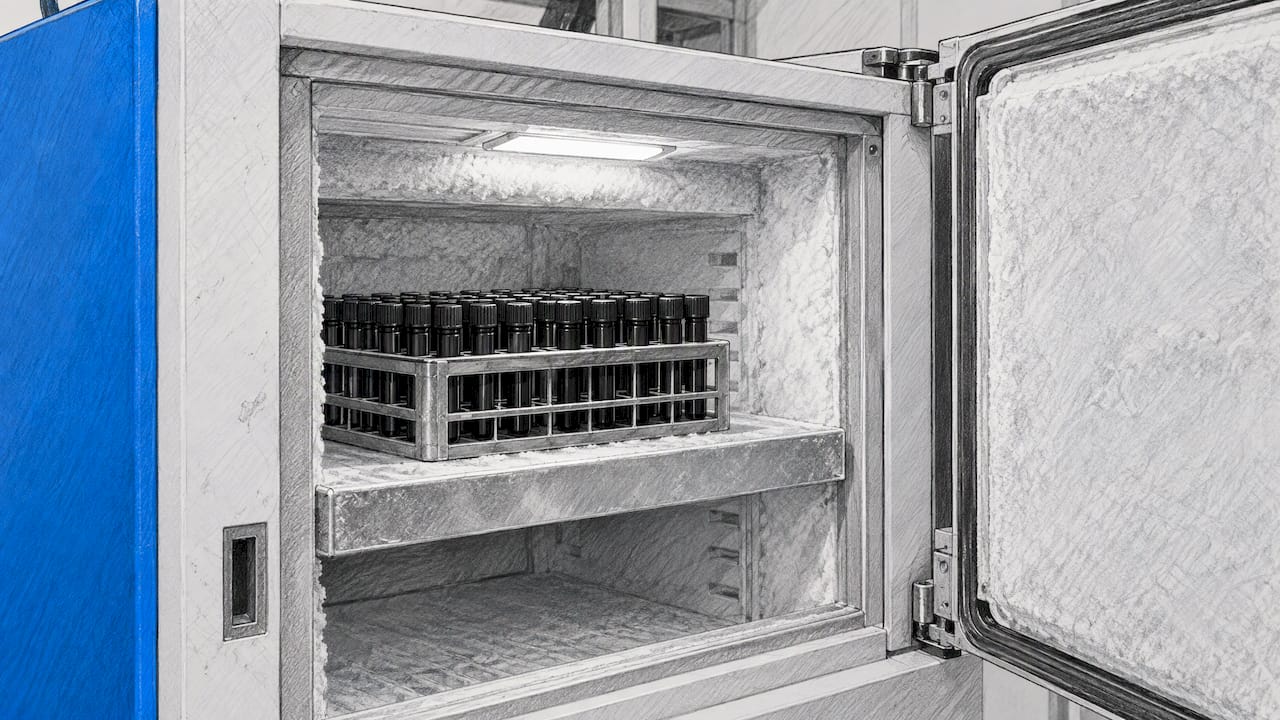
Lawrence Berkeley National Laboratory’s chemical hygiene guidance adds the basics: store hazardous materials away from heat and direct sunlight, with containers securely closed.
Our own guides go deeper on keeping lyophilized peptides cold and dry and on storage temperature, chemical stability versus sterility.
Solutions
Once reconstituted, the clock runs faster. The same recommendations say peptide calibrator solutions are best kept in sealed tubes at or below −70 °C, and working solutions are generally short-term preparations used within about three months. Aliquot into single-use volumes so you never thaw the same tube twice. See our notes on aseptic technique for research peptides for keeping solutions clean, and on shelf life, where sterility limits and chemical stability are different questions.
Freeze-drying is not a guarantee
A 2015 study on growth-hormone-derived peptides found that disulfide exchange differed between solid-state and aqueous storage. Lyophilization does not make every sequence chemically invariant, so verify stability for your actual sequence and conditions. Our peptide stability testing guide covers ICH-style protocols.
Shipping and receiving
Material can be compromised before it reaches your door. Log the condition on arrival and move it to storage promptly. Read more about cold chain shipping for peptides.
A short storage checklist
| Step | What to do |
|---|---|
| Receive | Inspect seal, label and lot number; log date |
| Store powder | Cold, dry, dark, closed; avoid frost-free freezers that cycle temperature |
| Reconstitute | Inside a hood, with clean technique, in single-use aliquots |
| Label | Peptide, lot, concentration, date, initials |
| Avoid | Repeated freeze-thaw, strong acids, oxidizers and other incompatible agents |
Proving what is in the vial
Safe handling assumes the vial contains what the label says. That is a documentation question, and a Certificate of Analysis (COA) is where it is answered.
The peptide assay recommendations describe reversed-phase HPLC with UV detection plus mass spectrometry for purity and identity, MS/MS to confirm sequence and characterize impurities, and amino-acid analysis to determine concentration. They also warn that one major HPLC peak may not be the desired peptide, which is why identity data matters alongside purity.
A 2025 study found tandem mass spectrometry could distinguish certain deamidation and isoaspartate species that conventional chromatography or standard mass spectrometry may miss. For sensitive assays, ask what methods sit behind the numbers.
A useful COA review, lot by lot:
- The lot number on the COA matches the vial.
- Purity is reported by HPLC.
- Identity is confirmed by mass spectrometry.
- Endotoxin data is present for the lot.
We publish a deeper walk-through in 3 checks before a lot enters your assay, and our laboratory standards page and research protocols guide cover routine setup.
Our perspective
Most peptide problems we hear about at the bench are not dramatic accidents. They are quiet ones: a lot nobody could document, powder weighed on an open bench, a solution thawed five times.
That is why we build around documentation. Every lot we sell is third-party batch tested for purity and identity, with a Certificate of Analysis and endotoxin data, and our research-grade peptides are sold for laboratory use only. When the paperwork travels with the vial, your safety plan and your data both start from something known.
We ship fast and discreetly from our U.S. facility, and our support team is available 24/7 if a question comes up about a purchase. Good lab safety is mostly routine, and routine is easier when the supplier’s records are complete.
Data Peptides
Where to find research peptides with batch documentation
If you are setting up or restocking a research workflow, our shop lists lab-grade peptides by category, including weight loss, muscle growth and recovery research peptides. Each ships with third-party testing and a COA, for laboratory research use only.
FAQ
Are peptides safe to handle in a lab?
Yes, with ordinary chemical precautions. Read the safety documentation, wear gloves, eye protection and a lab coat, and open powder in a fume hood or ventilated enclosure. Safe handling at the bench is a separate matter from use in people, which research peptides are not sold for.
What temperature should lyophilized peptides be stored at?
General research recommendations place long-term storage between −20 and −80 °C, dry, closed and protected from light. Sequence-specific stability data should guide the final choice.
Does OSHA regulate peptide labs?
OSHA’s Laboratory Standard, 29 CFR 1910.1450, applies to employers using hazardous chemicals in a lab. It calls for a written Chemical Hygiene Plan, training, exposure controls and at least annual plan review.
What should a Certificate of Analysis show?
A lot number matching your vial, HPLC purity, mass-spectrometry identity confirmation and endotoxin data. These let you tie the material in your hands to a tested batch.
Sources
- Peptide Synthesis for Beginners, American Peptide Society
- General Safe Practices for Working with Engineered Nanomaterials, NIOSH 2012-147
- Peptides are all over social media and the news, Harvard T.H. Chan School of Public Health
- Recommendations for the generation, quantification, storage and handling of peptides
- Chapter 45.7 Chemical Hygiene and Safety Plan, Lawrence Berkeley National Laboratory
- Thiol-disulfide exchange in peptides derived from human growth hormone
- Revealing deamidation and isoaspartate formation
- OSHA 29 CFR 1910.1450
- OSHA Laboratory Safety Guidance
- OSHA Fact Sheet: Laboratory Safety Chemical Hygiene Plan