
Peptide contamination is prevented at three points: the lot you buy, the way you store it, and the way you open, reconstitute and divide it. Start with a supplier that publishes lot-specific purity, identity and endotoxin data. Keep lyophilized powder cold, dry and dark. Then handle every vial with sterile technique and single-use aliquots. Skip any one of the three and a clear, clean-looking solution can still carry impurities that distort your results.
This guide is written for researchers and lab users who want reliable material in their assays. It explains what contamination actually is, what to read on a Certificate of Analysis (COA), and a handling routine you can follow at the bench. All products we discuss are for laboratory research use only.
TL;DR
- Contamination comes in two families: peptide-related impurities (truncated, oxidized, aggregated sequences) and non-peptide impurities (residual solvents, metals, endotoxin, microbes).
- A clear solution is not a clean solution. Purity and identity data, plus endotoxin data, tell you what your eyes cannot.
- Store lyophilized peptide at −20 °C or colder, dry and light-protected, and let the vial warm for at least 60 minutes before opening.
- Reconstitute with sterile technique, split into single-use aliquots at once, and avoid repeated freeze-thaw cycles.
- At Data Peptides, every lot is third-party batch tested with a Certificate of Analysis and endotoxin data, so you can check the lot before it enters your assay.
Table of Contents
- What peptide contamination actually means
- Why it matters for your results
- Step 1: Prevent contamination at the source with lot documentation
- Step 2: Store lyophilized peptide so it stays stable
- Step 3: Reconstitute and aliquot with sterile technique
- Does filtering remove endotoxin?
- What to do if you suspect a contaminated lot
- Why different manufacturing routes produce different risks
- Our perspective
- Choosing documented material for your next study
- FAQ
- Sources
What peptide contamination actually means
In the lab, “contamination” covers more than bacteria in a vial. A review of synthetic peptide impurities by D’Hondt and colleagues describes the ones that come from solid-phase peptide synthesis (SPPS), the standard method for making peptides chemically: deletion and insertion sequences, racemized diastereomers, protecting-group adducts, oxidation products, and dimers or larger oligomers. It also notes trifluoroacetic acid (TFA) counterion contamination and cases where a desired peptide was contaminated by an unrelated peptide.
The European Medicines Agency’s guideline on synthetic peptides, effective June 1, 2026 in the European Union, sorts impurities into two groups. It is a useful framework for any lab, wherever it sits.
Peptide-related impurities
These are close relatives of your target peptide:
- Deletion or truncated sequences: one or more amino acids missing because a coupling step failed.
- Racemized forms: the right residues, wrong 3D orientation at one position.
- Oxidation and deamidation products: cysteine, methionine and tryptophan oxidize easily; asparagine and glutamine deamidate.
- Disulfide exchange, oligomers and aggregates: peptides sticking to themselves or each other.
They are hard to spot because they behave almost like the real peptide on a chromatogram.
Non-peptide impurities
These are not peptides at all:
- Residual solvents such as DMF and TFA left from synthesis and purification.
- Elemental impurities, including heavy metals, and process reagents.
- Bacterial endotoxin (lipopolysaccharide, or LPS) and microbial bioburden.
- TFA counterions, which the EMA guideline notes can make up 10 to 20% of a peptide’s weight.
That last point matters for dosing arithmetic: the powder you weigh is not all peptide.
Why it matters for your results
Contamination is a data problem before it is anything else. The D’Hondt review points out that impurities can strongly influence early functionality studies and lead to erroneous conclusions. Endotoxin is the classic example. It triggers inflammatory signaling through the TLR4 receptor, so a cell assay can show an “effect” that comes from the contaminant, not from your peptide. The EMA guideline also notes that aggregated or misfolded impurities can provoke immune responses, and that residual solvents can be toxic at low concentrations.
A study in Clinical and Vaccine Immunology on impurities in commercial synthetic peptides reached a practical conclusion: research laboratories should run biological as well as biochemical quality checks on the peptides they use, and make suppliers aware of any suspected cross-contamination. Prevention starts with documentation, then handling, and keeps a feedback loop open with your supplier.
Step 1: Prevent contamination at the source with lot documentation
You cannot filter or wash impurities out of a vial you have already bought. Choosing a lot with good data is the most effective prevention step.
What the lot should come with
The authors of a multi-laboratory recommendations paper (Hoofnagle, Whiteaker, Carr and colleagues) argue that batch-to-batch consistency suffers when production cannot be traced to a specific laboratory. They recommend vendors who make their own peptides and supply detailed specification and characterization data, including mass spectrometry (MS/MS) and HPLC-UV chromatograms.
Their chromatogram advice is worth remembering. Shallow gradients, with 2% or less change in organic solvent per minute, keep impurities from hiding under the main peak through co-elution. A single sharp peak on a steep gradient proves less than it appears to.
A quick COA reading routine
- Identity: does the measured mass match the expected mass for your sequence?
- Purity: what method produced the percentage, and does the chromatogram show it?
- Lot number: does the COA’s lot match the number printed on your vial?
- Endotoxin: is a value reported for that specific lot?
- Date and testing party: is the test recent and independent?
Our guide to peptide impurity thresholds walks through how to judge the reported percentages, and three checks before a lot enters your assay condenses the review into a bench-side list.
Where we fit
At Data Peptides, all products are third-party batch tested for purity and identity, and each lot comes with a Certificate of Analysis and endotoxin data. Our research-grade peptides are sold with 99%+ purity for laboratory use only. If you are comparing sources, our ordering guide for researchers lists what to confirm before you place an order.
Step 2: Store lyophilized peptide so it stays stable
Most handling errors are storage errors. Lyophilized (freeze-dried) powder is far more stable than a solution. A 1994 FDA guidance for industry, reproduced by ECA’s GMP Navigator, describes lyophilized peptide as relatively stable at −20 °C when dry and protected from light, while moisture or solution speeds degradation and aggregation.
The recommendations paper gives the working rules:
- Store at −20 °C, or −80 °C for periods beyond roughly 6 to 12 months or for labile sequences.
- Keep the vial closed and dry, ideally with desiccant.
- Avoid frost-free freezers, whose temperature cycles promote moisture and degradation.
- Protect light-sensitive sequences (those with tryptophan or tyrosine) in amber vials.
- Let the vial reach room temperature for at least 60 minutes before opening, so condensation does not form on the powder.
- After opening, purge the remaining powder with dry nitrogen, recap, seal and return it to −20 °C.
Sequences with cysteine, methionine, tryptophan, asparagine, glutamine or an N-terminal glutamic acid are the ones most likely to degrade, especially in solution. If your sequence has several of those, treat it as a cold-chain priority.
For deeper reading, see our pages on keeping lyophilized peptides cold and dry and on storage temperature, chemical stability and sterility.
Which storage mistakes cause the most trouble
| Mistake | What goes wrong | Fix |
|---|---|---|
| Opening a cold vial straight from the freezer | Moisture condenses on the powder | Wait at least 60 minutes at room temperature |
| Storing in a frost-free freezer | Temperature cycling and humidity | Use a manual-defrost or ultra-low freezer |
| Leaving opened powder with air in the vial | Oxidation of Cys, Met, Trp | Purge with dry nitrogen or argon, reseal |
| Clear vials on an open shelf | Photochemical damage | Amber vials, dark box |
| Keeping a stock solution in one tube | Repeated freeze-thaw cycles | Single-use aliquots |
Step 3: Reconstitute and aliquot with sterile technique
This is where microbial and cross-contamination usually enter. The recommendations paper describes a routine that translates well to any bench.
Reconstitution
- Work in a laminar flow hood or equivalent clean area, with clean gloves and a wiped work surface.
- Use sterile solvent. For mass spectrometry-oriented stocks the paper suggests 5% acetonitrile with 0.1 to 1% formic acid. For vials that will be accessed repeatedly, bacteriostatic water is the option it names.
- Dissolve fully, then divide into single-use aliquots immediately, before anything goes back in the freezer.
- Where bacterial growth is a concern, use sterile solutions or filter through a 0.2 µm filter.
Pipetting habits that prevent cross-contamination
- Pre-rinse the pipette tip with the peptide solution, because peptides adsorb to plastic and the first draw loses material.
- Never reuse a tip between dilutions.
- Use silanized glass or modified polypropylene vials for stock solutions, which reduces adsorption losses.
- For photochemically active or oxidation-prone sequences, use amber tubes and blanket the headspace with argon or nitrogen.
Storing the solutions
The paper gives these targets: stocks at 0.5 to 2 nmol/µL frozen at −70 °C or colder in sealed vials, and working solutions at 1 to 100 pmol/µL kept at 4 °C for no more than three months. Avoid repeated freeze-thaw cycles, since oxidation is accelerated by them, and by high pH. Keep your own lab’s validated limits where they are stricter.
Worked example: a 10-vial stock
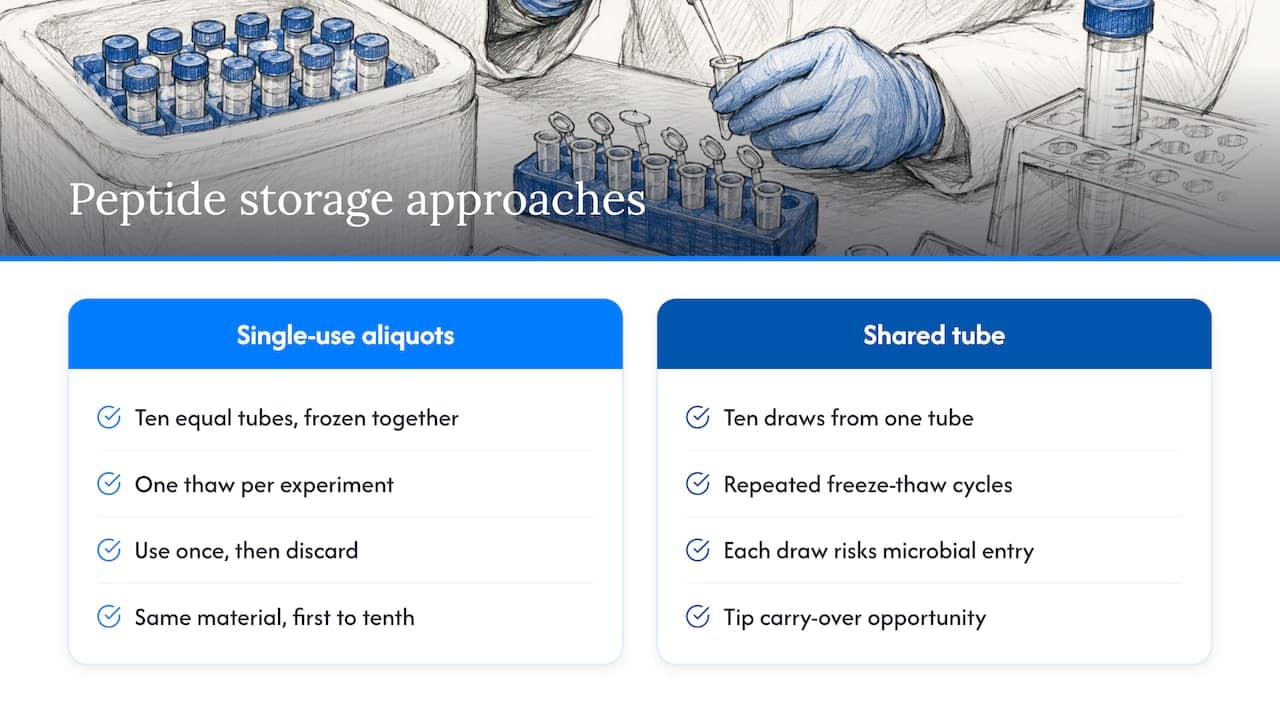
Suppose you reconstitute one vial and need it for ten separate experiments over two months. Prepare ten equal single-use aliquots on day one, label each with the peptide name, lot number, concentration and date, and freeze them all at once. Each experiment thaws one tube, uses it and discards the rest. Nothing is thawed twice and nothing is drawn from a shared tube, so the tenth experiment sees the same material as the first. Compare that to drawing ten times from one tube: every draw adds a chance of microbial entry, tip carry-over and a freeze-thaw cycle.
Our page on peptide shelf life explains how the commonly quoted 28-day window relates to sterility rather than chemistry, and our stability testing guide covers how to verify your own conditions.
Does filtering remove endotoxin?
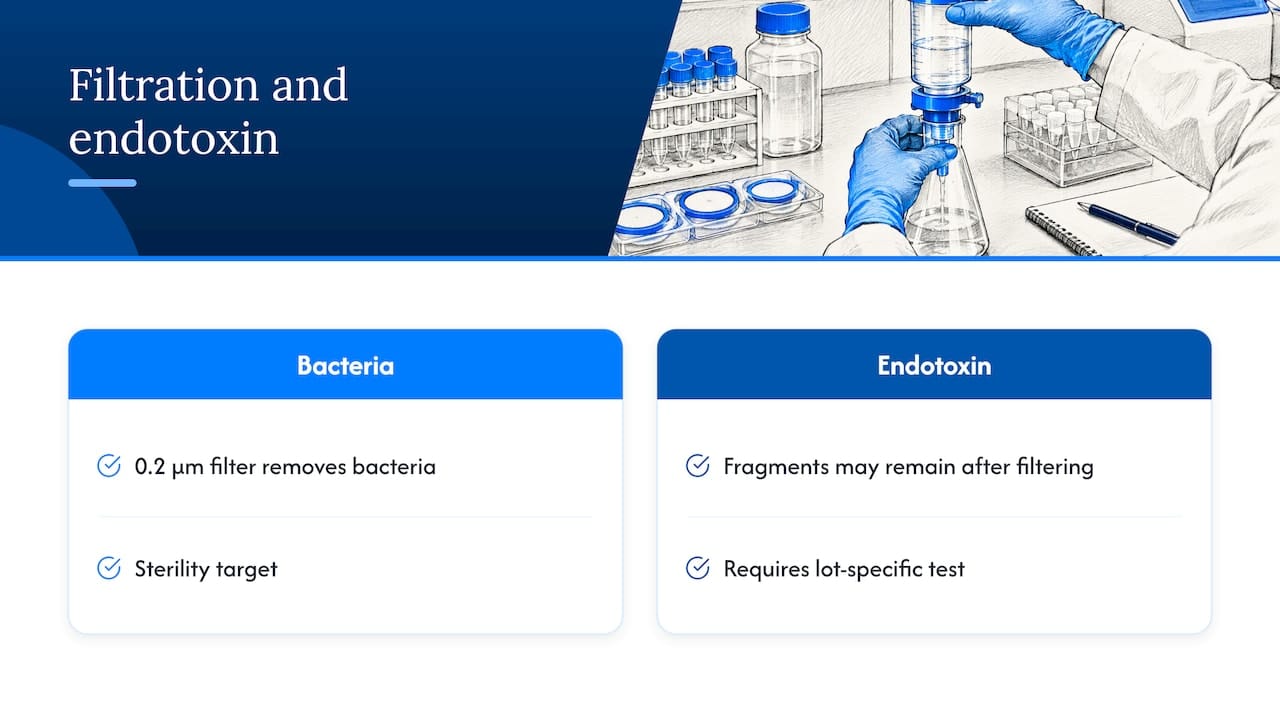
One of the pages that ranks for this topic raises a good question: does filtering a peptide solution remove endotoxins? A 0.2 µm filter removes bacteria, which is why the storage paper recommends it for sterility. Endotoxin is a different matter. It consists of cell-wall fragments that are far smaller than the cells themselves and can remain after the bacteria are gone. Sterile does not mean endotoxin-free.
The practical consequence: endotoxin has to be controlled upstream, in manufacturing, and verified with a lot-specific test result. That is why we include endotoxin data with each lot, and why you should look for a number on the document, not only a purity percentage. HPLC purity says how much of the sample is the main peptide by UV signal. It does not measure endotoxin, residual solvent, metals or water content.
What to do if you suspect a contaminated lot
Signs include unexpected cell responses, a changed chromatogram, haze or particles in a solution that was clear, or results that differ between lots.
- Stop using the lot and set aside the unopened and opened material, cold and labeled.
- Preserve the facts. Record lot number, storage history, reconstitution date, solvent, who handled it and which experiments used it. Do not assume the cause before you have the record.
- Separate handling from source. Re-run a retained aliquot with a fresh vial from the same lot, then from a different lot. If only the handled vial misbehaves, the problem is likely your process.
- Test the right thing. Mass spectrometry and HPLC for identity and peptide-related impurities, an endotoxin assay for LPS, and a biological check where your assay is sensitive to inflammatory signals. This follows the ASM paper’s advice to combine biochemical and biological QA/QC.
- Tell your supplier with the lot number and your data. The same paper recommends making suppliers aware of potential cross-contamination, and it helps them trace the batch.
At Data Peptides, our 24/7 support team can help with questions about a lot and its documentation.
Why different manufacturing routes produce different risks
FDA’s guidance on assessing immunogenicity risk of peptides notes that chemical synthesis, recombinant DNA and natural extraction each give a different impurity profile. Synthetic peptides tend toward peptide-related impurities such as deletions, while recombinant routes bring process-related ones such as host-cell proteins and leachables. For a lab, the point is that a COA should be read against the route used to make the material. A clean chromatogram for a synthetic peptide does not answer questions about endotoxin or residual solvent. Ask what was tested, with which method, on which lot.
Our perspective
Most contamination problems we hear about begin as documentation problems. A researcher receives a vial, a purity number and nothing else, and has no way to tell whether a strange result comes from the biology or the material.
That is why we publish lot-level documentation with each batch: third-party testing for purity and identity, a Certificate of Analysis, and endotoxin data. Our products are lab-grade research peptides with 99%+ purity, supplied for laboratory use only.
Handling then carries the rest. Cold, dry, dark storage, patient warming before opening, sterile technique and single-use aliquots protect what the documentation promises. Pair a well-documented lot with that routine and you remove most of the variables that make a peptide experiment hard to interpret.
We ship quickly and discreetly from our US facility, and our support team is available around the clock when a question comes up mid-experiment.
Data Peptides
Choosing documented material for your next study
If you are setting up a new assay, begin with the lot’s documents, then plan storage and aliquoting before the vial arrives. Our shop lists research peptides across weight loss, muscle growth, recovery, anti-aging, libido and ancillary supplies, each supplied for laboratory research only. For protocol planning, the peptide research protocols guide and our laboratory standards page lay out working practices you can adapt to your own SOPs.
FAQ
How do I know whether a peptide solution is contaminated?
You often cannot tell by eye, because a clear solution can still carry endotoxin, aggregates or chemical impurities. Visible haze, particles or color change are warning signs, but confirmation takes analytical testing such as HPLC with mass spectrometry and an endotoxin assay. Compare your results with the lot’s Certificate of Analysis.
How should I store peptides to prevent contamination?
Keep lyophilized peptide at −20 °C or colder, closed, dry and protected from light, and avoid frost-free freezers. Warm the vial to room temperature for at least 60 minutes before opening. After reconstitution, divide the solution into single-use aliquots and freeze them, so each is thawed only once.
Can HPLC be used to check peptide purity?
Yes. HPLC separates a peptide from related impurities and gives a purity percentage by UV signal, and it is paired with mass spectrometry to confirm identity. It does not measure endotoxin, residual solvents or metals, so those need separate tests. Shallow gradients reduce the chance that impurities hide under the main peak.
Does a 0.2 µm filter remove endotoxin?
No. A 0.2 µm filter helps remove bacteria and supports sterility, but endotoxin consists of much smaller cell-wall fragments and can persist. Endotoxin has to be controlled during manufacture and verified with a lot-specific test result.
What should I look for on a Certificate of Analysis?
Check that the measured mass matches your sequence, that purity is shown with its method, that the lot number matches your vial, and that endotoxin data is reported for that lot. A recent date and an independent testing party add confidence.
Sources
- Guideline on the Development and Manufacture of Synthetic Peptides, European Medicines Agency
- Recommendations for the generation, quantification, storage and handling of peptides, PMC4830481
- Related impurities in peptide medicines, PubMed
- Peptide Impurities in Commercial Synthetic Peptides, Clinical and Vaccine Immunology
- FDA Guidance for Industry on peptide purification and stability, 1994
- Assessing Immunogenicity Risk of Peptides, FDA