

Importing peptides into the United States is not a simple matter of ordering from abroad and waiting for the parcel. Every package must be declared to U.S. Customs and Border Protection (CBP), anything that counts as a drug is referred to the FDA, and an unapproved drug is usually refused. For a laboratory, the most predictable route is to buy from a U.S. supplier that ships from its own U.S. facility and documents every lot, so your order never depends on a customs decision. This guide explains the rules, what happens when a shipment is stopped, and how to source with fewer surprises.
It is written for people who buy peptides for laboratory research, and for the athletes, fitness enthusiasts and anti-aging or weight-loss readers who want to understand where research peptides sit in the legal picture. It is general information, not legal advice. If a specific shipment is at stake, talk to a licensed customs broker or an attorney who handles FDA matters.
TL;DR
- Under FDA’s personal importation policy, bringing unapproved drugs into the U.S. for personal use is generally not permitted.
- Every item offered for entry, including personal-use items, must be declared to CBP, and FDA-regulated products are referred to FDA for review.
- Refused products must be exported or destroyed, and incomplete paperwork can delay or detain a shipment.
- The October 2026 HHS draft policy on compounding peptides does not cover importing foreign-made peptides.
- Sourcing from a U.S. facility with a Certificate of Analysis (COA) for each lot keeps your project out of the customs queue.
Table of Contents
- Are peptides legal to import into the United States?
- How a peptide shipment moves through U.S. customs
- Personal use rules: what FDA allows and what it refuses
- Import Alert 66-41 and why overseas parcels get held
- What changed in 2026: the HHS compounding notice
- Research use versus human use: the line that decides everything
- A practical checklist for sourcing research peptides
- Why a U.S.-shipped, documented source is the lower-risk route
- Our view: documentation is the product
- Browse research peptides shipped from the U.S.
- FAQ
- Sources
Are peptides legal to import into the United States?
It depends on what the peptide is and what it will be used for. There is no single rule that covers every peptide. Peptides are chains of amino acids, and the law treats them according to how they are marketed and used, not by the word “peptide.”
Three situations come up most often:
- A finished drug for people. If a product is intended to treat, prevent or change a condition or body function in people, FDA treats it as a drug. Imported drugs must meet FDA standards for quality, safety and effectiveness, and depending on the product that can mean a marketing application such as an NDA, ANDA or BLA, or an IND for investigational use.
- A personal shipment. FDA says that in most circumstances it is illegal for individuals to import drugs for personal use, and a drug approved in another country but not in the U.S. is still illegal to import. FDA recommends obtaining medicines only from legal U.S. sources, according to its Personal Importation page.
- A research material for the laboratory. An active ingredient can be imported when it is brought in for research use or under an IND or approved application. That is the framing Morgan Lewis attorneys give in their November 2026 analysis of the HHS peptide policy.
The practical takeaway: research use is a defined category with its own conditions, not a label you can attach to any parcel. Documentation, the stated purpose and the nature of the shipment all matter.
If you want a plain-language overview of the research-use side from our own team, see our guide on whether peptides are legal for research in the U.S..
How a peptide shipment moves through U.S. customs
The flow is the same whether the box holds a few vials or a pallet.
Step 1: Declaration. All products offered for entry into the U.S., including personal-use items, must be declared to CBP. CBP then refers FDA-regulated products to FDA, as laid out on FDA’s Import Basics page. This is where most small buyers go wrong: a package with a vague description or no description gets flagged faster, not slower.
Step 2: FDA review. FDA checks, as applicable, registration, listing, the drug application, labeling and current good manufacturing practice (cGMP) compliance. If application information is incomplete, inaccurate or does not match FDA’s data systems, FDA may delay review, gather more information or detain the product.
Step 3: Decision. The product is released, held for more information, or refused. A product that requires an NDA, ANDA, BLA or IND and does not have one is subject to refusal.
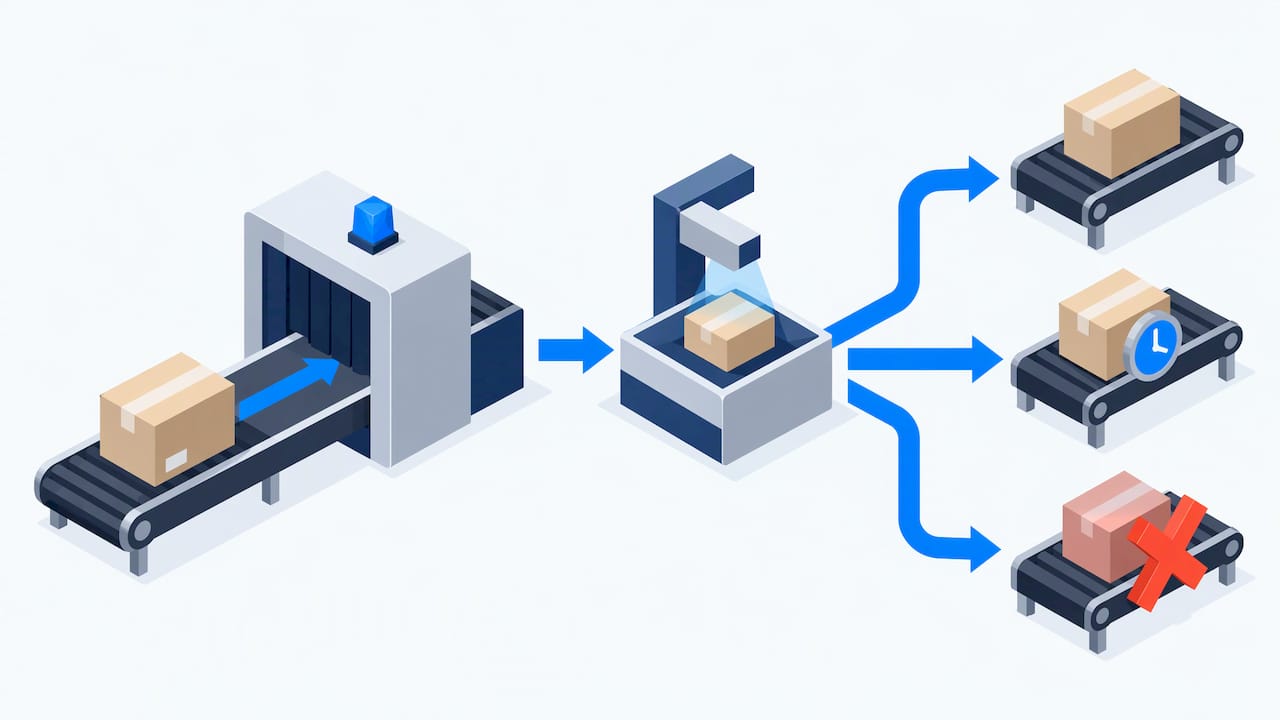
Step 4: If refused. Under 21 U.S.C. 381, an imported article that is adulterated, misbranded or in violation of section 355 is refused admission. It must be exported within 90 days of the refusal notice, or within any additional time allowed by regulation, or destroyed. HHS may destroy a refused drug or device valued at $2,500 or less without offering an export opportunity if it has not been brought into compliance.
In plain terms: a small shipment is not a safe shipment. A low value can make destruction more likely, not less.
What the foreign manufacturer has to do
FDA states that foreign establishments that manufacture, repack, re-label or salvage drug products imported into the U.S. must register with FDA before offering a drug for import. They renew annually, identify a U.S. Agent and include all known importers in the registration, per the same FDA guidance on importing human drugs. When a lab buys from an overseas seller, it usually cannot see whether any of that was done.
Personal use rules: what FDA allows and what it refuses
Many readers searching this topic are individuals, not institutions: athletes, fitness enthusiasts, people curious about anti-aging or weight loss. The rule for them is short.
FDA says personal importation of unapproved drugs is generally not permitted. Its staff may consider a more permissive decision in stated circumstances, for example for a serious condition where the quantity is generally no more than a three-month supply and the consumer provides specified information about a doctor or treatment abroad. FDA also allows foreign nationals visiting the U.S. to bring or ship a 90-day supply, with suggested documentation such as a copy of the visa or passport, a doctor’s letter and an English copy of the prescription. All of this is on the Personal Importation page.
Those provisions concern medical treatment. They are not a path for buying research materials, and they do not describe how our products are intended to be used. Our peptides are sold for laboratory research only.
FDA will refuse a personal importation when:
- the product is on an FDA import alert for earlier violations,
- the shipment appears intended for commercial distribution,
- the product appears to present a serious health risk,
- the article appears to represent health fraud, or
- food is imported with inadequate prior notice.
The second item matters for hobbyists who split orders with friends or buy in bulk: quantity and packaging can make a shipment look commercial.
Import Alert 66-41 and why overseas parcels get held
An import alert is an FDA notice that tells field staff which products or firms to stop at the border. Import Alert 66-41, revised on May 19, 2026 and published on November 6, 2026, says FDA divisions may detain, without physically examining them, identified products from firms on its Red List. This is called detention without physical examination.
To get a detained shipment released, the responsible party should provide evidence that the product does not contain unapproved new drug products. The alert also tells divisions to follow the Regulatory Procedures Manual chapter on personal importation, and says commercial or promotional shipments, and products subject to detention without physical examination, are generally not amenable to enforcement discretion.
The reasoning FDA gives is worth understanding. Without FDA review there is no way to know whether unapproved new drugs are safe and effective, made to a consistent quality, or labeled completely and accurately, and unapproved new drugs have resulted in patient harm. A laboratory cannot fix that by hoping. It can only reduce the uncertainty with documentation.
What changed in 2026: the HHS compounding notice
On October 30, 2026, HHS published a Federal Register notice announcing a draft enforcement-discretion policy on 503A compounding with certain peptide bulk drug substances. It applies while the 503A bulks list is developed through rulemaking. The notice says HHS does not intend to take enforcement action against specified compounders using a substance found in its Appendix A, and that future FDA rulemaking may add some or all of those peptides to the list.
Two points keep this in perspective for anyone thinking about imports:
- It is about licensed compounders, not importers. Morgan Lewis attorneys note that the policy does not address importing foreign-produced peptides. Compounders may look to domestic suppliers for bulk peptide drug substances.
- It is not a legal shield. The same analysis says enforcement discretion does not change the underlying statutory or regulatory requirements and can be modified later by HHS or FDA. FDA’s prohibition on misbranding still applies to peptide promotion.
For a research buyer, the lesson is that policy around compounding for patients does not change how a research lot is documented, labeled or sold. For our own reading of FDA direction on peptides, see our note on the PCAC picks and FDA peptide policy.
Research use versus human use: the line that decides everything
The same molecule can be a research reagent in a lab and a regulated drug in a clinic. What separates them is intended use, labeling and how the product is promoted.
For imports, the research-use route has conditions: the ingredient must be brought in for research use or under an IND or approved marketing application. For human use, the product generally needs FDA approval or another lawful pathway. Research materials are not a substitute for approved medicines, and nobody should treat them as one.
That is why we sell only for laboratory research, and why the page on buying peptides in the USA frames every purchase around documentation. If you are a researcher, your institution’s compliance office may ask for the lot’s COA and supplier details, so your supplier’s paperwork becomes part of your own record.
A note for readers drawn in by weight-loss claims: marketing of compounded or research peptides to consumers is tightly bound by FDA rules on claims. If your real goal is a medical weight-loss plan under a clinician, this article on compounded semaglutide safety for US patients covers the risks and rules around compounded products from the patient side.
A practical checklist for sourcing research peptides
Whether you are a principal investigator, a lab manager or a hobbyist with a bench setup, these checks reduce regulatory and quality risk.
- Find out where the product ships from. An order that ships from a U.S. facility is not a package you are bringing across the border, so it does not need your own customs entry. Confirm the shipping origin before you pay.
- Read the COA for the exact lot. A useful COA names the peptide, the lot or batch number, the purity result and the method, and identifies the testing laboratory. A generic PDF shared across all lots is not enough.
- Look for identity as well as purity. Purity says how much of the material is the target. Identity says it is the right molecule. Third-party testing should report both.
- Ask about endotoxin data. For work involving cell cultures or other sensitive assays, endotoxin levels matter. Our own approach is to provide endotoxin data for every lot.
- Keep records. Store the COA, invoice and storage log with your lab notebook. If an auditor, institution or journal asks, you have a clean file.
- Match the label to the use. Research-use labeling should be consistent across the vial, the invoice and the website. A mismatch is a red flag.
- Avoid anything that promises a medical outcome. If a seller markets a product as a treatment, FDA’s drug rules apply, and so do the import restrictions above.
If you are an athlete or a lab that works with sports organizations, also review our checklist of peptides banned in sports, since research materials can still intersect with anti-doping lists.
Why paperwork matters at the border and at the bench
FDA’s “Import for Export” route shows how heavy documentation gets when a drug-related product crosses the border for a non-standard purpose. The customs broker must use the affirmation of compliance code IFE and submit a Statement of Intent, a Chain of Possession statement and Certificates of Analysis covering formulation, ingredients and assay at the time of entry, and unused product must be destroyed, according to FDA’s Import for Export page. That route is a different program from ordinary research purchases, but it makes the point: Certificates of Analysis are the language regulators read.
Why a U.S.-shipped, documented source is the lower-risk route
Look at what the rules reward. Customs and FDA stop products with missing, inconsistent or unmatched information. They refuse commercial-looking shipments of unapproved drugs. They act on firms with violations on file. A lab buying from an overseas seller inherits all of those risks and cannot easily check any of them.
Buying from a U.S. facility moves most of that uncertainty off your desk:
| Question | Direct overseas import | U.S.-shipped research supplier |
|---|---|---|
| Who declares the package to CBP? | You, or your broker | Not applicable to your order as shipped from the U.S. |
| Risk of detention or refusal | Present, set by FDA and CBP review | Not a step in your order |
| Lot documentation | Varies by seller | COA and endotoxin data for every lot (our standard) |
| Delivery time | Depends on customs queue | Fast, discreet shipping from our U.S. facility |
| Support if something is wrong | Time zones and brokers | 24/7 support team |
Our USA peptides standards page and our overview of US-made peptides explain how we think about quality. For a wider look at selecting a supplier, see buying research peptides online.
Our view: documentation is the product
Most of the questions we hear about importing peptides are really questions about trust. A researcher wants to know that the vial matches the label, and that nothing will stop the order between the supplier and the bench.
That is why every Data Peptides product is third-party batch tested for purity and identity, and why we publish Certificates of Analysis and endotoxin data for every lot. Our peptides are sold for laboratory research use only, and we say so plainly on every page.
We ship fast and discreetly from our U.S. facility, and our support team is available 24/7 for every purchase. For labs, that combination is designed to keep ordering simple: a documented lot, a domestic shipment and someone to answer questions at any hour.
The regulatory picture keeps moving, as the October 2026 HHS notice shows. Our approach does not change with it: clear labeling, full documentation and research-only sales.
Data Peptides
Browse research peptides shipped from the U.S.
If your project calls for a documented source, our research peptide shop lists categories for weight loss, muscle growth, recovery, anti-aging, libido and ancillary supplies. Each is sold for laboratory research only, with a third-party tested lot, a COA and 99%+ purity guaranteed. You can go straight to a category such as recovery peptides for research or anti-aging peptides for research and compare lot documentation before you order.
FAQ
Are peptides legal to buy online in the USA?
It depends on the product and its intended use. Peptides sold for laboratory research are a distinct category from drugs sold for people, and FDA rules on approval, labeling and claims apply to the latter. Our products are for laboratory research use only, and our legality guide goes deeper.
Can I import peptides for personal use?
FDA says personal importation of unapproved drugs is generally not permitted, with narrow exceptions it may consider for specific medical situations. Those exceptions involve doctor information and generally no more than a three-month supply. If you have a medical need, speak to your physician about lawful U.S. options.
What happens if customs stops a peptide shipment?
CBP refers FDA-regulated products to FDA, which can delay, detain or refuse the shipment. A refused article generally has to be exported within 90 days of the notice or destroyed, and HHS may destroy a refused drug valued at $2,500 or less without an export opportunity. A customs broker or FDA attorney can advise on a specific case.
Does the 2026 HHS policy make importing peptides easier?
No. The October 30, 2026 draft policy concerns 503A compounding with certain peptide bulk substances. Legal analysis of it says it does not address importing foreign-produced peptides, does not act as a legal shield and can be changed later by HHS or FDA.
Are there peptide suppliers based in the US?
Yes. Some suppliers formulate, test and ship from U.S. facilities. We ship from our U.S. facility, provide a COA and endotoxin data for each lot, and sell only for laboratory research use.
Sources
- Personal Importation, FDA
- Importing Human Drugs, FDA
- Import Basics, FDA
- Import for Export, FDA
- Import Alert 66-41, FDA
- 21 U.S.C. 381, U.S. Code Title 21
- Federal Register notice, October 30, 2026
- HHS Opens the Door to Compounding Certain Unapproved Peptides, Morgan Lewis, November 10, 2026