

U.S. Customs and Border Protection (CBP) does seize peptide shipments, and the cases are almost always imports that were mislabeled, mis-declared or sent from overseas without paperwork that matches the contents. For a researcher, the practical answer is to buy from a supplier that ships from a U.S. facility and documents every lot. Our orders ship from the US facility with a Certificate of Analysis (COA) and endotoxin data for every lot, so the package is not crossing a border to reach your lab.
This guide explains why seizures happen, what the process looks like if a package is detained, which deadlines matter, and how to keep your research supply chain clean.
TL;DR
- CBP reported seizing about 5,000 individual peptide shipments between December 2025 and March 25, 2026, all mis-manifested and hidden in master cartons.
- A “research use only” label does not protect a product by itself: FDA looks at how a product is marketed and what the seller’s website says about use.
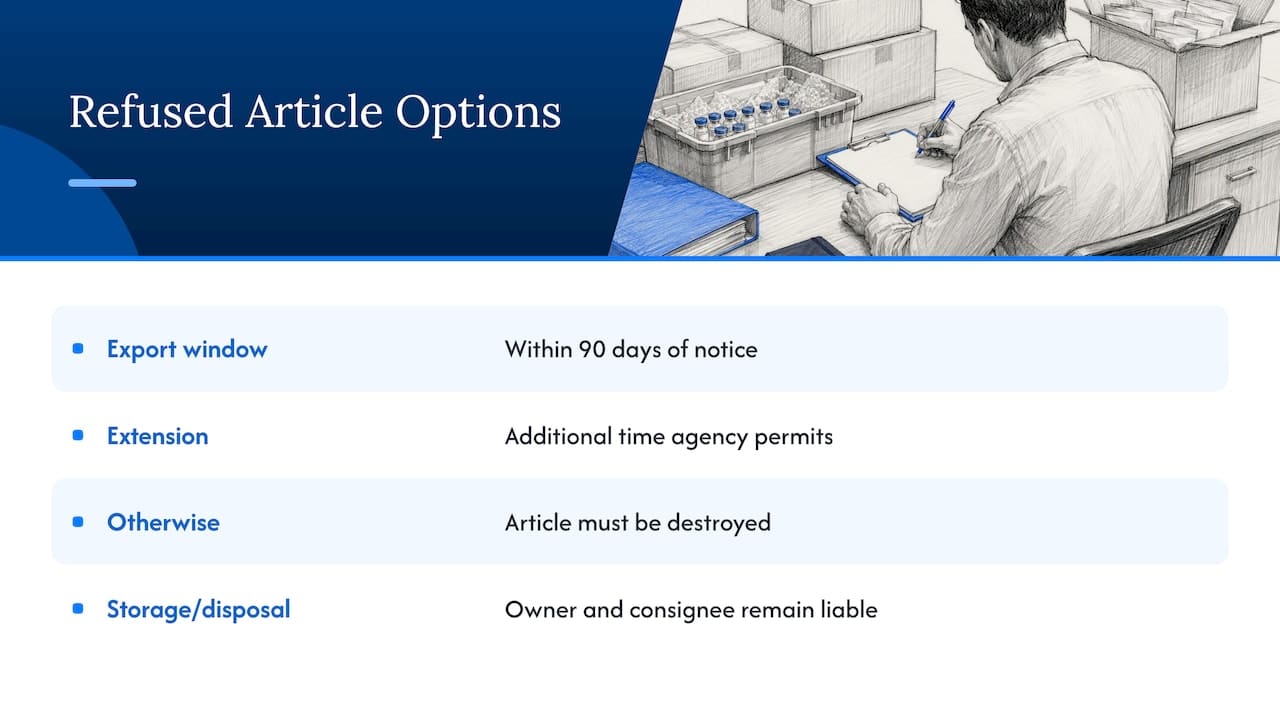
- A refused shipment must generally be destroyed or exported within 90 days of the refusal notice, and the owner and consignee pay storage and disposal costs.
- Domestic sourcing with batch COAs, accurate invoices and laboratory-only handling removes the border from the equation.
- Data Peptides sells laboratory-use research peptides only, shipped from the US facility, with 24/7 support.
Table of Contents
- Do peptides really get seized at U.S. customs?
- Why a “research use only” label is not enough on its own
- What happens when a peptide shipment is detained
- Can a seized shipment be returned?
- Can seizure lead to more than a lost package?
- Why the 2025-2026 crackdown looks the way it does
- How to keep your peptide supply clean: a researcher’s checklist
- Athletes, fitness readers and anyone not running a lab
- What we offer researchers
- Our perspective
- FAQ
- Sources
Do peptides really get seized at U.S. customs?
Yes. In a March 31, 2026 release, CBP’s Cincinnati office reported that officers uncovered a China-based scheme in December 2025 to smuggle GLP-1 active ingredients and other peptides. Between December and March 25, 2026, officers seized over 300 master cartons, each holding about 15 individual prelabeled shipments, roughly 5,000 packages in total.
Three details in that case explain most seizures:
- The shipments were mis-manifested. The paperwork described something other than the contents.
- They were concealed. Individual parcels were packed inside larger cartons with no manifest entry of their own.
- The products were unapproved drugs. The release lists retatrutide, semaglutide, tirzepatide, MOTS-C, TB10, semax and cagrilintide among them.
A package that is honestly declared, accurately described and properly documented is a different thing from a hidden parcel in a master carton. But the same release shows how closely CBP and FDA watch this category right now, and why a clean paper trail matters to anyone who orders peptides.
Why a “research use only” label is not enough on its own
Many researchers assume the label settles the legal question. FDA’s warning letters show it does not.
In a December 10, 2024 warning letter, FDA found that retatrutide, cagrilintide, semaglutide and other products were unapproved new drugs under sections 505(a) and 301(d) of the Federal Food, Drug, and Cosmetic Act (FD&C Act). It reached that finding despite “for research use only” and “not intended for human use” labeling, because the seller’s website established an intended human use.
A February 26, 2025 letter made the same point and added a border consequence: products that appear misbranded or unapproved may be detained or refused admission when they arrive at the border. According to a September 2026 legal analysis, FDA treated dosing information, injection instructions and dose calculators on seller websites as evidence of human use.
What that means for you:
- Intended use is judged by the whole picture: labels, website copy, instructions, and how the product is sold.
- Research peptides belong in laboratory work. They are not for human or animal consumption or for medical treatment.
- State regulators are also active. The same analysis reports an Alabama Medical Board notice from June 2026 and Ohio Board of Pharmacy guidance from December 2025 on research-grade peptides in clinical settings. If you work in a clinic or med spa, talk to your state board or your attorney before handling research-labeled products.
For a deeper look at the rules, see our guide on whether peptides are legal for research in the U.S..
What happens when a peptide shipment is detained
When CBP or FDA stops a package, the process runs in a few stages. Knowing them tells you what to read in any letter you receive.
Detention and notice
FDA uses import alerts to allow Detention Without Physical Examination (DWPE) when it has enough evidence that a product may violate the law. According to FDA’s Actions & Enforcement page, a Notice of FDA Action goes to the importer of record, the consignee and the filer, and the product is held until it is released. Products can still enter if the importer shows they comply.
Refusal
FDA lists the grounds for refusal: the product is adulterated, misbranded, an unapproved new drug, or forbidden or restricted for sale. When the importer cannot overcome the appearance of a violation, the product is refused admission.
The 90-day window
After refusal, the importer can work with CBP and FDA to destroy the product or export it from the United States within 90 days of the refusal. Under 21 U.S.C. § 381(a), a refused article must be destroyed unless it is exported within 90 days of the notice, or within additional time the agency permits. The owner and consignee remain liable for storage and disposal costs.
Small-value destruction
The same statute lets HHS destroy a refused drug or device valued at $2,500 or less without offering export, if it was not brought into compliance. A final rule effective July 1, 2024 (implementing the Safeguarding Therapeutics Act) gives the owner or consignee notice and a chance to appear and introduce testimony before FDA destroys a refused device at that value. Pending legislation, H.R. 2715, would extend no-export destruction to any refused item that presents a significant public health concern. Bills change, so check the congress.gov page for its current status.
Can a seized shipment be returned?
Realistically, rarely. The route out is to show compliance during the detention period, which is a task for the importer of record, usually with a customs broker or an attorney experienced in FDA import matters. If you receive a Notice of FDA Action or a CBP seizure notice, do three things:
- Read the response deadline on the notice itself and calendar it the day it arrives.
- Keep every invoice, COA, shipping record and the supplier’s description of the contents.
- Contact an attorney who handles FDA and customs matters before replying. That is the right professional for a legal response; a supplier cannot act as your lawyer.
If a package never arrives, the supplier’s tracking and your order records are the first things to gather. Our 24/7 support team can help you reconstruct an order’s shipping history.
Can seizure lead to more than a lost package?
It can. FDA’s enforcement page notes that violative imported products and the firms behind them may face CBP or FDA seizure, civil money penalties, bond actions, state embargo or stop-sale orders, and prosecution. Those consequences fall mainly on importers and sellers, but if you are the consignee on the paperwork, you are part of the record. This is why researchers who source peptides should care about who the importer of record is and what the documents say.
Why the 2025-2026 crackdown looks the way it does
The enforcement push is closely tied to GLP-1 drugs. FDA’s Office of Compliance Annual Report for fiscal year 2025 describes a worldwide “green list” import alert (66-80) for GLP-1 active pharmaceutical ingredients launched in 2025, warning letters to API manufacturers and compounders, and 250 import alert adjustments during the year. The alert itself says FDA evaluated 48 GLP-1 API sites and found 21% noncompliant, and describes sites that register as manufacturers, offer APIs for import, refuse records requests and then deregister.
To be added to the Green List, a firm must submit documentation including COAs for its last ten GLP-1 API lots, specifications and test methods, stability data, process validation records, batch records and five years of complaints and adverse events. The takeaway is that documentation is the currency at the border. Suppliers that can show lot-level testing are in a different position from those that cannot.
How to keep your peptide supply clean: a researcher’s checklist
You cannot control what CBP does, but you control who you buy from and how you document it.
1. Buy domestically
A supplier shipping from a U.S. facility to a U.S. laboratory avoids the import process for that order. All Data Peptides orders ship from our US facility, fast and discreetly.
2. Require lot-specific documents
Every lot should carry a COA that matches the batch number on the vial. Ours come with third-party batch testing for purity and identity and endotoxin data for every lot. Learn what to look for in our research peptide safety checks and in our guide to peptide scams and fake COAs.
3. Check how the seller talks about use
FDA’s letters turn on intended use. Choose a supplier whose labels, product pages and support all stay in the laboratory-use frame, with no dosing schedules, injection instructions or consumer claims. Our products are for laboratory research use only.
4. Keep records
Save the invoice, the COA, the shipping confirmation and the lot number together. If an institution audits your lab, one folder answers the question.
5. Know your institution’s rules
University and company procurement offices often have their own approved-vendor requirements. Check yours before ordering, and see our overview on how to buy research peptides online with quality and safety in mind.
A quick worked example
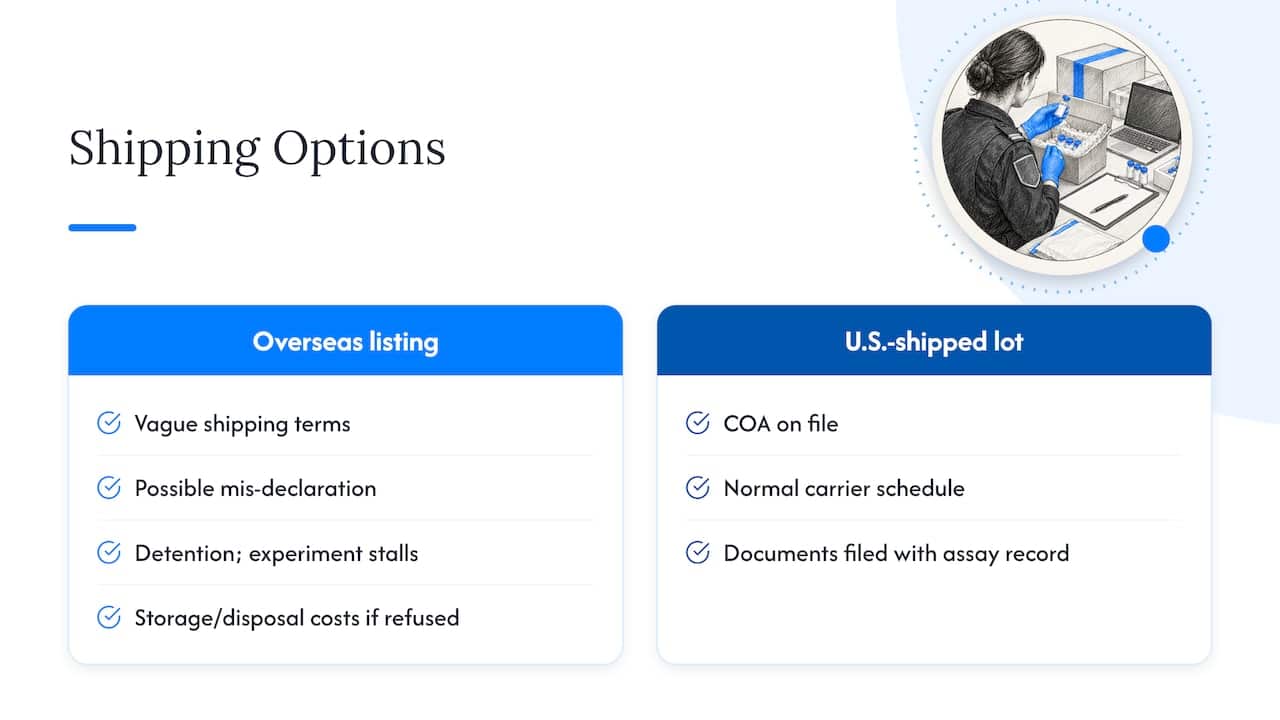
A lab manager needs a weight-loss research compound for an in-vitro assay. Option one is an overseas listing with vague shipping terms. If it is mis-declared on arrival, the lab could get a Notice of FDA Action, wait through a detention, and bear storage and disposal costs if the product is refused, all while the experiment stalls. Option two is a U.S.-shipped lot with a COA on file. The lab receives it on the carrier’s normal schedule and files the documents with the assay record. The cost comparison is the lot price against weeks of delay and the risk of losing the product.
Athletes, fitness readers and anyone not running a lab
Some readers come to this topic hoping to use peptides themselves for recovery, muscle, anti-aging or weight loss. Research-grade peptides are sold for laboratory work only and not for consumption or treatment, and FDA’s enforcement actions concentrate on products marketed for human use. If your interest is personal health, a licensed physician is the person to see. Competitive athletes should also read our checklist on peptides banned in sports before any lab purchase that touches sport-related research.
What we offer researchers
Our shop covers research peptides in weight loss, muscle growth, recovery, anti-aging, libido and ancillary supplies. Every product is sold for laboratory research use only, with a COA and a purity guarantee of 99%+. You can browse the full shop or go straight to a category such as weight loss peptides for research, recovery peptides or muscle growth peptides.
Our perspective
Most of the trouble researchers run into with peptide supply comes down to paperwork and provenance. A package that is clearly described, tied to a specific tested lot and shipped within the United States is easy to explain to a procurement office, a compliance officer or a carrier.
That is why we built our process around documentation. Every lot is third-party batch tested for purity and identity, and we provide a Certificate of Analysis and endotoxin data for it. Orders ship fast and discreetly from our US facility, and our support team is available 24/7 for any purchase.
We sell for laboratory research use only, and we think that discipline is part of quality. When a supplier keeps its labels, its pages and its paperwork in the research frame, the researcher gets a supply chain they can defend.
Data Peptides
FAQ
Do peptides get seized at customs?
Yes, in documented cases. CBP reported about 5,000 individual peptide shipments seized from December 2025 through March 25, 2026, all mis-manifested and hidden in master cartons. Honest declarations and U.S.-based sourcing keep your order out of that pattern.
Is BPC-157 FDA approved?
We do not make claims about the approval status of specific compounds in this guide. Check FDA’s own pages for the current status of any peptide before you plan work with it, and ask your institution’s compliance office if you are unsure. Our guide on peptide legality for research explains how to read the rules.
How long do I have if a shipment is refused?
The importer generally has 90 days from the notice of refusal to destroy or export the product, unless the agency allows more time. The owner and consignee pay storage and disposal costs. Read the deadline printed on your notice and talk to an attorney experienced in FDA import matters.
Does a “research use only” label make a peptide legal?
Not by itself. FDA’s warning letters have found products to be unapproved drugs despite research-only labels, because the seller’s website showed an intended human use. Keep purchases, handling and documentation in the laboratory-research context.
How can I buy peptides with fewer shipping risks?
Choose a supplier that ships from a U.S. facility, provides a COA for each lot and sells strictly for laboratory use. Our best place to buy peptides guide lists the quality and safety points to check.
Sources
- CBP: Cincinnati CBP foils scheme to smuggle over 5,000 unapproved peptides
- FDA warning letter, Xcel Research LLC, December 10, 2024
- FDA warning letter, USApeptide.com, February 26, 2025
- Legal 500: Federal regulators and state boards crack down on RUO peptides
- FDA: Actions & Enforcement
- FDA: Detention & Hearing
- 21 U.S.C. § 381, U.S. Code
- Federal Register, May 31, 2024 final rule
- H.R. 2715, Destruction of Hazardous Imports Act
- FDA Office of Compliance Annual Report, Fiscal Year 2025
- FDA Import Alert 66-80