

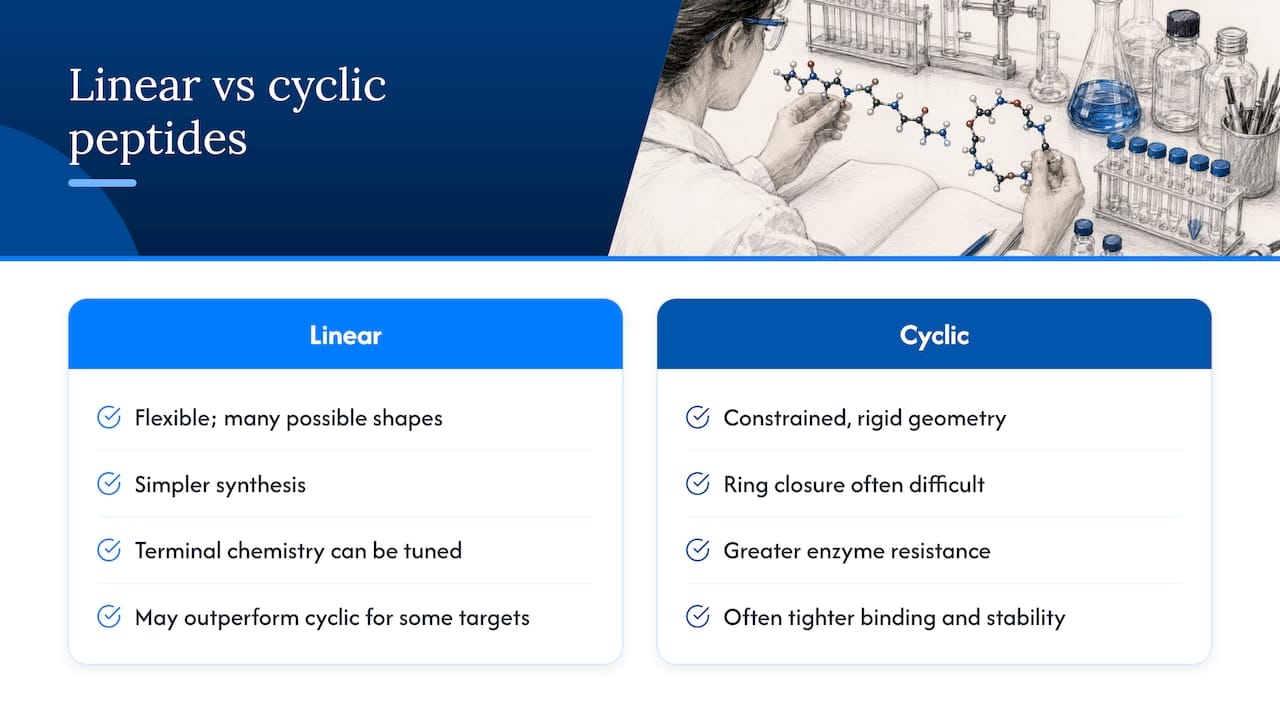
A linear peptide is an open chain of amino acids with a free start and a free end. A cyclic peptide is a chain that has been closed into a ring. That single change, the closed loop, is why cyclic peptides tend to be stiffer and more resistant to enzymes, and why linear peptides are more flexible and simpler to make. Neither is better in every case, and the right choice depends on the target and the assay. Whichever you work with, the batch you buy has to be what the label says, which is why documentation matters as much as topology.
This guide is written for researchers and for readers who follow peptide science closely: what the structural difference is, what it does to stability and binding, where linear peptides hold their own, and what to check when you source either type. Everything here describes laboratory research use only.
TL;DR
- Linear peptides are open chains with a free N-terminus and C-terminus. Cyclic peptides are closed into a ring, most often head-to-tail or through a disulfide bridge.
- The ring removes free ends and limits movement, which in favorable cases improves stability against enzymes and binding specificity.
- Cyclization is not a guaranteed upgrade. Some constrained geometries do not help, and in some studies linear analogues performed better.
- “Cyclic” describes a molecular shape. It has nothing to do with “cycling” a compound on and off a schedule.
- Whatever the structure, purity, identity and endotoxin data on a Certificate of Analysis decide whether your results are interpretable.
Table of Contents
- What actually differs: the structure
- Flexibility: why the ring matters
- Stability: enzymes, pH and half-life
- Side-by-side comparison
- Where linear peptides win
- How cyclic peptides are made
- “Do peptides need to be cycled?”
- Why verification matters more than topology
- Perspective
- Choosing between cyclic and linear for your work
- Our research peptides, documented lot by lot
- FAQ
- Sources
What actually differs: the structure
Peptides are chains of amino acids joined by peptide bonds. In a linear peptide the chain is unbranched and has two free ends: an amine at the N-terminus and a carboxyl group at the C-terminus. Those ends are chemically reactive, and they are where a lot of the trouble starts, as the sections below show.
In a cyclic peptide, the chain is covalently closed. A 2021 review of cyclization approaches sorts the methods into four general classes:
- Head-to-tail (backbone) cyclization: the N-terminal amine bonds to the C-terminal carboxyl group, forming a ring of amide bonds.
- Side chain-to-side chain: two amino acid side chains are linked, for example two cysteines forming a disulfide bond.
- Head-to-side chain: the N-terminus bonds to a side chain.
- Side chain-to-tail: a side chain bonds to the C-terminus.
Head-to-tail is the most prevalent mode according to a 2026 review of cyclic peptides in drug discovery, and it eliminates both free termini. Disulfide bridges are also common in nature: the same 2021 review notes that an estimated 50% of cysteine residues in polypeptides sit in disulfide bonds.
A quick size reference
Cyclic peptides typically fall in a molecular weight range of about 500 to 3,000 daltons, between small-molecule compounds and large biologics such as antibodies. A dalton is simply the unit used for molecular mass. Many familiar short research peptides are linear and sit at the lower end of that scale or below it. For more on small chains, see our overview of small peptides and their structure.
Flexibility: why the ring matters
A linear peptide in solution is floppy. According to a 2025 review of natural cyclic peptides, linear peptides are generally quite flexible and do not adopt one unambiguous geometry, while cyclic peptides adopt rigid three-dimensional shapes with limited conformational freedom.
Think of the difference this way. A loose chain can wiggle into many shapes, and only a fraction of them fit a receptor. A ring has already paid much of the entropy cost of folding, so it is closer to the shape it needs. The 2023 review of cyclic disulfide-rich peptides puts it as reduced entropic binding costs, which promotes greater specificity and affinity toward receptor and protein targets.
Two practical consequences for a lab:
- A rigid ring can reduce nonspecific interactions, because it has fewer shapes in which to stick to the wrong thing.
- A rigid ring can also be the wrong shape. If the ring locks the peptide into a conformation the target does not accept, activity can drop below the linear version.
Stability: enzymes, pH and half-life
Enzyme resistance
Linear peptides are exposed to two kinds of enzymes. Endopeptidases cut inside the chain and exopeptidases chew in from the ends. Head-to-tail cyclic peptides have increased resistance to exopeptidases because they have no free termini. The restricted geometry can also help the peptide evade protease catalytic sites, which in cell-based settings extends half-life.
The 2023 review adds a limit worth remembering: cyclization does not eliminate clearance by glomerular filtration (the kidney’s filtering step). A ring helps against enzymatic breakdown, not against every route of removal.
Chemical stability depends on the bond
The type of linkage changes the result. A CAS Insights report on cyclic peptides notes that disulfide bonds confer conformational rigidity but are redox-sensitive, while thioether and ether linkages offer more chemical stability because they resist reduction and proteolytic cleavage.
A worked example: pH changes the answer
The clearest illustration comes from an RGD peptide comparison in a 2012 comparative review. A cyclic version was 30-fold more stable at pH 7 than its linear counterpart, and generally more stable from pH 3 to 7. Between pH 8 and 12, however, the disulfide bond was likely reduced, and the cyclic peptide degraded faster than the linear one.
The lesson for bench work: “cyclic is more stable” is a statement about a specific peptide under specific conditions. Buffer pH, redox environment and storage all shape the result. Our note on peptide pH stability in the lab walks through how degradation behaves across the pH range.
Side-by-side comparison
| Feature | Linear peptide | Cyclic peptide |
|---|---|---|
| Backbone | Open chain, free N- and C-termini | Closed ring, often no free termini |
| Flexibility | High, many conformations | Limited, preorganized shape |
| Exopeptidase resistance | Exposed at both ends | Higher for head-to-tail rings |
| Binding specificity | Can be lower, shape-dependent | Often higher in favorable cases |
| Synthesis | Straightforward stepwise assembly | Extra cyclization step, often low yield |
| Chemical weak points | Terminal groups, protease sites | Depends on bond: disulfides are redox-sensitive |
| Typical use in research | Short signaling and screening sequences | Constrained binders, scaffolds, drug-discovery leads |
Where linear peptides win
It would be easy to read the literature as a story of rings beating chains. The evidence is more even.
Synthesis is simpler. Cyclization is often the most difficult step in making a cyclic peptide. A 2025 review explains that ring closure is not favored at equilibrium because of entropy losses and high energy barriers around amide bonds. It has to be run under kinetic conditions, such as dilute concentrations of 1 mM to 5 mM and low, ambient or mild temperatures. Dilute reactions mean more solvent, more purification and often lower yield.
Performance is target-dependent. The same 2012 review concludes that cyclization generally improves selective binding and stability, but not every strategy or constrained geometry does so to the same extent, and in some cases linear analogues showed better cancer-targeting properties than cyclic ones.
Terminal chemistry can be tuned. Linear peptides can be modified at the ends to change their behavior. Whether the C-terminus is an amide or a free acid, for example, changes charge and stability, which we cover in amidated peptides vs free acid.
So the practical rule: choose linear when you need a short, flexible, easily synthesized sequence and the target accepts it. Choose cyclic when you need constrained geometry, enzyme resistance or tighter binding, and you can afford the synthesis and verification work.
How cyclic peptides are made
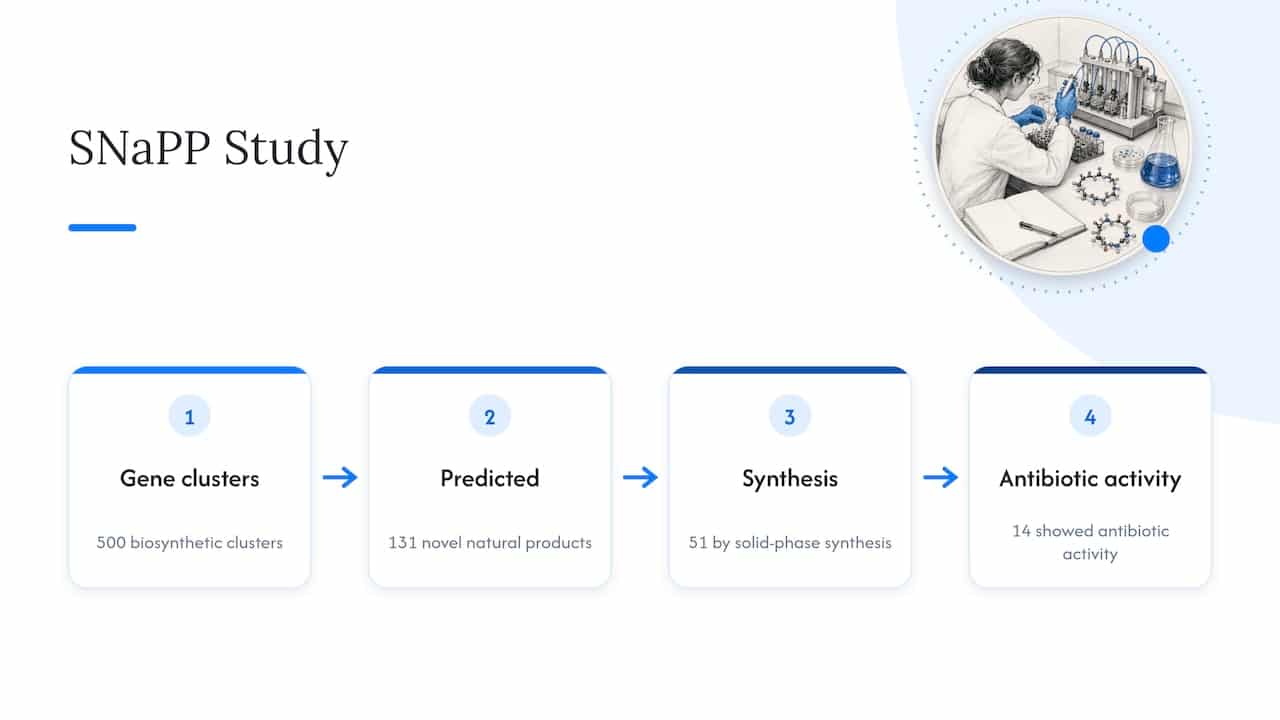
Most cyclic research peptides start life as a linear chain built by solid-phase synthesis, where amino acids are added one at a time to a resin. The ring is then closed, either on the resin or in solution. The 2021 SNaPP study shows the approach at scale: researchers predicted 131 novel natural products from 500 biosynthetic gene clusters, synthesized 51 of them using solid-phase synthesis and solution-phase cyclization, and found 14 with antibiotic activity, including against multidrug-resistant Gram-negative bacteria.
Beyond single rings, bicyclic peptides are an active area. A 2026 Journal of Peptide Science article describes them as occupying chemical space between antibodies and small molecules, with no signs of immunogenicity reported to date.
“Do peptides need to be cycled?”
This question appears in search results and mixes two unrelated ideas. A cyclic peptide is a molecule whose backbone forms a ring. “Cycling” a compound means alternating periods of use and rest. The first is chemistry. The second is a scheduling habit, and it has no connection to whether a peptide is linear or cyclic.
Nothing in the structural literature above says a peptide must be cycled. Dosing schedules in humans are medical decisions that belong to a licensed physician, and the products discussed on this site are for laboratory research use only, not for human or animal consumption. If you are working out an experimental design, the variables that matter are concentration, buffer, storage, exposure time and the verified identity of the material.
Why verification matters more than topology
A ring or a chain only means something if the vial contains the molecule you think it does. Three things go wrong often enough that they deserve a check on every lot.
- Purity. Truncated sequences and deletion products from synthesis can look similar on a quick read. Cyclic peptides add a second risk: incomplete cyclization leaves linear precursor in the mix, which behaves differently from the target.
- Identity. Mass spectrometry confirms that the molecular weight matches. A head-to-tail ring is lighter than its linear precursor by one water molecule, so identity data is how you tell the two forms apart.
- Endotoxin. Bacterial endotoxin carried through manufacturing can confound cell-based assays regardless of peptide structure.
When you read a Certificate of Analysis, look for the lot number matching your vial, the HPLC purity figure, the mass spec identity result and endotoxin data. Our guide to four COA checks for anti-aging research peptides applies the same logic to a specific product class, and what researchers should verify first for recovery peptides does the same for another.
Perspective
Most of the questions we see around cyclic and linear peptides come down to one thing: can I trust what is in the vial? Structure gets the attention, but a well-designed ring or a well-chosen chain only helps an experiment if the material is characterized.
That is why our approach centers on documentation. Our products are third-party batch tested for purity and identity, and every lot comes with a Certificate of Analysis and endotoxin data. We guarantee 99%+ purity, and our US facility ships fast and discreetly, with a support team available 24/7 for every purchase.
For a researcher, that means the variable you are studying, linear or cyclic, flexible or constrained, is the only variable that changes between experiments. Our catalog is for laboratory research use only, and we treat that as a standard of quality, not a footnote.
Data Peptides
Choosing between cyclic and linear for your work
Use these questions in order.
- What is the target? Receptor binding with a defined pocket often rewards a constrained shape. Screening many sequences quickly often favors linear.
- What will degrade it? If exopeptidases are the problem, head-to-tail cyclization addresses it directly. If the problem is redox conditions, a disulfide ring may make things worse and a thioether ring may be a better fit.
- What is your pH and buffer? The RGD example shows a ring can flip from more stable to less stable across a pH range.
- What can you verify? A linear peptide with a clean COA beats a cyclic one with an unverified ring closure.
- What is your timeline and budget? Cyclization adds steps and often reduces yield.
If you want to browse research peptides by category, our research peptide catalog lists weight loss, muscle growth, recovery, anti-aging, libido and ancillary supplies, each with batch documentation. For a deeper look at one family, see alpha peptides.
Our research peptides, documented lot by lot
If you are sourcing for laboratory work, Data Peptides offers lab-grade research peptides that are third-party tested, with a Certificate of Analysis and endotoxin data for every lot, supported by 24/7 customer service. Products are sold for laboratory research use only.
FAQ
What is the main difference between cyclic and linear peptides?
A linear peptide is an open chain with free N- and C-termini. A cyclic peptide is closed into a ring by a covalent bond, for example head-to-tail or through a disulfide bridge. The ring limits flexibility and, in many cases, protects against exopeptidases.
Are cyclic peptides always more stable?
No. They are often more resistant to enzymes, but stability depends on the linkage and conditions. In one comparison, a disulfide-cyclized peptide was 30-fold more stable at pH 7 yet degraded faster than its linear analogue at pH 8 to 12.
Why are cyclic peptides harder to make?
Closing the ring is disfavored thermodynamically, so it must be run under dilute, mild kinetic conditions. A 2025 review cites concentrations of 1 mM to 5 mM, which raises cost and often lowers yield compared with a linear sequence.
Do peptides need to be cycled?
The words are unrelated. “Cyclic” describes a ring-shaped molecule, while “cycling” refers to a schedule of use and rest. Human dosing questions belong with a licensed physician, and our products are for laboratory research use only.
How can I tell whether a peptide is cyclic or linear on a COA?
Look at the mass spectrometry identity result. A head-to-tail ring weighs one water molecule less than its linear precursor, so the measured mass distinguishes them. Pair that with the HPLC purity figure and endotoxin data for the same lot.
Sources
- Cyclic Peptides in Modern Drug Discovery: Trends and Perspectives (2026)
- Approaches for peptide and protein cyclisation (2021)
- Native and Engineered Cyclic Disulfide-Rich Peptides as Drug Leads (2023)
- Natural Cyclic Peptides: Synthetic Strategies and Biomedical Applications (2025)
- Flexible or fixed: a comparative review of linear and cyclic cancer-targeting peptides (2012)
- Synthetic Natural Product Inspired Cyclic Peptides (2021)
- Bismuth Bicycles, Journal of Peptide Science (2026)
- Cyclic peptides in drug discovery report, CAS Insights