
A peptide’s last residue can end in one of two ways. A free acid ends in a carboxylic acid group (-COOH), which is negatively charged at physiological pH. An amidated peptide ends in a carboxamide (-CONH2), which is neutral. That one-group swap can change how a peptide folds, how long it survives in a biological assay, how well it binds a receptor and how easily it dissolves. It does not always matter, and knowing when it does is the whole decision.
This guide covers what amidation is, how each form is made, what the published data show, and how to choose between the two for laboratory work.
TL;DR
- A free-acid peptide ends in a charged carboxyl group. An amidated peptide ends in a neutral amide, which is how many natural peptide hormones are built.
- Amidation often improves resistance to enzymatic breakdown and can be required for full receptor activity, but it is not universal: some peptides, such as PACAP, work equally well either way.
- Capping a terminus can lower solubility, so check the sequence’s isoelectric point and your buffer pH before you order.
- Amidation says nothing about whether a peptide is safe or effective in people. Judge any lot by its Certificate of Analysis, not by its terminal chemistry.
- Match the form to the published native form of the peptide you are studying, and state it in your methods.
Table of Contents
- What the two C-terminal forms are
- How amidated peptides are made
- What amidation changes in practice
- Side-by-side comparison
- Solubility: the practical catch
- How to choose for your experiment
- Stability and storage still apply
- Amidation is not a safety or efficacy signal
- Our perspective
- Where to find research-grade peptides
- FAQ
- Sources
What the two C-terminal forms are
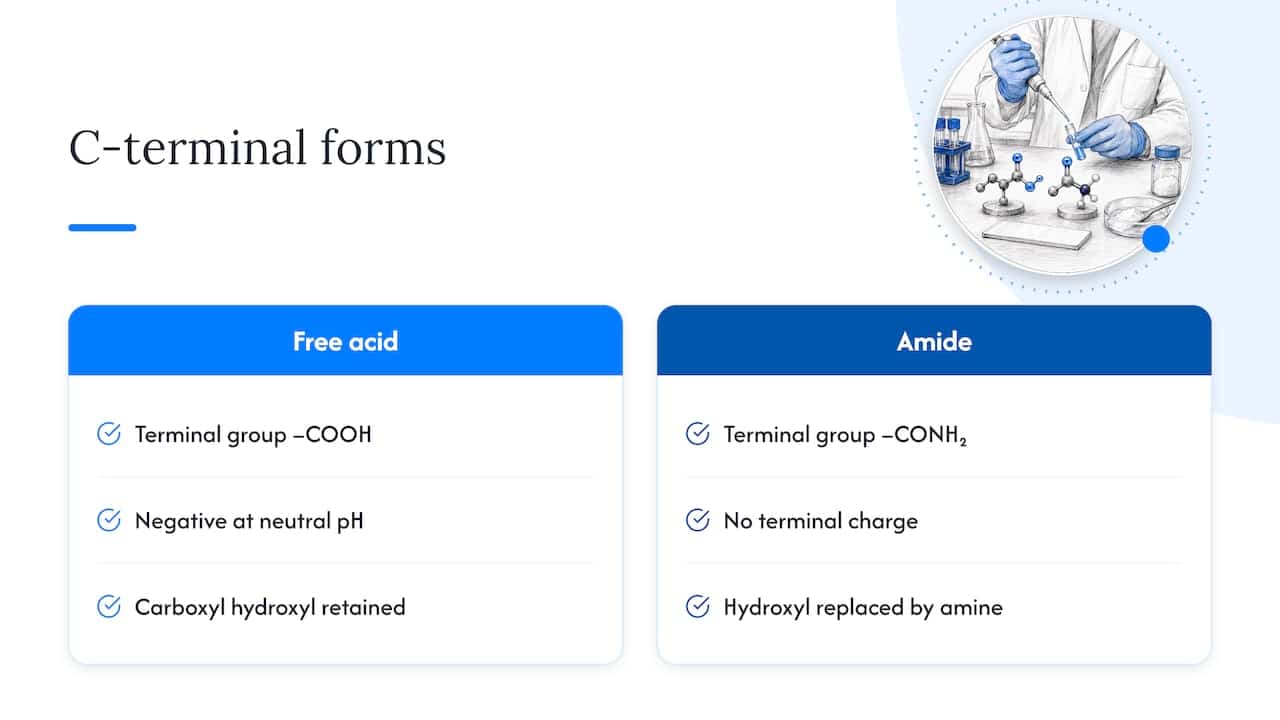
Every linear peptide has two ends. The N-terminus carries a free amine and the C-terminus carries the last residue’s carboxyl group. In the “free acid” form, that carboxyl group is left alone. In the amidated form, the hydroxyl of the carboxyl group is replaced by an amine, so the end reads -CONH2 instead of -COOH.
The practical consequence is charge. At neutral pH the free acid carries a negative charge at its tip. The amide carries none. Amidation therefore removes one charge from the whole molecule, and that is the root of most of the differences below.
Core peptide facilities treat both as standard options. MIT’s Biopolymers Laboratory lists free acid and amidation as the usual alternative C-terminal chemistries when you order a custom peptide, which is a good sign of how routine the choice is.
How amidated peptides are made
In biology
In the body, amidation is a post-translational step. A precursor peptide is made with an extra glycine at its C-terminus. The bifunctional enzyme peptidylglycine α-amidating monooxygenase (PAM) then converts it in two steps that need copper, molecular oxygen and ascorbate, as described in a Scientific Reports paper. The glycine is lost and the preceding residue is left with an amide.
PAM is the only enzyme that produces peptide amides in vivo, according to a review of amidation in hormone production. The same review notes that in vitro routes exist too: PAM itself, carboxypeptidase-Y based methods, and chemical synthesis.
In the lab
Most research peptides are made by solid-phase synthesis, and the choice of resin sets the C-terminus. Fmoc chemistry uses Wang or 2-chlorotrityl resin for a C-terminal acid and Rink Amide or Sieber Amide resin for a C-terminal amide, as a resin guide from a synthesis-reagent supplier lays out. Both are cleaved with trifluoroacetic acid. So making either form is routine, and the extra cost of an amide is rarely the deciding factor. The deciding factor is what your experiment needs.
What amidation changes in practice
Resistance to degradation
Amidated peptides tend to resist proteolytic breakdown better than their free-acid counterparts. An analysis of amidation’s role in peptide activity notes that this can extend half-life in the bloodstream. The reason is intuitive: enzymes that clip from the carboxyl end recognize a charged carboxylate, and a neutral amide is a poorer substrate.
For in vitro work, this matters whenever your medium contains peptidases, such as serum-supplemented cell culture or tissue homogenates. In a clean buffer, the difference can be small.
Structure and membrane interaction
Removing the terminal charge can stabilize helical conformations. In a study of the wasp venom peptides mastoparans, C-terminal amidation stabilized the α-helical structure and favored membrane interaction. The amidated form was substantially more active than the acid form in the tested membrane, mast-cell, hemolysis and antibacterial assays, and the authors tied this to greater helicity.
That result does not generalize to every peptide. A broader look at defense peptides found that amidation can increase, decrease or leave unchanged their antimicrobial and anticancer efficacy, according to a Lancashire research paper. Treat each peptide on its own data.
Receptor binding and activity
For many peptide hormones the amide is essential. A 2022 review of PAM states that many bioactive peptides require a C-terminal α-amide for full activity, and that amidation can alter structure, confer resistance to degradation and reduce pH effects on receptor binding. Structure-activity data on 45 bioactive peptides, summarized in a 1994 paper, show the amide is required for full activity in most amidated peptide hormones.
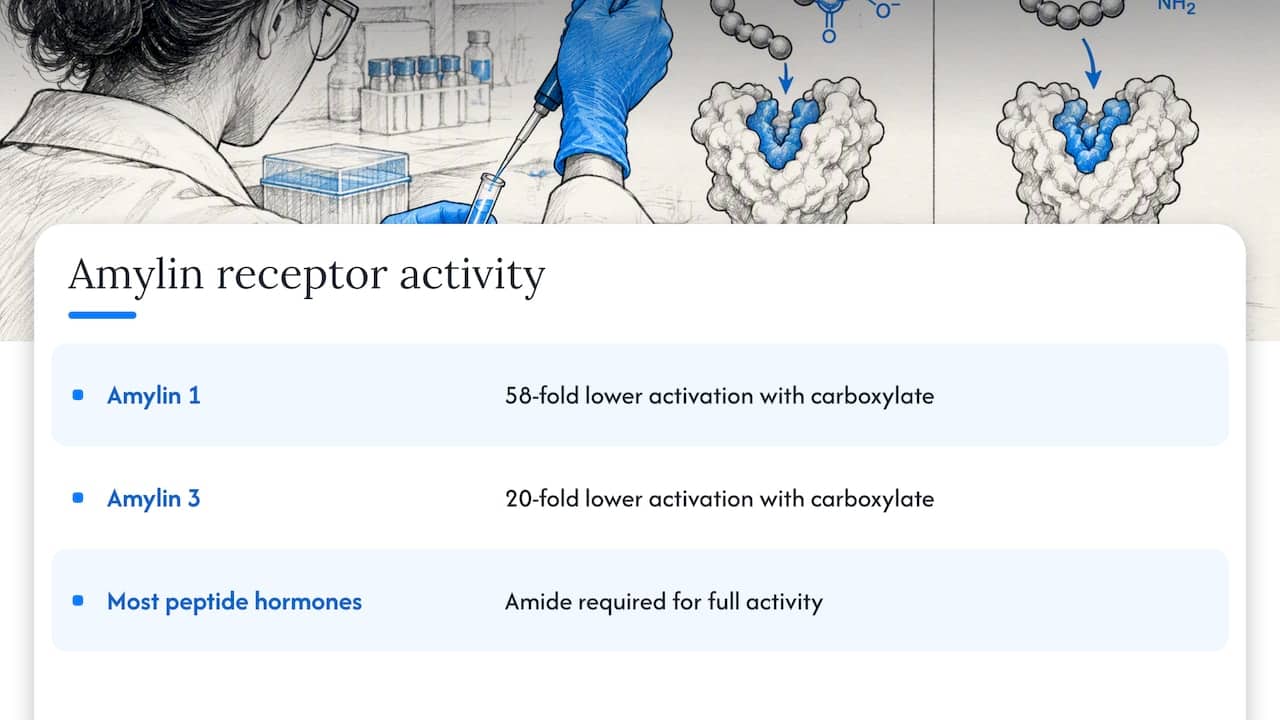
The human amylin example is striking. Replacing its C-terminal amide with a carboxylate cut activation of the Amylin 1 receptor 58-fold and the Amylin 3 receptor 20-fold. The same work notes that free-C-terminus amylin keeps significant toxicity, which makes it a useful tool for separating toxicity from receptor-mediated activity.
Charge is also part of the story. A review of C-terminally modified peptides explains that neutralizing the acid’s negative charge changes hydrophobicity and receptor binding, and cites human parathyroid hormone as a case where swapping the carboxy terminus for a carboxamide raises activity.
When it does not matter
Amidation is not a universal upgrade. In a study of PACAP, free-acid and amidated PACAP-27 and PACAP-38 were comparably active in several PAC1-receptor signaling assays, and the authors concluded amidation is dispensable for activity at that receptor. If you assume amide equals better, a case like this will surprise you.
Side-by-side comparison
| Property | Free acid (-COOH) | Amidated (-CONH2) |
|---|---|---|
| Charge at neutral pH | Negative at the terminus | Neutral at the terminus |
| Typical synthesis resin (Fmoc) | Wang, 2-chlorotrityl | Rink Amide, Sieber Amide |
| Protease resistance | Generally lower | Generally higher |
| Mimics natural hormone form | Only when the native peptide is a free acid | Yes, for the many hormones that are amidated in vivo |
| Receptor activity | Can drop sharply for amide-dependent peptides | Needed for full activity in most amidated hormones |
| Solubility | Often higher, with the extra charge | Can be lower, with one fewer charge |
| Best when | Native form is a free acid, or you need a charged terminus | Native form is an amide, or stability in peptidase-rich media matters |
Solubility: the practical catch
Reducing charge usually reduces how well a peptide stays in water. Capping termini commonly makes peptides less soluble than the unmodified forms. MIT’s guidance is to consider the sequence’s isoelectric point and your working buffer’s pH before choosing terminal chemistry, because blocking a terminus may lower solubility. The same page notes that neutralizing the terminus can better mimic the peptide’s in vivo form for some applications. You are trading one benefit against another.
A rough workflow:
- Count acidic (Asp, Glu) and basic (Lys, Arg, His) residues to estimate net charge at your buffer pH.
- If the peptide is already hydrophobic and near its isoelectric point, expect an amide to be harder to dissolve.
- Test a small aliquot first, then scale up. Our guide to dissolving peptides in the lab walks through solvent order and common pitfalls.
How to choose for your experiment
Ask these questions in order.
- What is the native form? Look up the peptide’s UniProt or primary-literature entry. If the natural molecule is amidated, the amide is the faithful version. If you use the acid, you are testing a different molecule.
- Does the published activity depend on it? Find a structure-activity study. If none exists, run both forms in a pilot assay.
- What is in your assay medium? Serum or tissue extracts carry peptidases, which favors the amide. Simple buffers reduce that advantage.
- Can you dissolve it? Check isoelectric point and buffer pH, as above.
- Can you reproduce it? Record the C-terminal form in your methods and on the lot record. Two labs comparing results need to know they used the same molecule.
A worked example
Say you want to study a short hormone-like peptide whose native form is an amide, in a cell assay with 10% serum. The amide is the faithful sequence, it resists serum carboxypeptidases better, and it will probably show the published potency. If you chose the acid to save solubility trouble, you may see a right-shifted dose-response curve and wrongly conclude the peptide is weak. The fix is not to avoid the acid, but to run it as a deliberate comparator alongside the amide.
Stability and storage still apply
Amidation helps against enzymes. It does not protect against oxidation, moisture, freeze-thaw cycles or microbial growth. Methionine, cysteine and tryptophan residues behave the same either way. Storage and handling rules are therefore the same for both forms: see our notes on peptide storage temperature and why the common 28-day rule is about sterility, not chemistry. If you need to design a degradation study, our overview of peptide stability testing covers ICH-style protocols.
Amidation is not a safety or efficacy signal
It is tempting to treat “amidated” as a quality badge. It is a structural feature, nothing more. The studies above show amidation can raise, lower or not change activity depending on the peptide, and some free-acid forms stay toxic. Nothing about terminal chemistry shows that a peptide is safe or effective in people or animals. The products we supply are for laboratory research only, and conclusions about biological behavior belong in properly designed studies, not in a product label.
Our perspective
We see the same mistake from new buyers again and again: they treat the C-terminal form as a line item rather than a variable in the experiment. The questions we get are rarely “which is better?” They are “which one did the paper use?” That is the right question.
Our view is simple. Choose the form that matches the literature you are building on, then verify what you received. Terminal chemistry is only as meaningful as the identity and purity data behind it. A mislabeled terminus, or a lot with a high share of truncated or deletion sequences, can undo a careful design. That is why every lot we sell is third-party batch tested for purity and identity, with a Certificate of Analysis and endotoxin data, and why we ask you to read the COA before you open the vial. Check that the reported mass matches the expected mass for the form you ordered: an amide and an acid of the same sequence differ by roughly one mass unit, so mass-spec data should confirm which one is in the vial.
If you are unsure which form a study used, ask our support team. We are available around the clock and would rather help you match the molecule than see you repeat an experiment.
— Data Peptides
Where to find research-grade peptides
If you are ready to source material, our research peptide catalog covers weight loss, muscle growth, recovery, anti-aging, libido and ancillary research supplies. Every lot ships with a Certificate of Analysis, orders go out fast and discreetly from our US facility, and all products are sold for laboratory research use only. Before you order, our guide on what to demand on a lot COA is a useful checklist for reading purity and identity data.
FAQ
Is an amidated peptide always more active than the free acid?
No. For many peptide hormones the amide is needed for full activity, and swapping it for a carboxylate can cut receptor activation dramatically, as with amylin. But PACAP shows comparable activity in several assays either way. The answer depends on the specific peptide and receptor.
Are amidated peptides more stable?
Typically they resist enzymatic breakdown better, which can extend half-life in biological systems. That does not protect against oxidation, moisture or microbial contamination. Storage rules are the same for both forms.
Is an amidated peptide harder to dissolve?
Often, yes, because the terminal charge is removed. The effect depends on sequence, isoelectric point and buffer pH, so test a small amount first.
How do I tell which form I have?
Check the product name and sequence notation on the label, then confirm with the mass-spectrometry data on the Certificate of Analysis. The amide is about one mass unit lighter than the acid of the same sequence.
Does amidation make a peptide safe for human use?
No. It is a structural modification. It says nothing about safety or efficacy, and our peptides are intended for laboratory research only.
Sources
- KI MIT Biopolymers Lab: peptide ordering and terminal chemistries
- Novel insights into peptide amidation and amidating enzymes (Scientific Reports, 2021)
- Peptide amidation: production of peptide hormones in vivo and in vitro (2001)
- Resins for solid phase peptide synthesis
- On the Importance of Being Amidated
- The effects of the C-terminal amidation of mastoparans
- The effect of C-terminal amidation on the efficacy of defense peptides
- Peptidylglycine α-amidating monooxygenase as a therapeutic target or biomarker (2022)
- C-terminal amidated peptides: production by the in vitro enzymatic route (1994)
- Recent Advances in the Synthesis of C-Terminally Modified Peptides (2020)
- C-terminal amidation of PACAP-38 and PACAP-27 (2016)