
Solid-phase peptide synthesis (SPPS) builds a peptide one amino acid at a time while the growing chain stays anchored to an insoluble resin bead. Because the chain is stuck to a solid support, you can drive each reaction with excess reagent and then simply wash the excess away. That one idea turned peptide chemistry from a years-long specialty into a routine laboratory method, and it is how most research peptides are made today.
This guide walks through the method as a bench chemist would: the resin, the protecting groups, the repeating cycle, cleavage, and the problems that decide whether the final product is clean or full of near-miss sequences. It also covers what SPPS means when you are reading a certificate of analysis for a peptide you plan to use in the lab.
TL;DR
- SPPS anchors the first amino acid (at its C-terminus) to an insoluble resin, then adds residues one at a time toward the N-terminus, washing between steps instead of purifying.
- Fmoc chemistry is now the dominant approach. It avoids the hazardous anhydrous hydrogen fluoride that classic Boc chemistry needs, and it is easy to monitor and automate.
- Resin swelling and chain aggregation cause most failed syntheses. Reagent quality cannot fix a bead that is not solvated.
- Every cycle can leave truncated or deletion sequences, so purification and analytical data (HPLC, mass spec) matter as much as the synthesis itself.
- Research-use peptides are not approved drugs. Synthesis quality tells you about purity and identity, not about safety in people.
Table of Contents
- Where SPPS came from
- The building blocks: resin, linker and protecting groups
- The Fmoc cycle, step by step
- Fmoc versus Boc
- Why the resin is the quiet star
- Coupling reagents: from DCC to modern activators
- Monitoring the synthesis while it runs
- The honest drawbacks of SPPS
- What SPPS means for the peptide you actually use
- Our perspective
- A word on regulation and research-only use
- Sourcing peptides for the lab
- FAQ
- Sources
Where SPPS came from
Bruce Merrifield developed the method in 1963. According to a review of automated peptide synthesizers, it lets the chain assemble on an insoluble support with coupling, washing and deprotection all happening in a single vessel, with no intermediate purification, typically in the C-to-N direction.
The efficiency gain was dramatic. The same review notes that a manual synthesis of bradykinin in 1964 took 8 days and gave a 93% crude yield, far faster than the years of effort that solution-phase routes had demanded for comparable peptides.
The core concept, as a primer on peptide synthesis puts it, is to keep chemistry already proven in solution but run it on a support so that purification between steps becomes a filtration and a wash.
The building blocks: resin, linker and protecting groups
Three components define any SPPS run.
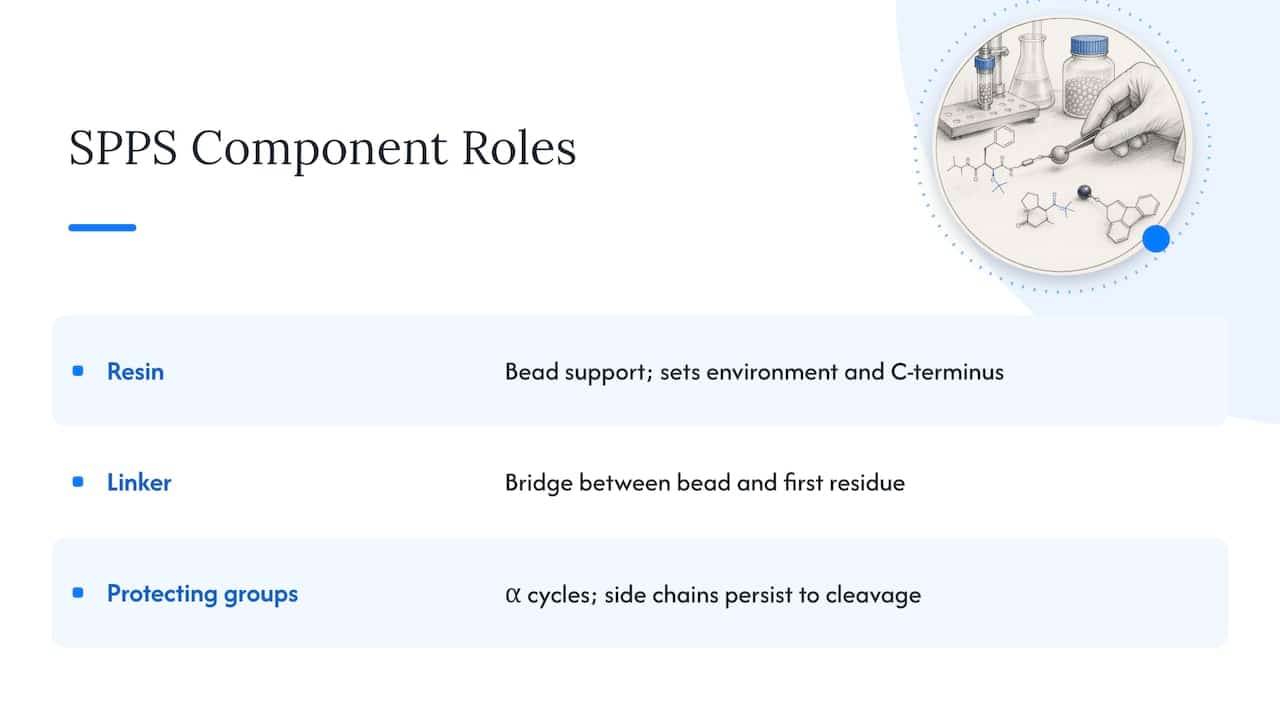
The resin. Small polymer beads, usually polystyrene-based, carry a reactive handle. The choice of resin and its substitution level (how many reactive sites per gram) sets the physical environment for the whole synthesis. It also decides what the C-terminus looks like after cleavage, for example a free acid or an amide.
The linker. This is the chemical bridge between the first residue and the bead. It has to survive every cycle and then release the peptide cleanly at the end.
Protecting groups. Amino acids have reactive amines and, often, reactive side chains. A temporary group on the alpha-amine is removed each cycle so the next residue can attach. Permanent side-chain groups stay in place until the final cleavage. The two strategies you will see named are Fmoc and Boc.
The Fmoc cycle, step by step
The American Peptide Society’s beginner primer describes manual Fmoc SPPS, and the sequence below follows the same logic.
- Swell the resin. Soak the beads in a solvent such as dimethylformamide (DMF), commonly for at least 30 minutes. Skipping this leaves interior sites unreachable.
- Deprotect. Treat the resin with a base, typically piperidine in DMF, to remove the Fmoc group and expose the amine.
- Wash. Flush away the base and the by-products.
- Couple. Add the next Fmoc-protected amino acid together with an activating (coupling) reagent so it forms a peptide bond with the exposed amine.
- Wash again. Remove excess amino acid and reagent.
- Repeat. Run steps 2 to 5 for every residue in the sequence.
- Cleave and deprotect. Treat the finished chain with a strong acid cocktail to release it from the resin and strip the side-chain groups.
- Purify and analyze. Precipitate the crude peptide, then purify it, typically by reversed-phase HPLC, and confirm identity by mass spectrometry.
A 30-residue peptide means roughly 30 passes through the deprotect, wash, couple, wash loop. That repetition is exactly why small per-step inefficiencies compound, a point we return to below.
Fmoc versus Boc
Boc (tert-butyloxycarbonyl) chemistry came first. Fmoc (9-fluorenylmethyloxycarbonyl) chemistry now dominates. Advances in Fmoc SPPS describes it as the method of choice today, helped by the low cost of very high-quality Fmoc building blocks, which exist because of multiton production of therapeutic peptides.
| Factor | Fmoc | Boc |
|---|---|---|
| Temporary group removed with | Base (piperidine) | Repeated TFA treatment |
| Final cleavage | Acid cocktail (TFA-based) | Anhydrous hydrogen fluoride (HF) |
| Sensitive modifications (phosphorylated, glycosylated) | Generally compatible | Harder to accommodate |
| Monitoring | UV absorption of the released fluorene group | Less convenient |
| Automation | Straightforward | More demanding because of HF handling |
| Typical use today | Default for most labs and manufacturers | Specialized or legacy cases |
The Wiley review explains that Boc’s repeated TFA exposure often caused premature loss of side-chain protecting groups and peptide loss from the resin, while Fmoc gives a more robust orthogonal scheme, where temporary and permanent groups are removed by different chemistry. Avoiding highly corrosive HF is also a practical safety and equipment advantage. Boc still has a place, but if you are reading a modern synthesis report, expect Fmoc.
Why the resin is the quiet star
If you ask experienced peptide chemists what makes or breaks a synthesis, many point to the support rather than the glamorous reagents. The introductory review on peptide synthesis treats solvation of the peptide-resin complex as the most crucial factor: if beads do not swell properly, interior sites stay inaccessible and couplings fail no matter how good the reagents are.
Two practical consequences follow:
- Swell first. Give the resin proper time in DMF before the first deprotection.
- Lower the loading for hard sequences. Longer or hydrophobic peptides tend to aggregate on the resin, with chains crowding each other and blocking reagent access to the amine. Using a lower-substitution resin, or adding chaotropic agents to improve solvation, usually helps more than simply extending reaction time, as the same review explains.
Coupling reagents: from DCC to modern activators
Forming the amide bond requires activating the incoming amino acid. In Merrifield’s original Boc work, DCC (dicyclohexylcarbodiimide) played that role. Its drawback is the insoluble by-product dicyclohexylurea. The synthesizer review notes that modern protocols often favor HBTU, HATU or PyBOP, which give higher efficiency and fewer side reactions when activating Fmoc-protected amino acids.
That answers a common question: DCC is historically important, but it is no longer the usual choice for Fmoc SPPS.
Monitoring the synthesis while it runs
Fmoc chemistry gives you a built-in readout. When piperidine removes the Fmoc group, the released fulvene-piperidine adduct absorbs UV light, so you can measure how much was removed at each cycle. The primer cited above describes this as a practical way to catch slow deprotection early. If the signal drops partway through, you can lengthen base treatment or change conditions before a failed coupling ruins the whole chain. Automated synthesizers often track this signal for you, but it is just as useful at the bench.
The honest drawbacks of SPPS
SPPS is the best general-purpose method we have, but it is not flawless. These are the limits that matter in practice.
- Error accumulation. The process is stepwise and iterative, so every cycle can leave behind truncated or deletion sequences. The Wiley review contrasts this with templated biological expression, where the ribosome does not accumulate errors the same way. Purification of the crude product is therefore essential to reach high purity, for example above 95%.
- Aggregation on resin. Long or hydrophobic sequences can fold or stack on the bead, leading to incomplete couplings.
- Length limits. The more cycles, the more compounding loss. Very long peptides are often assembled from fragments instead of in one run.
- Reagent and solvent use. Excess reagents drive each step to completion, which means significant solvent and reagent consumption relative to the amount of product.
- Crude is not finished. The material that comes off the resin is a mixture. Without HPLC purification and mass spec confirmation, you do not know what you have.
What SPPS means for the peptide you actually use
Understanding the method makes certificates of analysis easier to read, because each analytical test answers a specific synthesis question.
| Synthesis risk | What to look for in the data |
|---|---|
| Deletion or truncated sequences | HPLC purity trace with a single dominant peak |
| Wrong sequence or incomplete deprotection | Mass spec result matching the expected molecular weight |
| Residual reagents and contaminants | Lot-specific testing, not a generic template |
| Endotoxin carry-over | Endotoxin data for the specific lot |
| Batch-to-batch drift | A separate COA for each lot, not one document reused |
A purity figure alone is not enough. Ask which method produced it, which lot it describes, and whether identity was confirmed independently. Our own checklist, three checks before a lot enters your assay, walks through this from the buyer’s side, and our guide to buying research peptides online covers how to vet a supplier.
Our perspective
We sell research peptides, and we think about SPPS mostly as a quality question: what can go wrong between the resin and the vial, and what evidence shows it did not? Because SPPS accumulates small errors across many cycles, we do not treat a purity claim as meaningful unless it comes with the lot-level documentation behind it. That is why every lot we sell is third-party batch tested for purity and identity, with a Certificate of Analysis and endotoxin data for that lot.
We also draw a hard line on use. Our products are for laboratory research only. They are not for human or animal consumption, and a clean synthesis does not turn a research chemical into a medicine. If you are a researcher, the best thing you can do is read the data, compare it against the method that made the peptide, and question anything that looks too tidy.
— Data Peptides
A word on regulation and research-only use
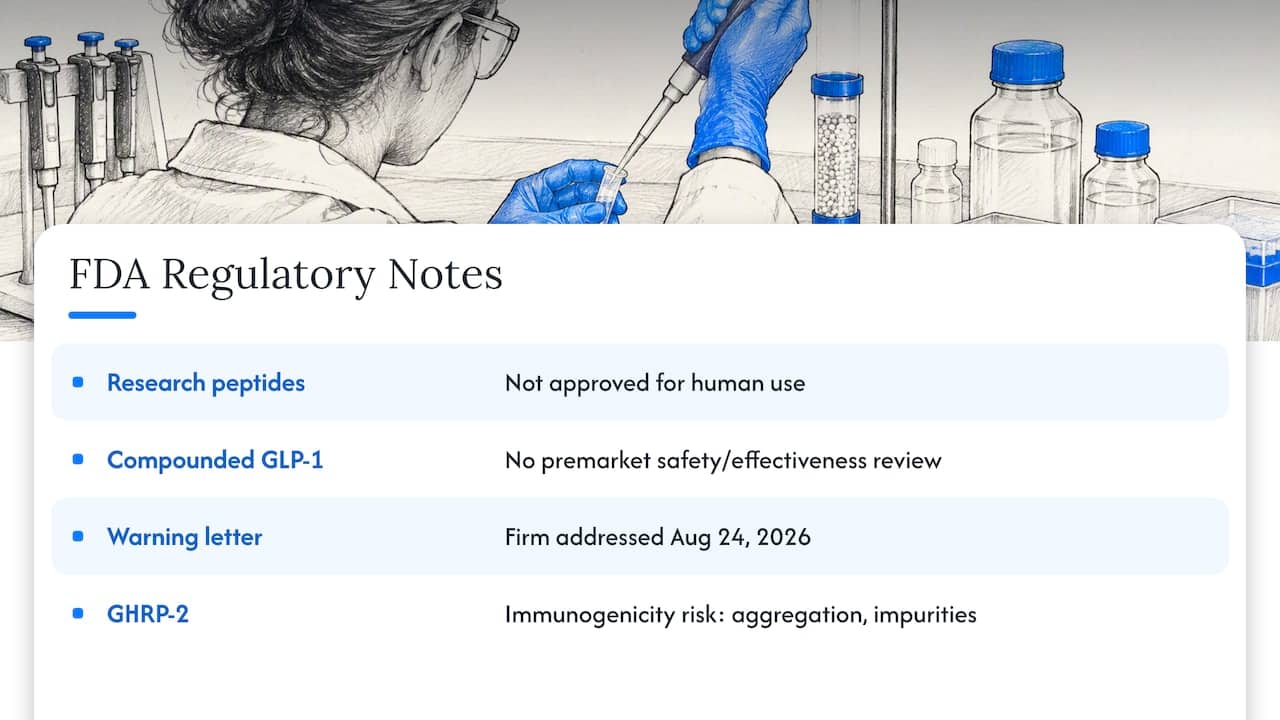
Synthesis quality and regulatory status are separate questions. The FDA has been explicit that products sold as research peptides are not approved for human use. In a warning letter dated August 24, 2026, the agency addressed a firm marketing peptide products, and its public materials on compounded and unapproved GLP-1 drugs note that compounded drugs are not FDA approved and that the agency does not review them for safety or effectiveness before marketing.
For certain peptides, the FDA has also flagged specific concerns. Its page on bulk drug substances that may present significant safety risks lists GHRP-2, for example, and cites immunogenicity risk linked to potential aggregation and impurities in compounded injectable and nasal forms. If you have questions about any peptide and your own health, talk to a licensed physician. Our overview of whether peptides are legal for research in the U.S. explains the research-use framework in more detail.
Sourcing peptides for the lab
Most labs do not synthesize every peptide in-house. For routine targets, buying a documented, third-party tested lot saves synthesis and purification time. We offer lab-grade research peptides across weight loss, muscle growth, recovery, anti-aging, libido and ancillary research supplies, with lot-level COAs, fast and discreet shipping from our US facility, and 24/7 support. You can browse the full research catalog or start with our guide to US research peptide quality standards. Every product is sold for laboratory research use only.
FAQ
What is the difference between solid-phase and solution-phase peptide synthesis?
In solution-phase synthesis, every intermediate is dissolved and has to be isolated and purified before the next step. In SPPS the chain stays attached to an insoluble resin, so excess reagents are washed away instead. That is why SPPS is faster and easier to automate for most research-scale peptides.
What is the role of DCC in peptide synthesis?
DCC is a carbodiimide coupling reagent that activates a carboxylic acid so it can form a peptide bond. It was important in Merrifield’s original Boc chemistry, but it produces insoluble dicyclohexylurea. Modern Fmoc protocols usually use reagents such as HBTU, HATU or PyBOP instead.
What are the disadvantages of solid-phase peptide synthesis?
The main ones are error accumulation over many cycles, aggregation of the chain on the resin, and heavy reagent and solvent use. Crude product always contains truncated or deletion sequences, so purification and analytical confirmation are required. Very long peptides are difficult to make in a single run.
Why is Fmoc preferred over Boc?
Fmoc avoids the highly corrosive anhydrous HF used for final cleavage in Boc chemistry. It is also compatible with sensitive modifications such as phosphorylation and glycosylation, and its deprotection can be monitored by UV absorption. Those advantages make it easier to automate and more widely used.
Sources
- Automated Peptide Synthesizers and Glycoprotein Synthesis (PMC)
- Introduction to Peptide Synthesis (PMC)
- Advances in Fmoc solid-phase peptide synthesis (Journal of Peptide Science)
- Peptide Synthesis for Beginners (American Peptide Society)
- NuScience Peptides LLC warning letter, 08/24/2026 (FDA)
- FDA’s Concerns with Unapproved GLP-1 Drugs Used for Weight Loss (FDA)
- Certain Bulk Drug Substances for Use in Compounding that May Present Significant Safety Risks (FDA)