

The peptide trends that matter in 2026 are GLP-1 medicines pulling the whole field forward, AI-assisted design speeding up discovery, oral delivery slowly improving, and a regulatory shift in the US that raises the stakes on quality documentation. For a laboratory, that last point is the practical one: as attention grows, the labs that do well are the ones that can show batch-level proof of identity, purity and endotoxin levels for every lot. That is the standard we build our research catalog around at Data Peptides.
TL;DR
- GLP-1 drugs turned peptides from a niche into a mainstream research priority, and the next wave is combination and long-acting variants.
- AI, high-throughput screening and closed-loop design-build-test cycles are making peptide discovery faster and more systematic.
- Oral delivery is advancing, but enzymatic breakdown and poor absorption remain the central hurdles.
- On Oct. 28, 2026, HHS issued an enforcement discretion policy covering six peptides at compounding pharmacies. It does not make research materials suitable for human use.
- Research buyers should insist on third-party testing, a Certificate of Analysis for each lot, and endotoxin data.
Table of Contents
- Why peptides are everywhere in 2026
- Trend 1: GLP-1 success pulls the whole field forward
- Trend 2: AI and closed-loop discovery
- Trend 3: Oral delivery moves from wish to workflow
- Trend 4: A regulatory moment in the US
- Trend 5: Evidence still separates approved drugs from everything else
- Trend 6: Documentation becomes the buying criterion
- What the trends mean for your lab
- Our perspective
- Start with the right catalog
- FAQ
- Sources
Why peptides are everywhere in 2026
Peptides are short chains of amino acids. They act as signals in the body, which is why they appeal to so many fields: metabolism, tissue repair, skin biology, cognition and aging. For years they were a specialist topic. Then semaglutide and related GLP-1 drugs showed that a peptide could deliver large, measurable clinical effects at population scale, and attention followed.
Stanford’s neuroscience team describes the current moment as a revolution in peptide science after Ozempic, with discovery momentum driven by GLP-1 successes and advances in technology. Consumer interest has moved in step, which is why search interest, social media coverage and regulatory activity have all spiked at once.
For a research lab, this creates two realities at the same time. Funding and curiosity are rising, and so is the volume of noise. Telling a well-characterized material from a poorly documented one is now a core skill. The trends below are organized around that skill.
Trend 1: GLP-1 success pulls the whole field forward
The clearest anchor in peptide science today is the FDA-approved GLP-1 class. The FDA’s 2026 approval package for WEGOVY (semaglutide) injection lists indications that include reducing major cardiovascular risk in eligible adults with established cardiovascular disease and obesity or overweight, and reducing excess body weight and maintaining weight reduction long term in adults and adolescents aged 12 and older with obesity. It also carries an accelerated approval indication for noncirrhotic MASH with moderate to advanced liver fibrosis, where continued approval may depend on confirmatory trial results.
The efficacy evidence behind it came from multiple randomized, double-blind trials, including 68-week studies in which dosing escalated to 2.4 mg weekly before maintenance. That is the benchmark: long trials, controlled designs, defined populations, regulated manufacturing.
What comes next in the GLP-1 pipeline
Stanford Medicine reports that some researchers expect peptide medicines to reach FDA approval sooner through GLP-1 variations, including a product that pairs a GLP-1 mimic with an antibody to extend duration (maridebart cafraglutide, or MariTide) and investigational combinations such as retatrutide and CagriSema (cagrilintide-semaglutide). The same report notes that clinical trials are testing approved GLP-1 mimics for heart disease, addiction and Alzheimer’s disease.
Two takeaways for researchers:
- The question is shifting from “does a peptide work on weight” to “which peptide, combined with what, for which condition.” That favors labs that can run clean comparisons between well-characterized materials.
- Interest in neighboring mechanisms, such as appetite, metabolism and tissue signaling, keeps growing. Our weight loss research catalog and the accompanying research guide to weight loss peptides cover materials for this kind of laboratory work.
People who are interested in prescription GLP-1 treatment for themselves are in a different category from laboratory research. That path runs through a licensed clinician, and a page on GLP-1 eligibility and providers explains how online evaluation and prescriptions work for those patients.
Trend 2: AI and closed-loop discovery
The second major trend is methodological. A 2026 review in Cell Biomaterials describes faster, more systematic peptide discovery built on high-throughput screening, structural modeling, AI-enabled design and chemical engineering. The central idea is the closed-loop workflow: designed peptides are synthesized quickly and tested, and the experimental results feed back into the next round of designs.
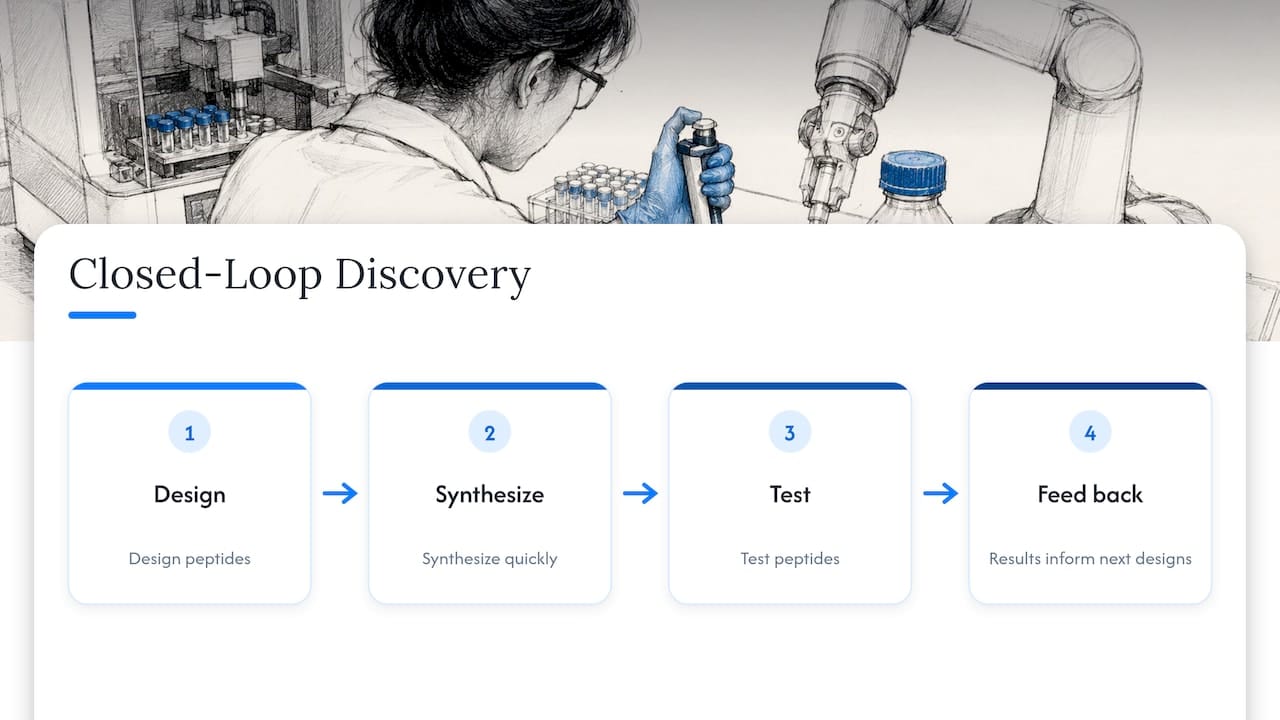
A comparative review published on March 30, 2026 maps AI across peptide drug discovery: virtual screening, lead optimization, de novo design, ADMET and toxicity prediction, and synthesis planning. It also stresses the problems that are specific to peptides, namely flexibility, stability and immunogenicity. Another 2026 review frames the shift as a move from manual screening to predictive and generative models, including tools in the AlphaFold and RoseTTAFold family, aimed at reducing trial and error in protein-peptide interaction design and supporting pharmacokinetic and toxicity assessments.
What this means at the bench
AI proposes, but the bench disposes. Every computational prediction ends in a physical sample that has to be what the label says. A closed loop is only as good as its weakest input: if the material in the vial differs from the designed sequence, or carries impurities, the experimental result teaches the model the wrong lesson.
That is why identity and purity data are not paperwork. In an iterative workflow they are part of the experimental design. Every Data Peptides lot is third-party batch tested for purity and identity, and our Certificates of Analysis and endotoxin data come with every lot, so the material you design around is the material you actually run.
Trend 3: Oral delivery moves from wish to workflow
Oral peptides are the headline in several market reports ranking for this topic, and the science explains both the excitement and the delay. An oral delivery review covering literature through May 2026 lists the obstacles plainly: enzymatic degradation, low intestinal permeability, mucus entrapment and presystemic metabolism. The strategies under study include peptide modification, enzyme inhibition, permeation enhancement, mucolytic approaches and advanced carrier systems.
AI shows up here too. Machine-learning models are being used to predict stability and permeability so candidates can be prioritized before expensive experiments. The same review is careful on one point: predictions should guide which experiments to run and support formulation design, while biorelevant experimental testing and clinical validation remain indispensable.
The practical reading for 2026 is that oral peptide candidates will appear more often in preclinical pipelines, and low bioavailability does not automatically end a project. If you work on this problem, our explainer on oral peptide bioavailability walks through why very low absorption percentages can still be meaningful in a research design.
Trend 4: A regulatory moment in the US
The biggest news for US readers is regulatory, and the details matter.
- Oct. 28, 2026: HHS issued guidance saying it would not take enforcement action against specialized pharmacies selling certain unapproved “wellness” peptides, provided manufacturing and related guidelines are met, according to Science. The products are marketed for conditions including joint problems, insomnia, opioid withdrawal and metabolic issues.
- Six named peptides: The Los Angeles Times reports the policy covers BPC-157, TB-500, KPV, epitalon, Semax and MOTS-c at compounding pharmacies. The same article states that BPC-157, TB-500 and injectable GHK-Cu are not FDA-approved for human use in any form, while topical GHK-Cu is a legal cosmetic ingredient.
- Direct-to-consumer plans: Science also reports that at least one telehealth company disclosed plans to sell a line of peptides directly to consumers after the guidance.
- The run-up: An FDA advisory panel recommended loosening restrictions for compounding pharmacies on six peptides, per Stanford Medicine, and Science reports the FDA in July advised against adding those peptides to the list that lets approved pharmacies produce them. Earlier, a May 1 Science News piece described FDA scientists’ concerns about possible immune reactions to certain injectable peptides.
What this does and does not change for a lab
The policy concerns pharmacy compounding for patients. It does not turn laboratory materials into products for people or animals. Research peptides remain for laboratory research use only, and that is how we sell them: for scientific researchers, research organizations, and professionals running laboratory applications, not for human or animal consumption or medical treatment.
If you want the legal picture for research purchasing, start with our guide on whether peptides are legal for research in the U.S., and our analysis of why six committee picks will not change FDA peptide policy. Teams that work with athletes or sports organizations should also read the checklist for peptides banned in sports.
Trend 5: Evidence still separates approved drugs from everything else
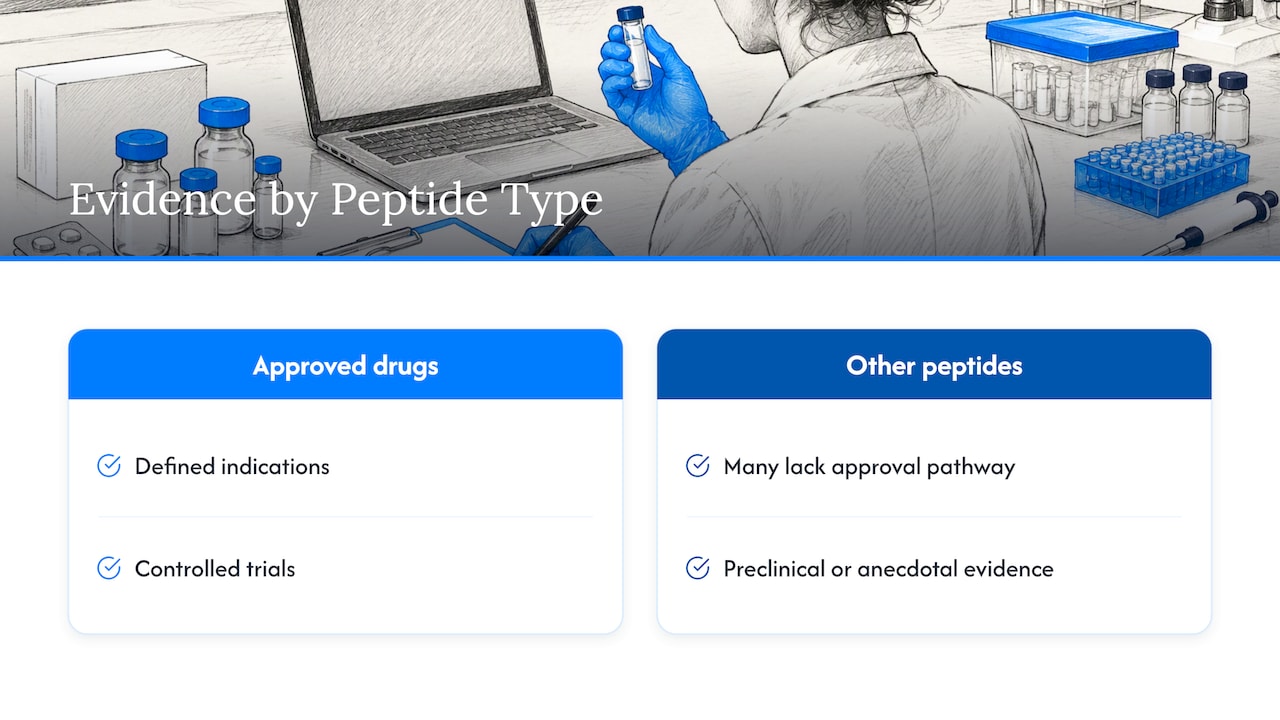
One pattern runs through nearly every 2026 source: peptides with deep clinical evidence and peptides with mostly preclinical or anecdotal evidence are getting lumped together in public conversation. Approved drugs like semaglutide have defined indications, controlled trials and regulated manufacturing. Many other peptides discussed online have not been through that path, and Stanford Medicine notes that animal testing and clinical trials are what establish safe and effective doses.
That gap is exactly why the research use only framework exists. It places these materials where they belong in the evidence chain: as tools for laboratory investigation, the stage at which mechanisms are characterized and doses are explored in model systems. Our categories for muscle growth, recovery and anti-aging research are built for that stage, and we publish supporting guides such as what researchers should verify first for recovery peptides and matching assay tier to procurement for anti-aging peptides.
Trend 6: Documentation becomes the buying criterion
As interest grows, so does the amount of poorly documented material in circulation. A July 2026 Los Angeles Times report on buying peptides online cites a 2024 Journal of Medical Internet Research analysis of semaglutide products sold without a prescription. It found endotoxin contamination in every tested sample, and labeled purity of 99% corresponded to measured purity between 7.7% and 14.37% across batches.
The lesson is not that testing is optional. It is that a purity number on a label means nothing without independent analysis behind it, and that endotoxin data belongs next to purity data.
A documentation checklist for 2026
When you evaluate any research peptide supplier this year, ask for these items for the specific lot you are buying:
- Third-party testing, so the analysis does not come from the party selling the material.
- A lot-specific Certificate of Analysis that matches the batch number on the vial.
- Identity confirmation (the sequence or mass is what the label says), not just a purity percentage.
- Purity data with the method stated.
- Endotoxin results, which matter for any cell-based or in vivo model work.
- Responsive support that can answer questions about a lot after you place the order.
We designed our process around exactly this list. All Data Peptides products are third-party batch tested for purity and identity, with a Certificate of Analysis and endotoxin data for every lot, and our 99%+ purity standard applies across the catalog. Our guide to buying research peptides online goes through quality and safety checks in more detail, and our piece on peptide scams, red flags and fake COAs shows what mismatched paperwork looks like. For a broader look at what the supplier landscape offers, see our overview of peptide companies and our note on USA peptide research standards.
What the trends mean for your lab
Put the trends together and the direction is clear. Discovery is getting faster because of AI and closed-loop workflows. The clinical bar is being set by GLP-1 drugs and their next-generation combinations. Oral delivery is an active frontier. Regulators are in flux. In all of it, the constant is that experimental conclusions are only as reliable as the materials behind them.
A few practical moves for the year ahead:
- Standardize your intake. Require a lot-matched COA with identity, purity and endotoxin data before any material enters an experiment.
- Record lot numbers in your protocols. If results shift between runs, the lot is the first variable to check.
- Keep your use case within research. Align purchasing, labeling and storage with laboratory research use only.
- Track the policy, not the buzz. Follow primary sources, such as FDA documents and peer-reviewed reviews, over social media claims.
- Plan for supply timing. Fast, discreet US shipping and reachable support reduce downtime when a project is on a schedule.
Our perspective
The 2026 peptide conversation is loud, and most of the noise is about people. Our job is the quieter part: making sure the material that reaches a lab bench is what it says it is.
We built Data Peptides around documentation. Every lot is third-party batch tested for purity and identity, and every lot comes with a Certificate of Analysis and endotoxin data. We think that is the right answer to a market where trust is the scarcest input. Researchers should not have to wonder whether a number on a label was measured.
We also hold a firm line on use. Our peptides are for laboratory research only, sold to researchers, research organizations and professionals working in lab settings. As policy debates continue, we think clarity about that boundary protects both the science and the people who do it.
Finally, we believe support is part of quality. Our team is available 24/7 for all purchases, and orders ship fast and discreetly from our US facility, so your timeline is not the thing that slows your research.
Data Peptides
Start with the right catalog
If your 2026 work touches metabolism, tissue recovery, muscle biology, aging or related areas, you can browse the full Data Peptides research catalog. It covers weight loss, muscle growth, recovery, anti-aging, libido and ancillary research supplies, each category with lot-level Certificates of Analysis and endotoxin data. Materials are for laboratory research use only.
FAQ
Are peptides the future?
In drug development, yes: peptide medicines are a fast-growing area, helped by GLP-1 successes and AI-driven discovery. Reviews published in 2026 describe faster design cycles and growing interest in oral delivery. Progress in the clinic still depends on long controlled trials, which is how approved drugs like semaglutide earned their indications.
What is the future of peptide synthesis?
Expect tighter loops between computation and the bench. A 2026 Cell Biomaterials review describes designed peptides being rapidly synthesized and tested, with results feeding the next design round. That makes synthesis speed and material quality more important, since each result informs the next model.
What peptide replaced BPC-157?
None has officially replaced it. BPC-157 is one of six peptides named in the Oct. 28, 2026 HHS enforcement discretion policy for compounding pharmacies, alongside TB-500, KPV, epitalon, Semax and MOTS-c. The Los Angeles Times notes that BPC-157 is not FDA-approved for human use in any form. For laboratory work, see our recovery research peptides.
Does the new HHS policy make research peptides legal to use on people?
No. The policy addresses pharmacy compounding and says nothing that turns laboratory research materials into products for humans or animals. Research peptides remain for laboratory use only. Anyone considering a medical treatment should talk to a licensed physician.
What documents should come with a research peptide?
At minimum, a lot-specific Certificate of Analysis from third-party testing that confirms identity and purity, plus endotoxin data. Every Data Peptides lot ships with these, and our 24/7 support team can answer questions about your order.
Sources
- After Ozempic: the revolution in peptide science (Stanford Neuroscience)
- Peptides talk is everywhere: But what does the science say? (Stanford Medicine)
- FDA WEGOVY approval package (Drugs@FDA)
- Peptide-protein interactions in drug discovery (Cell Biomaterials)
- A Comparative Review of Artificial Intelligence in peptide drug discovery (PMC)
- Peptides and Amino Acids in Drug Development (PMC)
- Emerging Technologies for Oral Peptide Delivery (PMC)
- U.S. expands access to unapproved peptides (Science)
- Peptides are unproven as health aids. FDA may unleash them (Science News)
- For peptide enthusiasts, a new HHS policy (Los Angeles Times)
- Buying Peptides Online? Here’s How to Spot Fake Products (Los Angeles Times)