

Peptide lot traceability means you can follow one production batch from the supplier’s lot number to the vial on your bench, to every aliquot you cut from it, to the experiment where you used it, and back again. In practice it comes down to one habit: carry the lot number, and the Certificate of Analysis (COA) tied to it, through every container and every record. This guide shows how to build that chain, how to check that a lot number, label and COA actually agree, and what to do when the paperwork doesn’t line up.
It is written for laboratory researchers and research organizations. All peptides discussed here are for laboratory research use only, not for human or animal consumption.
TL;DR
- A lot number is only useful if it connects to a lot-specific COA, the physical label and your own records. A purity percentage on a web page is not traceability.
- Record the lot, supplier, receipt date, storage conditions and COA at receiving, and link the COA to the same controlled record rather than leaving it in an email inbox.
- When you split a lot into aliquots, give each child container a reference that points back to the parent lot, and log the event as well as the identifier.
- Small mismatches between label and COA don’t prove the data are wrong, but they do stop you from drawing strong lot-level conclusions until they are resolved.
- Traceability shows where a material came from and what was tested. It says nothing on its own about safety in humans, efficacy or legal status.
Table of Contents
- What lot traceability means for peptides
- The record chain, link by link
- Matching the lot number to its COA and label
- Keeping traceability when a lot is split
- A sample lot record
- When documentation is incomplete or inconsistent
- What traceability does and does not establish
- Our perspective
- Order with the lot paperwork in hand
- FAQ
- Sources
What lot traceability means for peptides
A peptide batch is more than a vial and a purity figure. It is one manufacturing run with its own synthesis, purification and testing history. Two vials of the same sequence from different runs can differ in purity, in content, in counter-ion and water content, and in impurity profile. If your records only say “peptide X, 5 mg,” you cannot tell later which run produced your result.
U.S. regulation gives a useful working definition of the identifier itself. Under 21 CFR § 210.3, a lot, control or batch number is a distinctive combination of letters, numbers or symbols from which the complete history of manufacture, processing, packing, holding and distribution can be determined. That regulation governs drug manufacturing, so it does not apply to your research bench directly. But the idea carries over cleanly: the number is a key, and it is only worth anything if the history behind it can actually be retrieved.
For a research lab, that gives you three practical reasons to care:
- Reproducibility. If a result shifts between experiments, the first question is whether the material changed. Without a lot record you can’t answer it.
- Troubleshooting. When an assay behaves oddly, you need to know which lots were in play, how long they were stored and how many freeze-thaw cycles they saw.
- Audit and publication. Reviewers, collaborators and quality staff increasingly expect you to be able to reconstruct what material was used.
The record chain, link by link
A complete chain has no gaps between the point where material was quoted and the point where its data were generated. The documentation workflow described in a practical batch-traceability framework for research materials makes the key point well: internal identifiers should point to controlled records that hold the supplier’s lot or batch details, and the certificate should be linked to that same record rather than filed separately, so a later reviewer can reconstruct what was bought and how it arrived and was stored.
Here is a chain you can adopt as is.
- Quotation or purchase order. Record the product name, sequence or catalog reference, quantity and the supplier’s quotation number. If the supplier states the lot at order time, note it. If not, note that it was assigned at shipment.
- Shipment record. Keep the packing slip, tracking number and dispatch date. These tie the lot you received to the order you placed.
- Receiving log. On the day it arrives, write down the material name, supplier, lot or batch identifier, date received, container count, condition on arrival and who received it.
- Label check. Compare the lot number on the vial label to the packing slip and to the COA. Photograph the label if your system allows.
- COA filing. Attach the COA to the receiving record. Don’t leave it in an inbox folder where it can be separated from the lot.
- Storage and handling record. Log storage location, temperature, date of first opening, reconstitution date, diluent and any aliquoting.
- Experiment linkage. In the notebook or electronic record, cite the internal material ID, not just the peptide name, every time the material is used.
Each step is small. The value comes from doing all seven the same way every time, so a gap is visible instead of silent.
Give every lot an internal ID
Supplier lot numbers are not unique across suppliers. Two vendors can issue the same short code. Assign your own internal material ID at receiving, such as a sequential number with a year prefix, and record the supplier lot against it. Your notebooks then cite one ID that you control, and the supplier lot is one field inside that record.
Matching the lot number to its COA and label
The lot number is what connects the vial to its COA. That means the identity, purity and other reported results on the certificate belong to that production batch and no other. Verifying the match is a short, concrete task.
A COA works best when you treat it as the lot-specific analytical record. According to a review of what makes a COA only as strong as its source-record trail, a reviewer should confirm the report identifies the material unambiguously using at least these fields as a consistent chain:
- Material name
- Batch or lot number
- Sample identifier
- Report identifier
- Testing laboratory
- Test date
Walk through them against the physical vial. The material name should match the label. The lot number on the COA should be character-for-character the same as on the label. The sample ID and report ID should be present and internally consistent, and the laboratory and test date should be stated. If the COA comes from an independent laboratory, the lab’s name should appear on the report itself.
The same source makes a point worth remembering: a small mismatch in lot, sample ID or report ID does not automatically mean the data are wrong. It does mean you can’t draw strong lot-level conclusions without more evidence. Treat a mismatch as an open question to resolve with the supplier, not as a verdict either way.
For a deeper walk through the certificate itself, see our guide to three checks labs run on a peptide COA.
What a COA can and cannot show
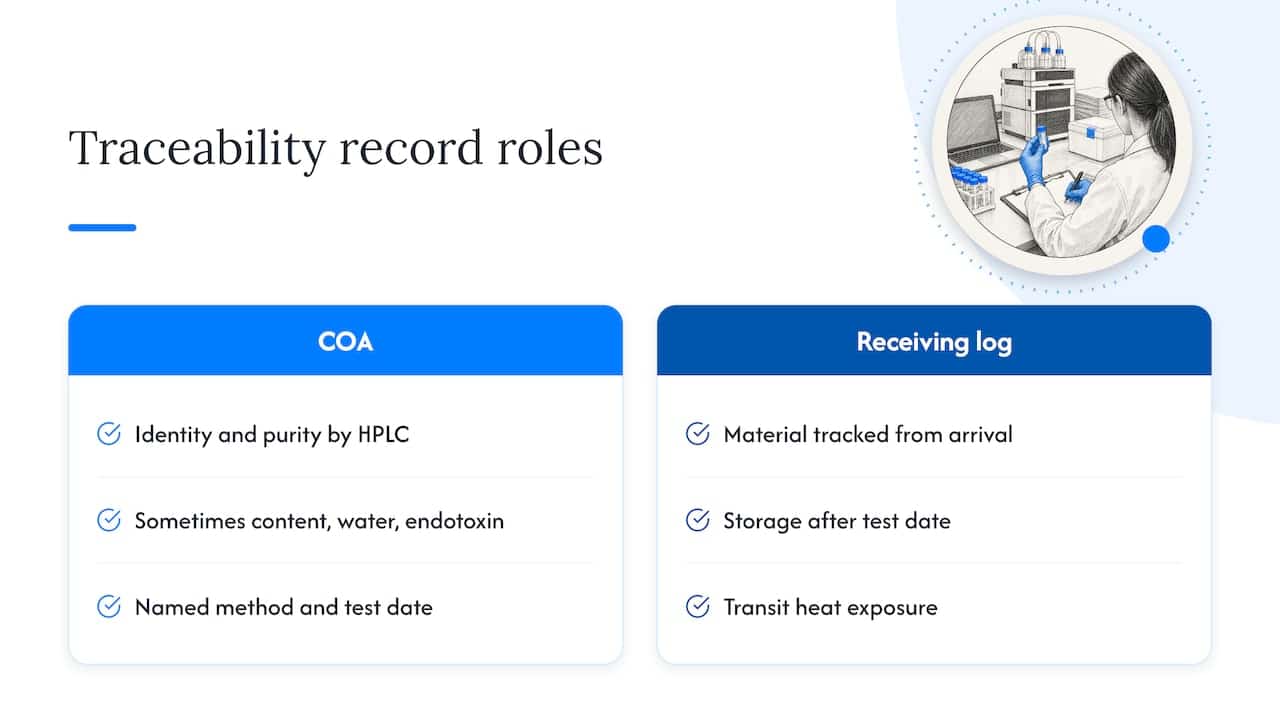
A lot-specific COA tells you what was measured on a sample of that lot, by a named method, on a named date. Typical entries are identity confirmation (often by mass spectrometry), purity by HPLC, and sometimes content, water or endotoxin data. It does not tell you how the material was stored after the test date, or whether the vial you hold was exposed to heat during transit. That is why your own receiving and storage records are the second half of traceability: the COA covers the lot at testing, and your log covers the material from the day it reached you.
Keeping traceability when a lot is split
Most labs don’t use a whole vial in one go. You reconstitute, divide into aliquots, freeze, thaw and redistribute. Each of those steps can break the chain if the new container carries only the peptide name.
The rule is simple: carry the lot number through every derived container. Practical ways to do it:
- Label children with a parent reference. An aliquot label might read the internal material ID, the parent lot, an aliquot number and the date. Even a short code works if it resolves to the full record.
- Record the event, not only the identifier. Write down who divided the material, when, in what diluent, at what concentration and into how many aliquots. An identifier without the event leaves a hole in the history.
- Note what the parent COA covers. The COA describes the lot as tested, not each aliquot you make later. State that in your record so no one assumes each tube was individually tested.
- Track the count. If you made twelve aliquots and used eleven, the record should show where each went.
- Control the rack. Keep aliquots in a mapped location, and update the map when tubes move.
The same logic applies when a supplier divides bulk material into smaller packs for resale. Ask which parent lot each pack came from, and whether the COA you receive refers to that parent lot. If you move material between your own sites, the transfer record should name the lot, the quantity and the receiving person.
A sample lot record
This is an illustrative layout, with made-up values, that you can adapt for a spreadsheet or electronic notebook. Every row answers a question a reviewer is likely to ask.
| Field | Example entry | Why it matters |
|---|---|---|
| Internal material ID | 26-0142 | One identifier you control, cited in every notebook entry |
| Material name | As printed on the label | Must match the COA |
| Supplier and lot number | Supplier name, lot as printed | Links to the production batch |
| Date received and by whom | Receiving date, initials | Anchors the storage clock |
| Condition on arrival | Intact, label legible, temperature noted | Documents transit |
| COA reference | Report ID, sample ID, lab, test date | Ties analytical data to the lot |
| Label and COA match | Yes or no, with date checked | Shows the check was done |
| Storage location and temperature | Freezer ID, set point | Supports stability reasoning |
| Retest or expiry date | As stated by supplier, or “not stated” | Flags a documentation gap |
| Aliquot log | Count, date, diluent, concentration | Preserves the chain after splitting |
| Experiments used in | Notebook page references | Closes the loop from result back to lot |
If you can fill in every row for every lot, you can answer nearly any traceability question quickly.
When documentation is incomplete or inconsistent
Sooner or later a lot arrives with something off: a missing retest date, a COA lot number that differs by a character, a report without a sample ID. A calm, written process beats improvising.
- Quarantine the material. Label it “hold,” store it under the recommended conditions and keep it out of experiments until the question is resolved.
- Describe the discrepancy exactly. Write what the label says, what the COA says and where they differ. Photograph both.
- Contact the supplier in writing. Ask for a corrected or complete COA, the report and sample identifiers, and confirmation that the lot on the label is the lot that was tested. Keep the reply with the lot record.
- Decide what you can still conclude. A mismatch that the supplier explains and documents may be a typographical error. One that can’t be explained means the COA data can’t be attributed to that lot with confidence.
- Record the decision. Note whether the lot was released, used for non-critical work only, retested in-house or rejected, who decided and when.
A missing retest date is a gap of a different kind. It doesn’t say the material is bad, but it removes a reference point for how long you can rely on stored material. Ask the supplier whether a retest date applies, and if none is provided, record “not stated” and consider setting your own internal review interval based on your storage conditions and assay sensitivity. For the safety and acceptance side of this decision, our piece on three checks before a lot enters your assay goes through the release criteria in more detail.
What traceability does and does not establish
Traceability is a documentation discipline. Done well, it establishes that a specific material can be linked to a specific batch, a specific analytical report and a specific sequence of handling events. That is valuable for science.
It does not establish several things, and your records and any write-up should not imply that it does:
- Human or animal safety. A clean chain of custody says nothing about how a compound behaves in a living organism.
- Efficacy. A traceable lot is not evidence that the compound works for any purpose.
- Legal status for any particular use. Rules for peptides depend on the compound, the use and the buyer. Research-use-only material is for laboratory work, and questions about regulatory status for a particular compound or activity belong with your institution’s compliance office or qualified counsel.
- Fitness for competitive sport. Some peptides are prohibited in sport. If your work touches anti-doping topics, our checklist for peptides banned in sports is a good starting point for lab staff.
Keeping those limits in view protects your credibility. A traceability record supports statements such as “lot X was used in experiments A to D,” not statements about outcomes outside the laboratory.
Our perspective
We think a lot number should be a promise you can check, not a decoration on a vial. When a researcher asks us where a peptide came from, the useful answer is a document trail: the lot, the COA that belongs to that lot, and the data behind both.
That is how we approach every product we list. Our peptides are third-party batch tested for purity and identity, and we provide Certificates of Analysis and endotoxin data for every lot. We design our documentation so the lot on the label and the lot on the report can be matched without guesswork, because we know your records are only as strong as the material they describe.
We also know traceability is not only the supplier’s job. The best results come when a lab pairs lot-level documentation with its own receiving checks, aliquot labeling and notebook discipline. We are glad to support that with fast, discreet U.S. shipping and a support team available 24/7 for questions about a lot or its paperwork.
Everything we sell is for laboratory research use only. That boundary shapes how we document, label and talk about our products.
Data Peptides
Order with the lot paperwork in hand
If you are building or tightening a traceability system, start with material that arrives documented. Browse our research peptide catalog by category, including weight loss, muscle growth, recovery, anti-aging and libido research peptides, plus research supplies for handling and storage. Each lot ships with its Certificate of Analysis, and our ordering guide for researchers explains what to expect at checkout and on delivery. All products are for laboratory research use only.
FAQ
What is the difference between a lot number and a batch number for peptides?
In most supplier documentation the two terms are used interchangeably. Both identify one production run. U.S. drug regulations define the lot, control or batch number as an identifier from which the full history of a batch can be determined, which is the standard worth holding any supplier’s number to. Always record the exact string as printed rather than retyping it from memory.
Where should I store the COA for each peptide lot?
Store it in the same controlled record as the receiving log and the internal material ID, not in a separate email folder. That way anyone reviewing an experiment can move from the notebook entry to the material record to the certificate in a few steps. Keep a PDF copy and note the report ID and test date in the record itself.
What should I do if the lot number on the vial doesn’t match the COA?
Place the material on hold and don’t use it in experiments yet. Document the exact difference with photos, then ask the supplier in writing to confirm which lot was tested. A mismatch isn’t automatic proof the data are wrong, but until it is explained you can’t attribute the COA results to that lot with confidence.
Do I need to track aliquots separately from the parent vial?
Yes. Every aliquot should carry a reference to the parent lot and your internal material ID, plus its own aliquot number and date. Log the division event with diluent, concentration and count. Without that, a result from a thawed tube can’t be traced back to a specific lot.
Does lot traceability mean a peptide is safe or legal to use?
No. Traceability documents where material came from and what was tested. It doesn’t establish safety, efficacy or legal status, and research-use-only peptides are for laboratory work only. For compliance questions about a specific compound or activity, consult your institution’s compliance office or qualified counsel.
Sources
- 21 CFR § 210.3, Definitions (Cornell Legal Information Institute)
- From Receipt to Result: A Practical Batch-traceability Framework for Research Materials (Labcompare)
- A COA is only as strong as its source-record trail (Lab News)