
Peptide pH stability describes how well a peptide keeps its sequence, structure and solubility at a given pH. There is no single safe pH. The best range depends on the sequence, but published work on several peptides points the same way: mildly acidic solutions, roughly pH 4 to 6, often hold up better than neutral or basic ones, and a dry, cold, lyophilized powder holds up better than any solution.
This guide explains the chemistry in plain terms, walks through what studies measured at different pH values, and turns it into handling habits for research labs. All peptides we discuss are for laboratory research use only.
TL;DR
- pH drives the main chemical routes of peptide breakdown: hydrolysis, deamidation, oxidation and epimerization each dominate at different pH ranges.
- Solubility is lowest at a peptide’s isoelectric point, so pH has to balance solubility against chemical stability.
- In an exenatide study, pH 4.5 and 5.5 stayed relatively stable over four weeks at 37°C, while pH 7.5 and 8.5 showed deamidation and aggregation.
- Dry lyophilized powder stored cold and protected from light is far more stable than any solution, whatever the pH.
- Check the batch Certificate of Analysis, then match solvent, pH and storage to your specific sequence.
Table of Contents
- What pH stability means for a peptide
- How pH drives the main degradation routes
- Solubility and the isoelectric point
- What studies measured at different pH values
- Solutions versus solids
- Buffers and pH modifiers are not interchangeable
- A practical workflow for research labs
- Shelf-life claims and what they actually mean
- Our perspective
- Where to source research peptides
- FAQ
- Sources
What pH stability means for a peptide
A peptide can fail in two ways. A 2023 review of peptide formulation separates them cleanly. Chemical instability changes the molecule by making or breaking covalent bonds: oxidation, hydrolysis, β-elimination, deamidation, racemization, isomerization and disulfide exchange. Physical instability leaves the bonds intact but changes non-covalent interactions: shifts in secondary structure, adsorption to surfaces, aggregation and precipitation.
pH touches both. It sets the charge on every ionizable group, which changes how the chains attract each other. It also supplies or removes the protons and hydroxide ions that catalyze bond cleavage. So “pH stability” really means: at this pH, how fast does each degradation route run, and does the peptide stay in solution?
How pH drives the main degradation routes
Hydrolysis
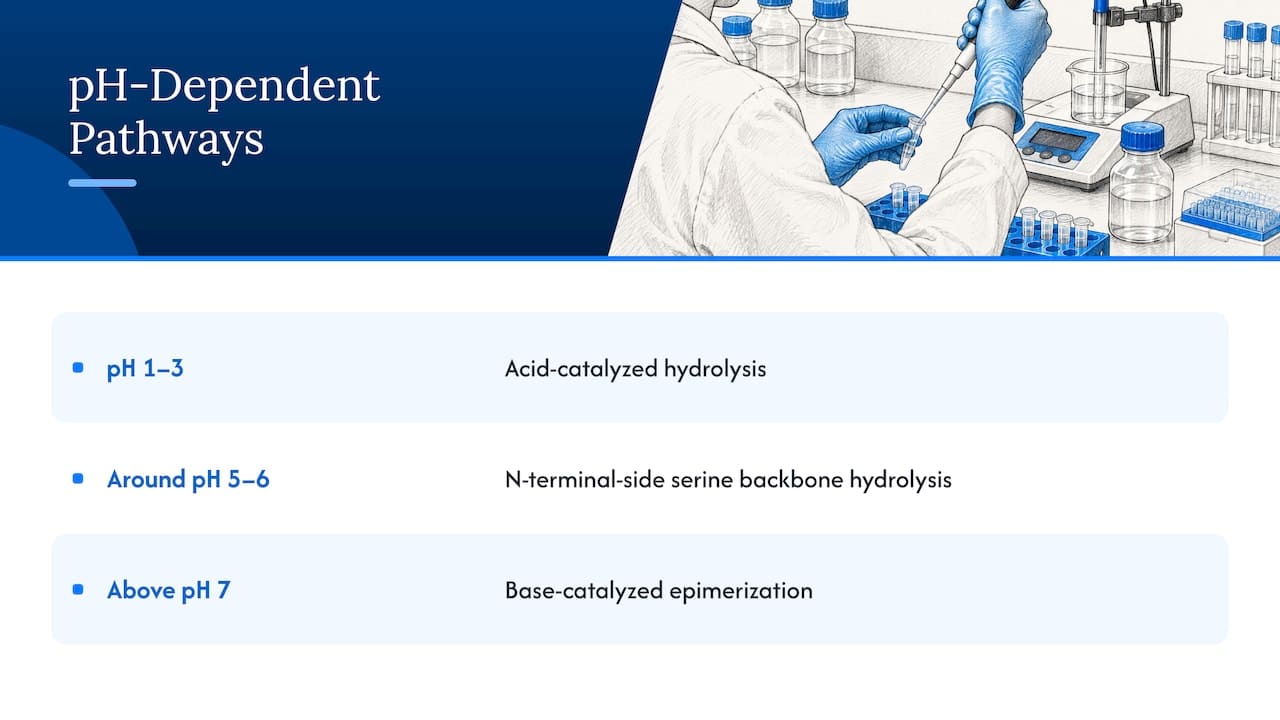
Hydrolysis cuts the peptide backbone. It is generally catalyzed by acids and bases and depends strongly on pH. In the review’s examples, gonadorelin and triptorelin undergo acid-catalyzed hydrolysis at pH 1 to 3. Around pH 5 to 6, the backbone can hydrolyze on the N-terminal side of serine. Above pH 7, base-catalyzed epimerization becomes the primary pathway.
Notice what this means: no pH removes every route. Moving the pH only changes which route leads.
Deamidation
Asparagine and glutamine residues can lose their amide group. The FDA guidance on synthetic peptides lists asparagine and glutamine deamidation among the expected changes when a peptide sits in solution. Studies on exenatide tie this reaction to higher pH, as the data below show.
Oxidation
A 2014 primer on peptide developability notes that cysteine, methionine, histidine, tyrosine and tryptophan residues are the sensitive ones. Metal impurities and light can make oxidation worse, and peroxide contaminants in excipients such as polysorbates can accelerate it. Oxidation propensity generally lessens at lower pH. That is one reason methionine-containing peptides are often handled at the acidic end of the workable range.
Aggregation and precipitation
The 2017 review on physical stability lists sequence, concentration, pH, net charge, excipients, chemical modification, surfaces and impurities as influences, along with temperature, agitation, pressure and lyophilization. Self-association into amorphous or fibrillar aggregates is what limits many peptides in practice. A peptide can be chemically intact and still be useless because it has clumped.
Solubility and the isoelectric point
Every peptide has an isoelectric point (pI), the pH at which its net charge is zero. Solubility is at its minimum at the pI, and it rises as you move away from it in either direction.
The temptation is to shift the pH far from the pI to dissolve the powder. The same primer warns that adjusting pH to improve solubility can raise the risk of acid- or base-catalyzed hydrolysis or deamidation. The goal is an optimum region where solubility is high and chemical instability is low. For a cationic peptide that often means a mildly acidic solvent. For an acidic peptide it can mean a mildly basic one, which is a trade-off worth weighing against the chemistry above. Our guide to dissolving peptides in the lab covers the practical order of solvents.
What studies measured at different pH values
The table collects results from published studies. They involve different peptides and conditions, so read each row as an example of a pattern, not a rule for your sequence.
| Peptide and study | Conditions | What happened |
|---|---|---|
| Exenatide, Benet et al. 2021 | pH 4.5 to 8.5, 37°C, 28 days | Parent peak fell to 88.6 ± 0.7% at pH 4.5. Oxidation drove loss at pH 5.5 to 6.5. Deamidation drove it at pH 7.5 to 8.5, with significant aggregation. |
| 177Lu-labelled minigastrin analogue, Trindade and Balter 2020 | pH 3.5 to 6.0, gentisic acid stabilizer | Oxidized methionine impurity rose from 9% to 35% as pH rose. Parent peptide fell from 78% to 55%. Best results at pH 3.5 to 4.0. |
| Hv1a spider-venom peptide, Herzig and King 2015 | pH 1 to 13, temperatures up to 75°C | Highly stable at pH 1 to 7. Degradation began as pH approached the cysteine pKa (about 8.3). Only 6% intact after 24 h at pH 13. |
| Linear Hv1a variant, same study | Varied pH | Stable only near neutral pH, with marked degradation in acid and alkaline conditions. |
The exenatide example in detail
The exenatide work is a useful template because it shows the sequence of events. At high pH, the peptide mainly undergoes N28 deamidation and unfolding of its Trp-cage structure, which seem to come before dimerization, oligomer formation and precipitation. The authors note that deamidation, oxidation and fragmentation are not reversible, while aggregation is reversible and depends on concentration, pH and temperature.
That distinction matters at the bench. A cloudy solution that is only aggregated may behave differently from one that has been chemically modified. Only an analytical method can tell you which you have.
Why the best pH shifts with the residue profile
The minigastrin result shows the oxidation side of the trade-off: with a methionine in the sequence, lower pH protected the parent peptide. The exenatide result shows the deamidation side: with an asparagine in a vulnerable spot, higher pH hurt. A peptide with both liabilities lands in a narrow window, which is why optimum pH is found by testing the specific molecule.
Structure can override the general rules
Hv1a stayed intact across a wide pH span because of its disulfide-bonded cystine knot motif. Its linear version lost that protection and degraded in acid and base. The lesson: disulfide-bridged and cyclic peptides can tolerate conditions that would damage a linear chain, but they have their own weak point near the cysteine pKa. Our article on amidated peptides versus free acids shows how another structural feature, the C-terminus, changes charge and behavior.
Solutions versus solids
Everything above concerns solutions. Dry peptide behaves differently, and that difference is the most practical stability tool you have.
The FDA guidance states that lyophilized synthetic peptide is relatively stable at -20°C under dry conditions and protected from light. In solution, or under high humidity, degradation and aggregation run faster. Methionine, tryptophan and cysteine oxidize, asparagine and glutamine deamidate, and the backbone may hydrolyze.
Solids are not simple either. Bell’s review of peptide stability in solids and solutions reports that degradation rates depend on buffer type and concentration, and that pH-rate profiles differ between solution and solid. Dehydration and partial rehydration change the effective pH of a reduced-moisture solid. Lyophilization concentrates buffer, which can speed degradation in low-moisture solids. And solution data cannot predict the shelf life of a dry solid.
Two practical points follow. First, a pH that is optimal in solution does not tell you how the powder will age. Second, keeping the powder dry is itself a pH-control measure. See our notes on keeping lyophilized peptides cold and dry and on storage temperature, chemical stability and sterility.
Buffers and pH modifiers are not interchangeable
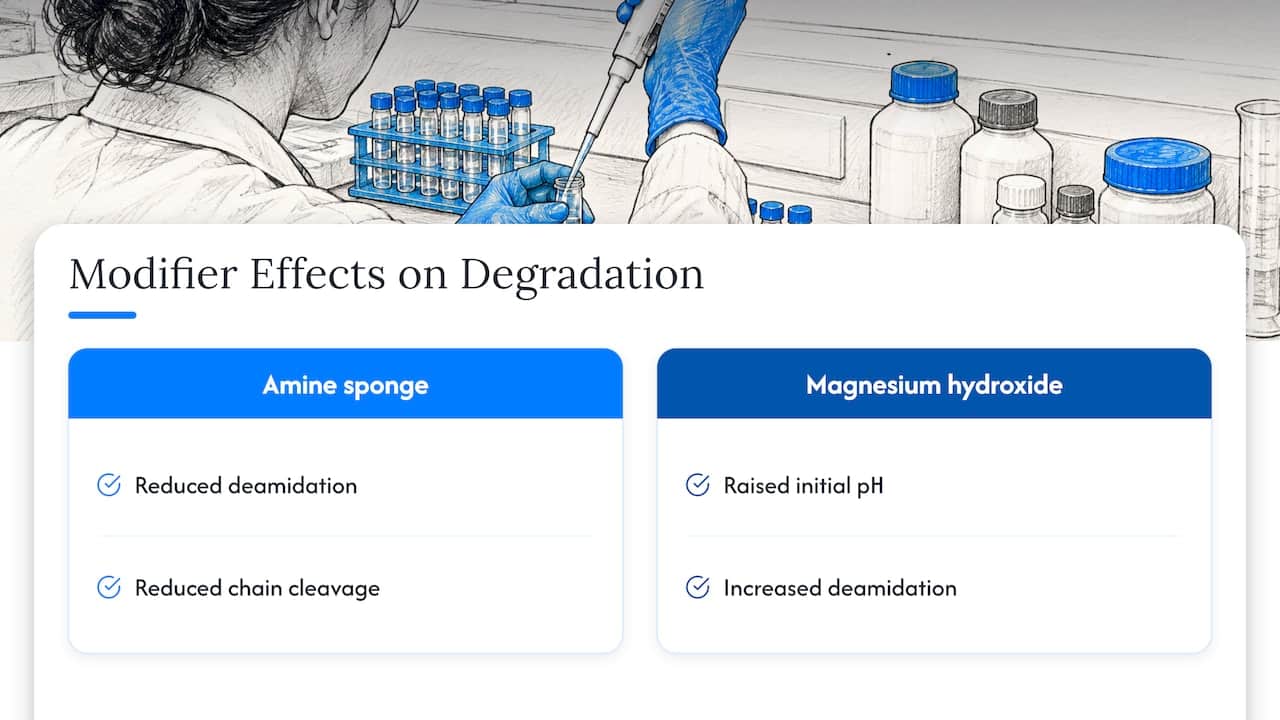
Adding a buffer or modifier to control pH is not automatically protective. A study of PLGA films under accelerated storage found that a basic amine proton sponge reduced peptide deamidation and chain cleavage compared with an unbuffered control. Magnesium hydroxide raised the initial pH but increased deamidation. The effectiveness of a pH modifier depended on both how it changes pH and which degradation reaction matters for the peptide.
So choose a buffer for a reason. Match it to the dominant degradation route of your sequence, keep its concentration as low as the experiment allows, and use reagents free of oxidizing contaminants.
A practical workflow for research labs
- Read the sequence. Flag methionine, cysteine, tryptophan, histidine and tyrosine (oxidation) and asparagine or glutamine (deamidation). Estimate the pI.
- Pick a starting pH range. Mildly acidic conditions are a common starting point for oxidation-prone sequences. Keep away from the pI to avoid precipitation.
- Dissolve carefully. Use the gentlest solvent that works and adjust pH gradually rather than pushing to an extreme.
- Keep solutions short-lived. Prepare only what the experiment needs and keep the rest as dry powder.
- Control the environment. Protect from light, limit freeze-thaw cycles and agitation, and avoid metal contamination.
- Verify, don’t assume. Track purity over time with reverse-phase liquid chromatography, and add size exclusion or light scattering when aggregation is possible.
The Benet study used exactly this kind of readout: reverse-phase chromatography to follow the parent peak and its oxidation and deamidation impurities. Our guide to peptide stability testing protocols goes through the ICH-style design in more detail.
Shelf-life claims and what they actually mean
A pH-stable window is not the same as a shelf life. A commonly quoted 28-day figure for reconstituted peptides is a sterility convention, not a chemical measurement, and we explain the difference in our peptide shelf life article. Likewise, shipping heat can stress powder before it reaches your bench, which we cover under summer shipping and cold chain shipping.
Our perspective
Stability starts before the vial reaches your bench. In our experience, labs lose more peptide to handling choices than to the molecule itself: the wrong solvent, a pH pushed too far, or a solution kept longer than the experiment needed.
That is why every lot we offer is third-party batch tested for purity and identity, with a Certificate of Analysis and endotoxin data. A clear CoA gives you the baseline you need to judge any later change. Without a baseline, you cannot tell whether a shifted peak came from the supplier or from your own buffer.
We ship fast and discreetly from our US facility, and our 24/7 support team can help you find the right documentation for a specific lot. Our products are sold for laboratory research use only, and we design our documentation to support that work.
Data Peptides
Where to source research peptides
If you are planning a stability study, start with material whose identity and purity are documented. Our research peptide catalog covers weight loss, muscle growth, recovery, anti-aging, libido and ancillary research supplies, each with batch testing and Certificates of Analysis. You can also read about our product quality standards before you order. All products are for laboratory research use only, not for human or animal consumption.
FAQ
What pH is best for peptide stability?
There is no universal answer. Published examples favor mildly acidic conditions for oxidation- and deamidation-prone peptides: exenatide was relatively stable at pH 4.5 and 5.5, and a methionine-containing analogue did best at pH 3.5 to 4.0. The right value for your peptide depends on its sequence and structure, so test it.
Why does my peptide precipitate when I adjust the pH?
Solubility is lowest at the isoelectric point, where net charge is zero. If your adjustment moves the solution toward the pI, the peptide can aggregate and fall out. Move the pH away from the pI, or change solvent, rather than forcing the peptide to dissolve at the pI.
Does freezing or lyophilizing remove pH problems?
It reduces them, but does not erase them. Dry powder stored at -20°C, protected from light, is relatively stable according to FDA guidance. However, lyophilization can concentrate buffer and change the effective pH of low-moisture solids, so the formulation still matters.
How do I know whether my peptide degraded or just aggregated?
Use analytical methods. Reverse-phase liquid chromatography tracks the parent peak and impurities such as oxidation or deamidation products, while size exclusion chromatography or dynamic light scattering detect aggregates. Aggregation can be reversible, whereas deamidation and oxidation are not.
Sources
- Designing formulation strategies for enhanced stability of therapeutic peptides (Nugrahadi et al., 2023)
- The effects of pH and excipients on exenatide stability (Benet et al., 2021)
- Physicochemical and formulation developability assessment of therapeutic peptide candidates (Bak et al., 2014)
- Factors affecting the physical stability (aggregation) of peptide therapeutics (Zapadka et al., 2017)
- Oxidant and antioxidant effects of gentisic acid in a 177Lu-labelled peptide (Trindade and Balter, 2020)
- The cystine knot is responsible for the exceptional stability of Hv1a (Herzig and King, 2015)
- FDA Guidance for Industry on synthetic peptide chemistry, manufacturing and controls
- Peptide stability in solids and solutions (Bell)
- Effect of excipients on PLGA film degradation and peptide stability (Houchin et al., 2006)