

Heavy metals testing for peptides measures trace elements, usually arsenic, cadmium, lead and mercury, in a specific lot, most often by ICP-MS. It does not measure identity or purity. Those need separate tests such as HPLC and mass spectrometry. A heavy metals line on a Certificate of Analysis (COA) is useful only when you can see the metals tested, the method, the reporting limit and the lot number it belongs to.
This guide is written for laboratory researchers and buyers who review documentation before a lot goes into an assay. Everything here concerns research use only, not human or animal consumption.
TL;DR
- The core metals are arsenic, cadmium, lead and mercury. USP says these must at minimum be considered when elemental impurities are assessed.
- ICP-MS is the quantitative method to look for. Screening tools such as X-ray fluorescence are far less sensitive.
- Heavy metals results say nothing about identity, purity, endotoxin or sterility. Each needs its own test.
- A result belongs to one lot. Match the lot number, method, units and reporting limit before you rely on it.
- Ask for a COA for every lot, not one sample document reused across shipments.
Table of Contents
- Why a peptide could contain heavy metals at all
- Which metals get tested
- How heavy metals are measured
- What heavy metals testing is not
- Limits, standards and where US guidance applies
- How to read a heavy metals result on a lot COA
- Does one tested vial prove every batch is clean?
- Our perspective
- Where to browse documented research peptides
- FAQ
- Sources
Why a peptide could contain heavy metals at all
Metals are not part of a peptide’s sequence. They arrive through the process around it. The FDA notes that trace metals can enter pharmaceutical protein products as leachables from container-closure systems, from buffer systems, and through reactions promoted by light, heat, agitation or freeze-thaw exposure. The agency also says metals can damage protein products through fragmentation and aggregation, so this is a quality question as well as a contamination one.
USP’s chapter on elemental impurities describes the same pattern from the manufacturing side. Elemental impurities can be catalysts or environmental contaminants. They may be naturally present, intentionally added, or introduced inadvertently through processing equipment and container-closure interactions.
For a synthetic peptide, that translates into a short list of places to look:
- Raw materials and reagents. Amino acid building blocks, solvents and cleavage reagents can carry trace metals.
- Catalysts. Some synthesis and purification steps use metal-containing catalysts.
- Equipment. Metal vessels, tubing and filters can shed ions.
- Packaging and handling. Vials, stoppers and repeated freeze-thaw cycles can add or mobilize metals.
This is why a quality-minded supplier tests the finished lot rather than assuming a clean process.
Which metals get tested
The four elements to expect are arsenic, cadmium, lead and mercury. USP states that these must at minimum be considered in the risk assessment and included in the target elements evaluation when testing is done.
Panels vary by laboratory. One US peptide-testing lab describes a commonly offered panel of arsenic, cadmium, chromium, mercury and lead, measured by ICP-MS. So a COA that lists those five is normal. A COA that says only “heavy metals: pass” is not informative, because you cannot tell which elements were measured.
| What to look for | Reasonable on a COA | Weak on a COA |
|---|---|---|
| Elements named | As, Cd, Pb, Hg at minimum | “Heavy metals: pass” |
| Method | ICP-MS (or ICP-OES with stated limits) | No method listed |
| Units | µg/g or ppm, with the sample basis stated | Unitless “conforms” |
| Reporting limit | Stated per element | Absent |
| Lot number | Matches the vial label | Generic or missing |
| Laboratory | Named, with a report date | Unsigned summary |
How heavy metals are measured
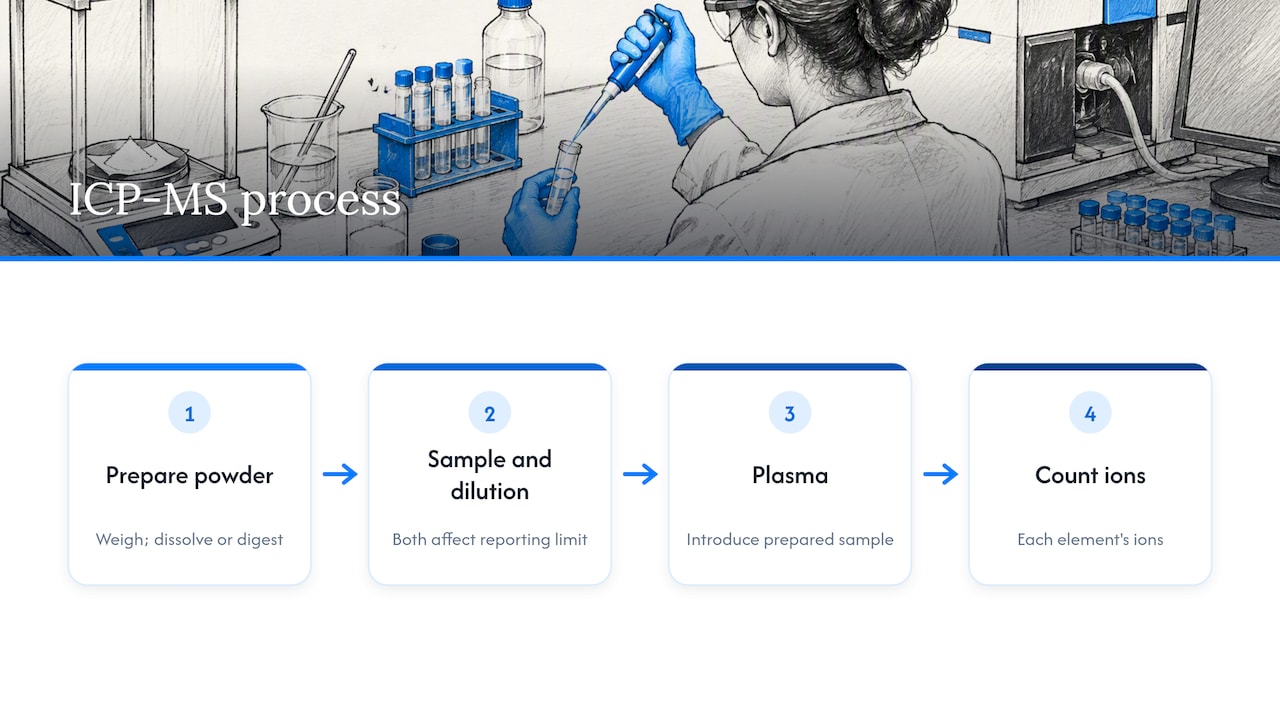
The usual quantitative method is inductively coupled plasma mass spectrometry (ICP-MS). The sample is prepared, introduced into a plasma, and the instrument counts each element’s ions. Sample preparation matters. USP’s procedures chapter explains that material not directly soluble in aqueous or organic solvents is digested using a closed-vessel procedure in strong acid, and that preparation depends on the material under test. A lyophilized peptide powder is typically weighed and dissolved or digested before analysis, so the amount of sample and the dilution both affect the reporting limit.
The same USP chapter sets system suitability requirements. One is checking instrument drift, which must not exceed 20% for each target element, so the result is reliable across the analytical run. You will rarely see drift data on a one-page COA, but a lab that works to this framework should provide it on request.
Screening versus quantitative testing
Some labs use handheld or benchtop X-ray fluorescence for quick screens. That can flag gross contamination but is not a substitute for ICP-MS when you need low-level numbers. If a COA lists XRF only, treat it as a screen and ask whether a quantitative result exists.
What heavy metals testing is not
This is where most misreadings happen. Heavy metals testing is an elemental assay. It does not tell you:
- Identity. Whether the molecule is the sequence you ordered. That needs mass spectrometry; see our guide to LC-MS for peptides.
- Purity. The percentage of the target peptide versus related peptide impurities. That is the job of HPLC, and the thresholds are covered in our piece on how researchers assess peptide impurities.
- Quantity. How much peptide is in the vial.
- Endotoxin or sterility. Separate assays entirely.
- Degradation over time. That belongs to peptide stability testing.
A lot can pass heavy metals and still be the wrong peptide or be degraded. The reverse is also true. Think of the COA as a set of independent checks, each answering one question.
Limits, standards and where US guidance applies
The regulatory frame most labs borrow from is USP General Chapters <232> and <233>. Chapter <232> defines the limits; <233> provides the official analytical procedures for evaluating elemental impurities in drug products. USP states that its limits apply to drug products containing purified proteins and polypeptides, including synthetically produced polypeptides.
Two cautions follow for research buyers:
- Those limits are written for finished drug products. Research peptides are not drug products, so a research COA that cites USP methods is borrowing a rigorous framework, not claiming drug approval. Read the claim as method quality, not regulatory status.
- Limits depend on context. USP’s limits are set per route of administration and daily dose. A concentration that is acceptable in one setting says little about another, which is why the units and sample basis on the COA matter more than a bare “pass”.
For analytical detail, the FDA’s laboratory documentation points analysts to the Elemental Analysis Manual for methods, sample preparation, digestion and data treatment. It is a good reference for how a method should be documented, even if your supplier uses a commercial lab’s own validated method.
How to read a heavy metals result on a lot COA
Use this sequence each time a COA arrives.
- Match the lot. The lot number on the COA must equal the number on the vial or packing slip. A report for a different lot, however clean, tells you nothing about yours.
- Confirm the laboratory and date. The report should name the testing lab and show when analysis was done relative to the lot’s manufacture.
- Check the element list. Arsenic, cadmium, lead and mercury should all be present. Extra elements are a bonus.
- Read the unit and basis. µg/g of peptide powder is different from a concentration in a reconstituted solution. If the basis is unclear, ask.
- Look at the reporting limit. “Not detected” means below the limit of detection. A high limit makes “not detected” less meaningful. Compare the limit with the limit you need for your assay.
- Confirm the method. ICP-MS with a digestion step is what you want to see.
- Cross-check the other tests. Identity, purity and endotoxin values should appear for the same lot.
A worked example
Imagine a COA that lists lot 24-017, with lead, arsenic, cadmium and mercury all reported as below a limit of 0.1 µg/g by ICP-MS, a named laboratory and a report date. The same lot has an HPLC purity figure and a mass-spec identity confirmation. That is a coherent record. Now imagine a COA with “heavy metals: pass”, no lot number and no lab name. The first lets you judge fitness for your assay. The second asks you to take it on faith. (These values are illustrative, not data from any real lot.)
Does one tested vial prove every batch is clean?
No. A result describes the sample that was tested from the lot that was tested. Lots differ because reagent batches, equipment, handling and packaging can differ. That is exactly why the sources of trace metals described above are process-related and not fixed properties of the peptide.
The practical rules:
- Require lot-specific COAs. Each new lot needs its own report.
- Keep records. File the COA with the lot number in your lab notebook or inventory system.
- Look for consistency. Several consecutive lots with similar reporting limits and results suggest a controlled process.
- Retest when it matters. If a metal-sensitive assay is central to your study, an independent check on an incoming lot is reasonable.
Our own checklist for incoming material is in Research Peptide Safety: 3 Checks Before a Lot Enters Your Assay.
Our perspective
We think a COA should answer questions, not close them. Heavy metals data is one layer in a documentation stack: identity, purity, endotoxin and elemental impurities, all tied to one lot number.
That is how we approach our catalog. Our products are third-party batch tested for purity and identity, and we provide Certificates of Analysis and endotoxin data for every lot. Our goal is that a researcher can open a document, see what was measured, and decide whether the lot suits the assay.
We also ship from our US facility and keep a support team available around the clock, so questions about a lot’s paperwork do not wait. We would rather you read the report critically than trust a badge. Details on how we think about domestic sourcing are in our overview of US made peptides.
Data Peptides
Where to browse documented research peptides
If you are comparing lots before an experiment, our research peptide shop lists categories including weight loss, muscle growth, recovery, anti-aging and libido research compounds, plus ancillary supplies. Every product is sold for laboratory research use only. For help matching a document to a lot, contact support before you order.
FAQ
Which heavy metals should a peptide COA list?
At minimum arsenic, cadmium, lead and mercury, the elements USP says must be considered in an elemental impurities assessment. Some labs add chromium to the panel. If the COA names no elements, you cannot tell what was actually tested.
Is ICP-MS required?
It is the quantitative method most labs use for trace elements, and it is what a US peptide-testing lab lists for its heavy metals panel. Screening methods like X-ray fluorescence are much less sensitive, so they are better treated as a first look than a final number.
Does a passing heavy metals result mean the peptide is pure?
No. It only covers the elements tested. Purity comes from HPLC, identity from mass spectrometry, and endotoxin from its own assay. You need all of them for the same lot.
Can I reuse one COA across several orders?
Only if the lot number is the same. A new lot is a new manufacturing event, and trace metals can enter through reagents, equipment or packaging that change between runs. Ask for the COA tied to the lot you receive.
Sources
- FDA: Trace metals and their impact on protein quality, safety and efficacy
- USP General Chapter <232> Elemental Impurities, Limits (USP 38, Second Supplement)
- USP General Chapter <232> Elemental Impurities, Limits (USP 39)
- USP General Chapter <233> Elemental Impurities, Procedures
- Vanguard Laboratory: Peptide testing
- FDA: QMS Standard Operating Procedure template (Elemental Analysis Manual reference)