
Sterile filtration pushes a peptide solution through a membrane with a pore rating of 0.2 or 0.22 µm to remove bacteria and particulate matter. It does not remove endotoxin, dissolved chemical impurities or viruses. It also cannot turn a casually prepared solution into a sterile pharmaceutical product. This guide covers what a filter accomplishes in a research laboratory, how filters are validated, where peptide loss and endotoxin fit in, and what to document. Everything here concerns laboratory research use only.
TL;DR
- A 0.22 µm sterilizing-grade filter removes viable microorganisms and particles. The FDA defines it by validated, reproducible microbial retention, not by pore size alone.
- Filtration is not a fix for endotoxin, chemical impurities or a contaminated starting material. Those are controlled by sourcing, testing and manufacturing processes.
- Membrane material and surface area can change how much peptide reaches the receiving vial, so run a pilot and verify concentration.
- A filter used at a lab bench does not make a solution equivalent to an aseptically manufactured, released drug product, and it does not make anything suitable for human use.
- Lot-specific documentation (COA, endotoxin data, your own filtration record) matters more than the filter step itself.
Table of Contents
- What sterile filtration actually does
- What a filter does not do
- Endotoxin: the question filters get asked most
- How sterilizing-grade filters are selected and validated
- Peptide loss on the membrane
- Dissolving first, filtering second
- Why a filter does not make a solution safe for people
- Documentation that carries more weight than the filter
- Looking for lab-grade material to work with?
- FAQ
- Sources
What sterile filtration actually does
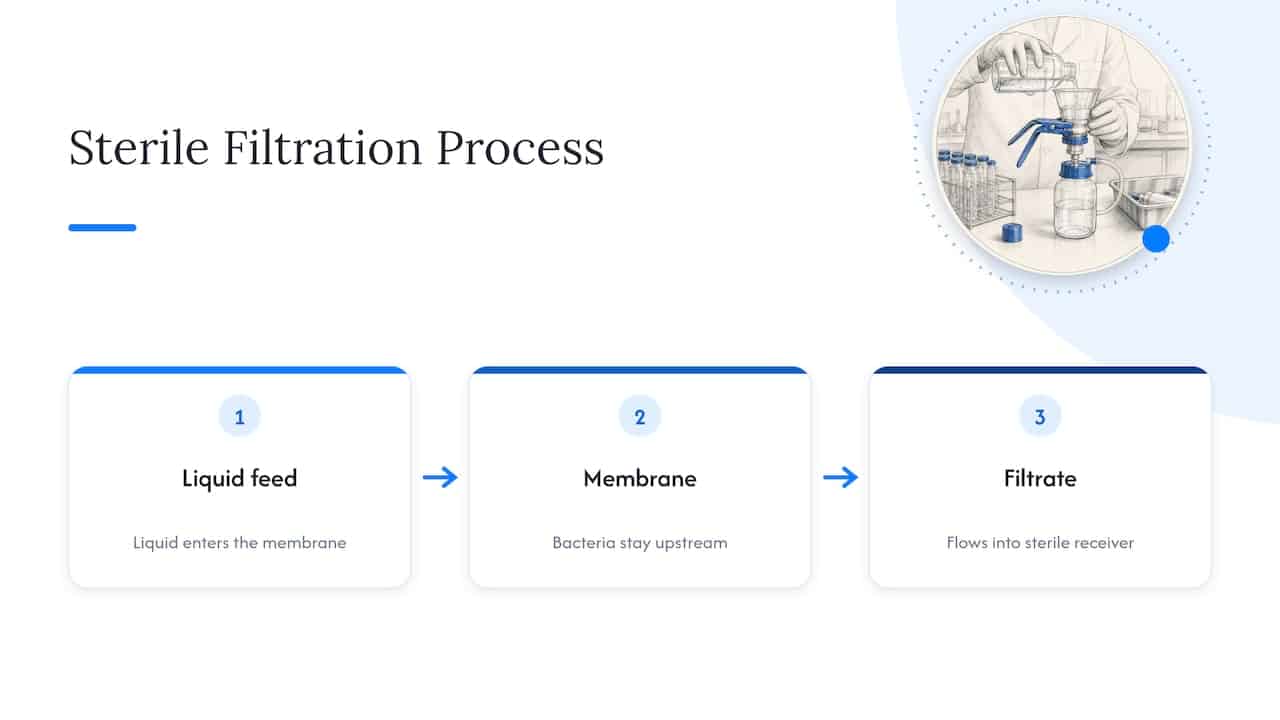
Sterile filtration is a particle-removal step. A liquid passes through a membrane whose pores are small enough to hold back bacteria. The filtrate goes into a sterile receiver, ideally inside a clean airflow environment, and the bacteria stay on the membrane.
The FDA’s guidance on sterile drug products produced by aseptic processing (September 2004) defines a sterilizing-grade filter as one validated to reproducibly remove viable microorganisms from a process stream and produce a sterile effluent. It typically refers to a pore size rating of 0.2 µm or smaller. Note the wording: the definition rests on validation, not on a number printed on a package.
The same expectation shows up in product labeling. The prescribing information for VYEPTI (revised October 2022), for example, calls for an infusion set with a 0.2 or 0.22 micron in-line or add-on sterile filter. That is a finished, regulated drug with a defined administration system. It tells you how routine 0.2 to 0.22 µm filtration is in regulated settings, and it says nothing about filtering research material at a bench.
Why researchers filter at all
In a research lab, the usual reasons are practical:
- Cell culture or in vitro assays where microbial growth would ruin a run.
- Clarifying a solution that carries undissolved particles after reconstitution.
- Reducing bioburden in a stock that will be aliquoted and stored for repeated use.
Each of these is about protecting an experiment, not about creating something safe to administer.
What a filter does not do
The limits matter as much as the function. A 0.22 µm membrane:
- Does not remove dissolved endotoxin. Endotoxins are bacterial lipopolysaccharides, and the FDA-referenced industry literature treats filtration as removing bacteria and particulate, not inherently dissolved endotoxin, viruses or soluble chemical impurities. Those need separate steps such as ultrafiltration or chromatography at manufacturing scale.
- Does not repair earlier contamination. If a vial was contaminated before filtration, the cells are caught but their debris and products may still pass.
- Does not correct purity problems. Truncated sequences, deletion peptides and residual solvents flow straight through. Purity is a synthesis, purification and analytical question, not a filtration one. Our guide to how researchers assess peptide impurities explains the reporting thresholds involved.
- Does not prove sterility by itself. Sterility is demonstrated through a validated process, controlled environment and testing, not by the existence of a filter step.
A clear liquid can look reassuring. Clarity says nothing about what is dissolved in it, which is why documentation and lot data have to carry the weight.
Endotoxin: the question filters get asked most
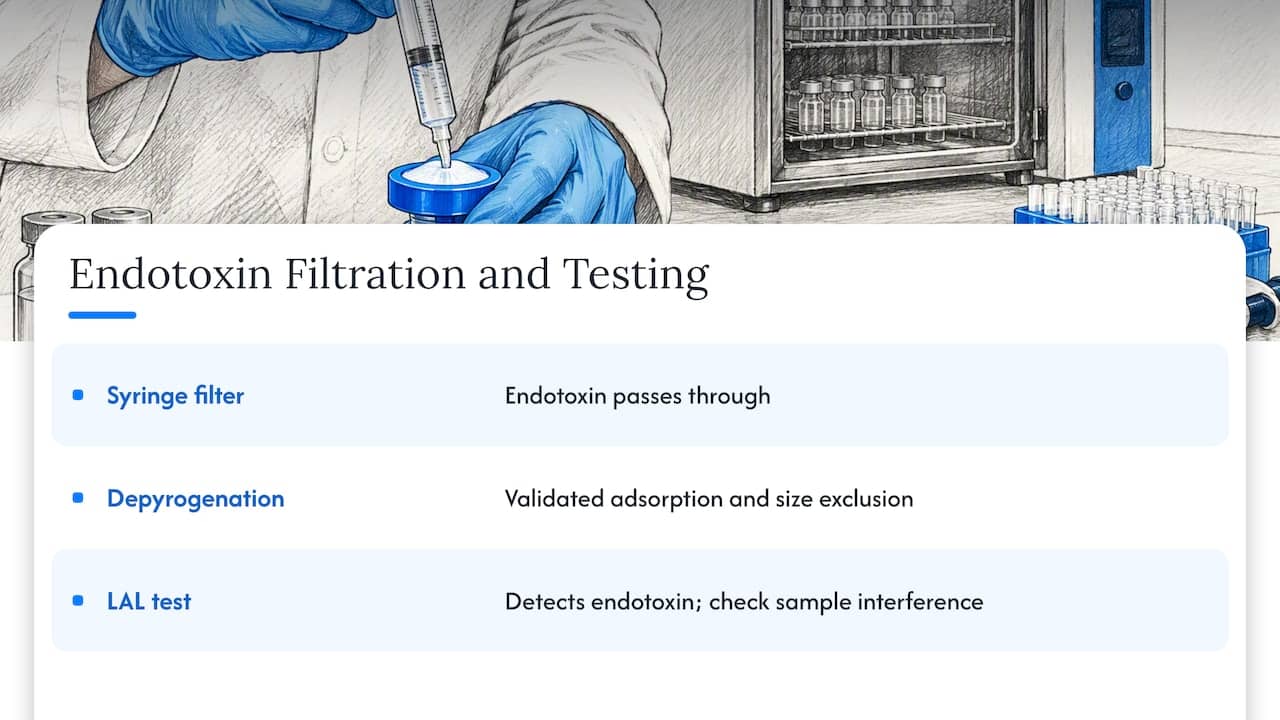
People often ask whether filtering removes endotoxins. For a standard 0.22 µm membrane used on a peptide solution, the answer is no. The pieces of bacterial cell wall that make up endotoxin are far smaller than the pores, so they pass through along with the peptide.
There is nuance. The USP chapter on depyrogenation by filtration describes physical removal of endotoxins from pharmaceutical solutions by adsorption and size exclusion. That refers to specifically designed depyrogenation filtration in pharmaceutical processing, evaluated and validated for a given product. It is not what happens when a syringe filter is attached to a vial at the bench.
The tool that actually measures endotoxin is a test. USP general chapter <85>, the Bacterial Endotoxins Test, uses Limulus Amebocyte Lysate (LAL) to detect or quantify bacterial endotoxins. It also requires you to show that the sample does not interfere with the reaction, which matters for peptides, since some sequences, salts or counterions can inhibit or enhance the assay.
That is why a lot-level endotoxin result belongs in the paperwork before filtration is even considered. If you want to know how to read one, see our guide to reading peptide endotoxin COAs. For teams building broader controls around endotoxin control and depyrogenation, this overview of endotoxin control and depyrogenation workflows may help frame the operational side.
How sterilizing-grade filters are selected and validated
A package that says 0.22 µm is not the same as a filter validated for sterilizing service. The FDA guidance describes the standard challenge: under ASTM F838-05, the filter must demonstrate complete retention of Brevundimonas diminuta (ATCC 19146) at a challenge of at least 10^7 colony-forming units per square centimeter of effective filtration area.
Three practical points follow for a lab:
- Look for the sterilizing-grade claim and individually wrapped, sterile units. A non-sterile filter placed on a sterile solution adds contamination risk of its own.
- Match the filter to the fluid. Validation is performed with a particular test fluid. Real process fluids can behave differently, and the same guidance on integrity testing points out that fluids can shift bubble-point behavior compared with a standard wetting fluid. Whatever you filter, you are working at the edge of what the manufacturer’s data covers, so keep that in mind.
- Treat pore size as a rating, not a promise of a sieve. Retention involves capture inside the membrane as well as simple sieving.
A short selection checklist
| Question | What to check |
|---|---|
| Is it sterilizing grade? | Manufacturer states validated bacterial retention at 0.2 or 0.22 µm |
| Is the unit sterile? | Individually wrapped, with an intact package and a lot number |
| Is the membrane compatible? | Chemical compatibility with your solvent (water, buffer, dilute acid, organic cosolvent) |
| Is peptide loss acceptable? | Low-binding membrane type and a pilot recovery check |
| Is the size right? | Membrane diameter matched to your volume, to avoid excess hold-up |
Peptide loss on the membrane
Peptides stick to surfaces. Depending on sequence, charge, hydrophobicity and concentration, a measurable fraction can adsorb to a membrane, and the effect is generally worst for dilute solutions. Membrane chemistry matters, and low-protein-binding hydrophilic membranes such as PES or PVDF are the usual first choices for peptide work, while nylon and cellulose-based membranes are commonly more adsorptive. Because the evidence for specific loss figures is thin, do not rely on a general number. Measure it.
A simple pilot looks like this:
- Prepare a small test solution at the concentration you will actually use.
- Take a pre-filtration sample.
- Filter through the candidate membrane, discarding the first fraction if your protocol allows.
- Take a post-filtration sample.
- Compare the two by your analytical method, such as HPLC, and record the recovery.
If recovery is low, try a different membrane, a larger-surface unit, or a higher working concentration. Record the choice either way.
Dissolving first, filtering second
Filtration cannot rescue a poorly dissolved peptide. If particles are still there because the peptide never fully went into solution, the membrane will simply clog or strip out the very material you want. Work out solvent and solubility before the filter enters the process. Our guides on how to dissolve peptides in the lab and on a six-step SOP for matching sequence features to peptide solvents cover that stage.
Once the solution is clear, a typical research workflow goes like this:
- Work in a clean, controlled space with sterile consumables and appropriate PPE.
- Use sterile, high-quality solvent appropriate for your assay.
- Confirm complete dissolution visually and, where relevant, analytically.
- Attach a new, individually wrapped sterile filter and pass the solution slowly and steadily, without forcing it, since excess pressure can compromise a membrane.
- Collect into a sterile receiver, label it with date, lot, concentration and the filter lot.
- Store according to your protocol and record the conditions.
Storage is its own variable. Cold temperatures protect chemical stability, but they do not sterilize anything, and the difference is explained in our piece on peptide storage temperature, chemical stability versus sterility. For longer-running studies, see our notes on peptide stability testing under ICH-style protocols.
Why a filter does not make a solution safe for people
This is the point most often misread. A syringe filter used on an informally prepared peptide solution does not make that solution sterile in the sense the FDA means, and it does not make it safe for human use. Here is why.
- Sterility is a system property. The FDA’s guidance on aseptic processing covers facility design, equipment suitability, process validation and quality control, all under the current good manufacturing practice regulations in 21 CFR parts 210 and 211. A filter is one component of that system.
- Filtration does not address endotoxin, chemistry or identity. A solution can pass through a perfect filter and still carry endotoxin, wrong-sequence impurities or the wrong substance entirely.
- There is no release testing. Manufactured sterile products are tested and released against specifications. A bench-filtered solution has none of that behind it.
For that reason, the products we sell are for laboratory research use only. They are not for human or animal consumption, injection or medical treatment. Anyone with a medical question should talk to a licensed clinician, and anyone who wants a medicine should get one that is prescribed and dispensed through regulated channels.
Documentation that carries more weight than the filter
In research, reproducibility depends on records. When you filter, write down:
- Peptide name, lot number and COA reference
- Endotoxin result for the lot, and the method used
- Solvent and its lot
- Filter manufacturer, membrane type, pore size, diameter and lot
- Starting and final concentration, with the method used to confirm
- Date, operator, environment and storage conditions
Our Certificate of Analysis page shows what we publish per batch, and the laboratory standards guide goes through good practice for handling and records.
Our perspective
We sell peptides to laboratories, so we see the same misunderstanding repeatedly: people treat the filter as the quality step. In our view, quality is decided much earlier, at synthesis, purification and batch testing.
That is why we put third-party batch testing for purity and identity, Certificates of Analysis and endotoxin data for every lot at the center of what we do. Our approach is designed so that a researcher can see what is in a lot before it ever reaches a bench, and then use filtration for what it is good at: protecting an experiment from microbes and particles.
We also keep our support team available around the clock, so a question about a COA or handling can be answered before a run is wasted. Everything we ship is for laboratory research use only.
Data Peptides
Looking for lab-grade material to work with?
If you are setting up a study, start from documented material. Browse our research peptide catalog to see each category, including recovery peptides for research, with lot-specific COAs and endotoxin data, fast discreet US shipping and 24/7 support. All products are for laboratory research use only.
FAQ
Does filtering peptides remove endotoxins?
No. A standard 0.22 µm membrane removes bacteria and particles, but endotoxin fragments are much smaller than the pores and pass through. Endotoxin is measured with a test such as the LAL assay described in USP <85> and is controlled upstream, at manufacturing.
Is 0.22 µm the right pore size for peptides?
For sterilizing-grade filtration, 0.2 or 0.22 µm is the standard rating, and the FDA’s definition rests on validated bacterial retention. The more important choice for peptides is membrane material, because some membranes bind peptide more than others. A pilot recovery check will tell you what your sequence does.
Can I use a sterile filter instead of buying sterile product?
No. A filter at the bench does not replicate aseptic manufacturing, release testing or validated controls, and it does not make any material suitable for human use. Our products are sold for laboratory research only, and filtering is simply one step in protecting an assay.
Should I filter before or after dissolving?
After. Make sure the peptide is fully dissolved first, since undissolved material will clog the membrane or be removed from the solution. Then filter through a new, individually wrapped sterile unit and record the filter lot.
Sources
- FDA Guidance for Industry: Sterile Drug Products Produced by Aseptic Processing, Current Good Manufacturing Practice (September 2004)
- VYEPTI prescribing information (revised October 2022)
- USP 1228.3 Depyrogenation by Filtration
- USP 85 Bacterial Endotoxins Test (USP 32, 2009)
- Endotoxin control and depyrogenation workflows