
In a laboratory, a peptide dose is a number you choose, justify and record: a concentration in a cell assay, or a mg/kg amount in an approved animal protocol. It is not a recommendation for a person. Research-use-only peptides have no approved human dose, so the useful skill is knowing how to find credible dose figures, read them in context, do the math correctly and document everything. This guide covers that workflow.
TL;DR
- A research dose is defined by the model, route, vehicle, compound form and endpoint of the study you are reading or designing. A figure copied without that context is not a protocol.
- Research-use-only labels do not change how the FDA views a product when the seller’s claims point to human use, so keep every dose discussion inside laboratory work.
- Pull dose figures from the original paper or a regulatory document, not from a chart on a vendor page or forum.
- A certificate of analysis supports your dose math only if you verify it. Purity and identity decide whether a stated mass is the mass you are actually working with.
Table of Contents
- What “dosing” means when the work is research
- No approved human dose exists for research-use-only peptides
- Where to find dose figures you can trust
- What to check before you reuse a dose from a paper
- Why peptide doses differ across compounds, models and routes
- Can animal or lab doses be scaled to people?
- What nonclinical safety work asks for
- Planning a dose-response design
- What a certificate of analysis proves, and what it does not
- The U.S. regulatory line
- Our perspective on research dosing
- Browse lab-grade research peptides
- FAQ
- Sources
What “dosing” means when the work is research
Search results for this topic are full of dosing charts with milligram ranges and weekly schedules. Those charts blur two very different things: the dose a researcher applies to a defined experimental system, and the dose of a medicine prescribed to a patient. They are not interchangeable.
In a research setting, a dose belongs to an experimental design. It might be a concentration in a culture well, an exposure in a rodent study approved by an institutional animal care committee, or a planned step in a regulated clinical program. Each carries its own controls, endpoints and oversight. The number only means something together with those details.
The regulatory view matters here too. In a December 2024 warning letter, the FDA said that a research-only label does not control the outcome when a seller’s claims show intended human use. The agency treated the products in that letter as unapproved new drugs. For you, the practical lesson is simple. Keep your protocols, notes and any public writing about doses framed around laboratory systems, and do not describe personal use.
No approved human dose exists for research-use-only peptides
Approved peptide medicines show what a real human dose looks like. The label for the peptide drug GATTEX (teduglutide) specifies 0.05 mg/kg subcutaneously once daily, with 0.025 mg/kg once daily for specified renal impairment, plus preparation, administration and safety-monitoring instructions. That level of specificity comes from a full development program, with a defined patient population, a dose adjusted for kidney function and monitoring built in.
A research-grade vial has none of that behind it. No label, no indication, no renal adjustment and no monitoring plan. The American Medical Association reported on April 29, 2026 that newer injectable peptides often lack substantial human evidence, standardized research and reliable information on dosing frequency, manufacturing safety and long-term effects. Anyone with a question about a peptide and their own health should talk to a licensed physician, not a product page.
Where to find dose figures you can trust
The best dose figure is the one you traced to the original methods section. A workable verification path looks like this:
- Search PubMed for the compound name plus the model you care about (for example, a cell line or a rodent strain). PubMed lets you locate papers and open the original methods, which is where the dose is defined.
- Check ClinicalTrials.gov if human studies exist. Records show the study design, the intervention, the dose form and route, the outcomes and, when posted, adverse-event data. They also show whether a trial was planned, ongoing, completed or stopped.
- Read regulatory documents for how doses are justified. FDA and ICH guidance explain what regulators expect from nonclinical work.
- Confirm the figure on a primary page. If a number appears on a blog, a calculator site or a vendor chart, treat it as a lead to check, never as the source.
Online summaries of research databases can help you learn the tools, but the numbers you carry into a protocol should come from the paper itself.
What to check before you reuse a dose from a paper
When you find a dose, extract the full context into your notes. A short checklist:
- Species, strain, age and sex of the model, or the cell type and passage number.
- Route and vehicle: what the peptide was dissolved in, the pH, any carrier or preservative.
- Unit basis: total mass per animal, mg/kg, molar concentration, or micrograms per well. Many mistakes come from mixing these.
- Compound form: salt form, counter-ion, amidated or free acid, modified or native. Content of actual peptide per milligram of powder can differ. Our note on amidated peptides versus free acid explains how a C-terminal change alters the molecule you are measuring.
- Schedule and duration: single exposure, repeated dosing, washout periods.
- Endpoint and timing: what was measured and when relative to the dose.
- Controls: vehicle-only, scrambled sequence, positive control.
- Reported variability: standard deviation, group size, whether results replicated.
If a paper omits several of these, the dose is not reproducible from that paper alone, and you should say so in your own methods.
Why peptide doses differ across compounds, models and routes
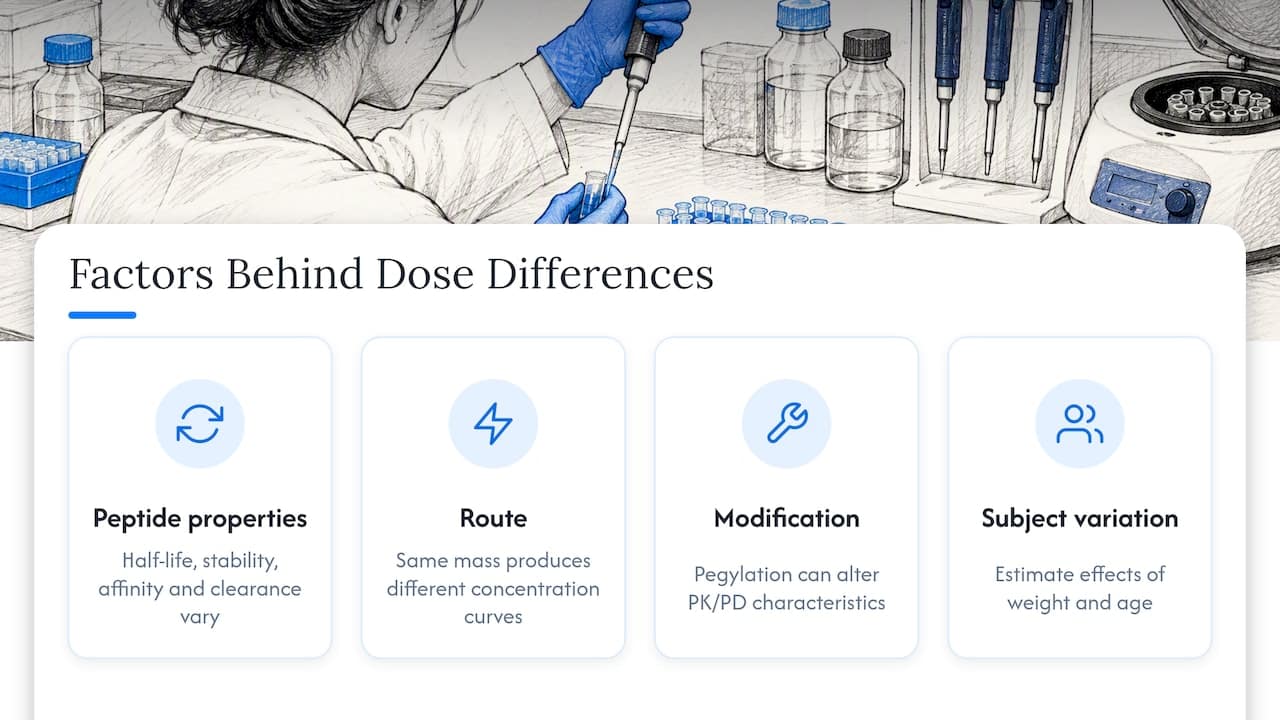
Two peptides of similar length can behave very differently. Half-life, stability in serum, receptor affinity, and clearance route all vary. Route changes exposure as well: the same mass delivered into a culture medium, under the skin, or into a vein produces different concentration curves.
Modification is another variable. The European Medicines Agency’s guideline on therapeutic proteins notes that chemical modification such as pegylation can alter pharmacokinetics and produce isoforms with different PK/PD characteristics. The same guideline says clinical programs should estimate inter-subject variability, including effects of weight and age, and consider individualized dosing when needed. In plain terms, one average dose rarely fits every subject, and a modified molecule needs its own characterization.
This is why a study on a native sequence cannot simply be applied to its modified relative. Our article on PEG-MGF research walks through exactly this problem: native-form studies do not test the pegylated form. The same caution applies to compounds such as Humanin, TA1 and Peptide T, where each paper’s model and form should be read on its own terms. For a decapeptide analog, the triptorelin protocol and assay timing guide shows how timing of sampling shapes what a dose appears to do.
Can animal or lab doses be scaled to people?
This is the question behind many dosing searches, and the careful answer is that scaling exists as a regulatory tool, not a shortcut for individuals. A published practice guide on dose conversion explains that animal NOAELs can inform preliminary human-dose estimates, but allometric scaling gives only an empirical, approximate starting dose, and the first-in-human estimate includes a safety factor. The FDA’s approach for the maximum recommended starting dose in clinical trials uses the dose-by-factor method, which estimates a human-equivalent dose from preclinical NOAELs by allometry.
Three points follow:
- The method is built for sponsors running regulated first-in-human trials, with toxicology packages and an IND behind them. Under 21 CFR part 312, clinical investigations that administer a drug to human subjects generally must be conducted under an IND, with certain exceptions.
- The output is a starting point with a safety factor built in, not a target.
- Peptides add complications: species differences in receptors and degradation enzymes can make the conversion less reliable than for small molecules.
If your work is in vitro or in approved animal models, you do not need human-equivalent math at all. Use the published model-specific doses and justify any deviation.
What nonclinical safety work asks for
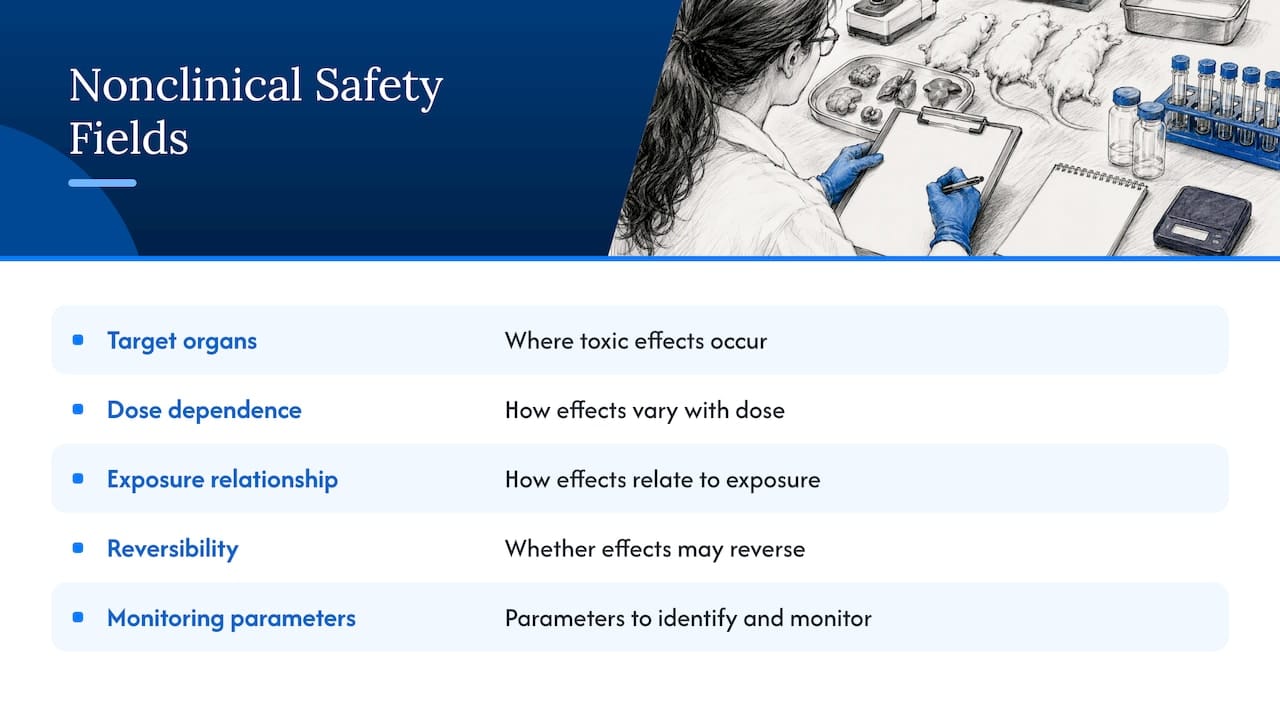
Regulators describe what a good dose justification contains. The ICH M3(R2) guidance says nonclinical safety assessments should characterize toxic effects, including target organs, dose dependence, exposure relationship and potential reversibility. That information helps estimate a safe starting dose and identify monitoring parameters. Repeated-dose toxicity studies are among the studies that support safe exposure in human clinical trials.
A useful example of how a NOAEL is reported: a 90-day repeated oral-dose study of a collagen peptide in rats found a NOAEL of 2000 mg/kg/day for both sexes under the study conditions. Notice the phrase “under the study conditions.” That is a food-type collagen hydrolysate given by mouth. It says nothing about an injected signaling peptide. Always attach the compound, route and model to a NOAEL before you quote it.
There is also a gap worth knowing. A review of peptide development noted a lack of specific regulatory guidance for peptides, with the industry relying mainly on small-molecule ICH M3(R2) and biologic ICH S6(R1) guidance. That is another reason to document your reasoning in detail: no single rulebook fills in your choices.
Planning a dose-response design
When no published dose fits your system, build the range yourself and keep it defensible.
- Start from the closest published model and record every difference in yours.
- Use a spaced range, such as half-log steps, rather than two or three arbitrary points. A range lets you see a curve instead of a coincidence.
- Include vehicle controls matched for pH, buffer and any preservative.
- Pilot first with small group sizes before committing materials, with oversight approval where animals are involved.
- Decide your endpoints and timing before you dose, and write them down.
- Record lot number, certificate of analysis and storage history for every batch used.
Reconstitution math, worked through
Most dosing errors in the lab are arithmetic and unit errors, not scientific ones. The formula is simple: concentration equals mass divided by volume.
- A 5 mg vial reconstituted with 2 mL of diluent gives 2.5 mg/mL.
- If your protocol needs 0.5 mg per aliquot, you draw 0.2 mL (0.5 mg divided by 2.5 mg/mL).
- For a molar concentration, divide mass concentration by molecular weight. A 2.5 mg/mL solution of a peptide with a molecular weight of 1,000 g/mol is 2.5 mM.
- Check whether your calculation should use net peptide content rather than gross powder weight, since salts and residual water are part of the vial mass.
The diluent itself deserves attention. Sterility, pH and preservative choice affect stability and contamination risk, so it helps to review guidance on preparing safe research solutions before you make stock solutions. Log the date, volume, diluent lot and storage conditions on the vial and in your notebook, and discard according to your lab’s stability data rather than habit.
What a certificate of analysis proves, and what it does not
Your dose is only as accurate as the material behind it. A certificate of analysis (COA) typically reports purity by HPLC and identity by mass spectrometry for a specific lot. That tells you the batch was tested and what the test found.
It does not replace your own checks. In a 2024 warning letter, the FDA said that manufacturers cannot rely on supplier COAs alone: they must establish the reliability of supplier test results and conduct at least one specific identity test on each incoming component lot. The context there is drug manufacturing, but the logic carries into good lab practice: confirm the lot on the COA matches the lot on the vial, check the date and the method, and run an identity check when the result matters.
A practical COA review:
- Lot number matches the vial.
- Purity method and wavelength are stated.
- Mass spec result matches the expected molecular weight.
- Endotoxin data is included when you work with cells or animals.
- Testing was done by an independent laboratory, with its name and date shown.
For a longer walk-through, see our four COA checks and assay tier guidance and the list of what researchers should verify first for recovery-related compounds.
The U.S. regulatory line
Two regulatory facts frame all of this. First, the FDA’s 2023 draft guidance defines a peptide, in the drug-development context, as a polymer of 40 or fewer amino acids, and says a peptide meeting the statutory definition of a drug is regulated under the Federal Food, Drug, and Cosmetic Act. A new drug generally needs FDA approval before interstate marketing. Second, the 2024 warning letter cited above found the listed products were drugs under section 201(g)(1) because they were intended to affect the structure or function of the body, among other intended uses.
So claims and intent matter. For laboratory buyers, that means purchasing for documented research, keeping records, and not repurposing material for people or animals outside an approved protocol. Our guide to peptide legality for research in the U.S. covers the details. If you compete or work with athletes, our checklist for peptides banned in sports explains the compliance side.
Our perspective on research dosing
Most dosing confusion starts when a number is separated from its study. A figure like “5 mg” means nothing until you know the model, the route, the vehicle and the endpoint. We would rather see a researcher spend an hour tracing one dose to its methods section than copy ten from a chart.
That is why we focus on documentation. Every lot we supply is third-party batch tested for purity and identity, with a Certificate of Analysis and endotoxin data, because your dose calculations depend on knowing what is in the vial. Our materials are for laboratory research use only, and we say so plainly.
Our approach is to give you clean material, clear paperwork and fast, discreet U.S. shipping, with support available 24/7 when a question comes up about a lot or a document. The experimental design stays yours, and we think it should be built on primary literature.
Data Peptides
Browse lab-grade research peptides
If you have a protocol and need documented material, our research peptide catalog covers weight loss, muscle growth, recovery, anti-aging, libido and ancillary categories. Each lot ships with a COA and is sold for laboratory research use only. You can also go straight to recovery peptides for research or muscle growth peptides for research.
FAQ
Is there a standard dose for a research peptide?
No. A dose is tied to a specific model, route, vehicle and endpoint, so there is no universal number. Check the original paper for the system closest to yours, and justify any change in your methods.
Can I use a published animal dose for a person?
No. Allometric scaling is a regulatory method for estimating a starting dose in sponsor-run clinical trials, and it carries a safety factor and requires toxicology data. Research-use-only peptides have no approved human dose, and human studies generally need an IND.
Where should I look for dose information?
Start with PubMed for the original papers and ClinicalTrials.gov for human study records, then read the methods section for route, units and vehicle. Use regulatory guidance for how doses are justified. Treat charts on websites as leads to verify.
Does a COA guarantee my vial matches the label?
It documents what testing found for a lot, but you still need to confirm the lot number matches and, for important work, run an identity check. The FDA has said that relying on supplier COAs alone is not enough in manufacturing, and the same caution is sensible in the lab.
What is the most common dosing mistake in the lab?
Unit confusion is the usual culprit: mixing total mass, mg/kg and molar concentration, or using gross powder weight instead of net peptide content. Write out the calculation, check it with a colleague, and record the final concentration on the vial.
Sources
- Xcel Research LLC warning letter, FDA, December 10, 2024
- GATTEX (teduglutide) label, FDA, 2024
- What doctors want patients to know about injectable peptides, American Medical Association
- Guideline on the clinical investigation of the pharmacokinetics of therapeutic proteins, EMA
- A simple practice guide for dose conversion between animals and human
- Investigational New Drug Applications: determining whether human research studies can be conducted without an IND, FDA
- M3(R2) Nonclinical safety studies, FDA
- Non-clinical studies in the process of new drug development
- Toxicity of a 90-day repeated oral dose of a collagen peptide
- Development of peptide therapeutics: a nonclinical safety perspective
- Genuine Virgin Aloe Corp warning letter, FDA, 2024
- Clinical pharmacology considerations for peptide drug products, FDA draft guidance, December 2023