

Discreet peptide packaging means two things. The first is a shipment that arrives in a plain, unremarkable outer package. The second is a storage setup, such as a hard-shell vial case, that keeps vials organized and out of sight once they are in your lab or refrigerator. Neither one changes what is inside the vial, and neither one says anything about whether a product is approved or safe for people. This guide covers both meanings, how to choose a case, how to handle vials in a shared fridge, and what to do after a temperature excursion.
Everything here is written for laboratory research use. The peptides we sell are for research only, not for human or animal consumption.
TL;DR
- Discreet packaging covers the shipment (a plain outer shipper) and the storage (an opaque, hard-shell case). It is about privacy and protection, not quality.
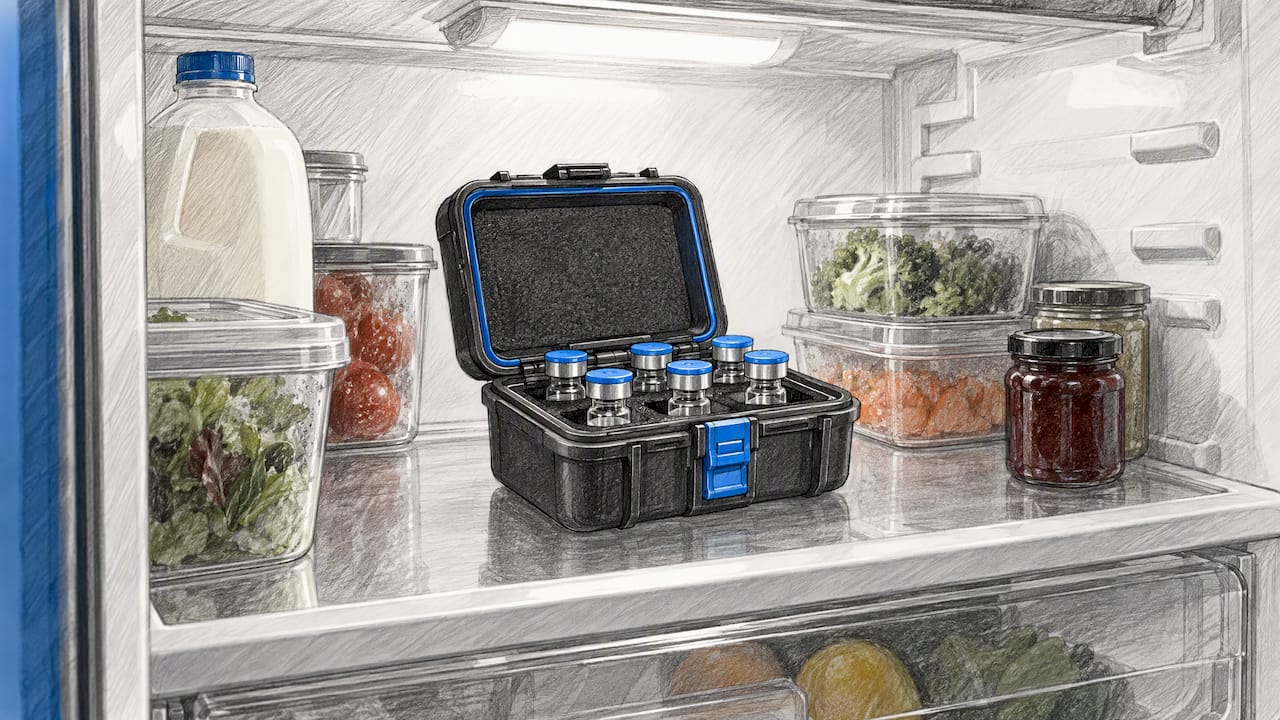
- A good vial case is rigid, has vial-sized pockets, closes with a mechanical latch and fits your refrigerator shelf. It organizes and protects vials but does not cool them.
- Label every container in a shared refrigerator, keep food and drink out of lab storage, and keep the case on a middle shelf away from the door.
- Packaging never proves a peptide is approved, clinically proven or safe for human use. Judge a product by its Certificate of Analysis and batch testing.
- If a vial leaves its labeled temperature range, document the excursion before deciding what to do with it.
Table of Contents
- What discreet peptide packaging actually covers
- Why labs and researchers want it
- How to choose a discreet vial case
- Where to put the case in the refrigerator
- Labeling and handling in a shared refrigerator
- After a temperature excursion
- What plain packaging does not prove
- Our perspective
- Stocking your bench
- A quick checklist for receiving a shipment
- FAQ
- Sources
What discreet peptide packaging actually covers
Peptide packaging is a stack of layers, not a single box. One buyer’s guide lists a primary container, a secondary carton and insert, an insulated mailer, a tamper-evident seal and an outer shipper as the parts that can make up a shipment. “Discreet” usually refers to the outermost layer: a shipper that does not announce its contents.
The inside layer is more standardized. Most research peptides ship as freeze-dried powder in a small glass vial, closed with a rubber stopper, a crimped aluminum seal and a flip-off cap. Amber glass is used when a product is light-sensitive.
That gives you a useful way to think about the topic:
| Layer | What it does | Where discretion matters |
|---|---|---|
| Outer shipper | Carries the package through the mail | Plain exterior, no product descriptions |
| Insulation or insert | Cushions vials and buffers temperature | Not visible to anyone handling the box |
| Secondary carton | Holds and identifies the vial | Inside the box, for your records |
| Primary vial | Contains the lyophilized peptide | Sealed, labeled for lot traceability |
| Storage case | Organizes vials after arrival | Opaque shell that looks like any small case |
We ship orders fast and discreetly from our U.S. facility, and our team is on hand around the clock if a shipment raises a question. Discreet shipping is a service detail. The proof of quality sits elsewhere, in third-party batch testing, Certificates of Analysis and endotoxin data for every lot.
Why labs and researchers want it
The reasons are practical more often than secretive.
- Shared spaces. Core facilities, university labs and small research groups often share refrigerators and benches. A compact case keeps one project’s vials separate from another’s.
- Loss prevention. Small vials roll, knock together and break. A fitted case prevents that.
- Light protection. An opaque case reduces light exposure between uses.
- Tidy records. Vials kept in labeled pockets are easier to inventory by lot.
- Privacy. Some researchers, including independent and hobbyist researchers working at home, simply prefer that a package or a refrigerator shelf does not advertise what it holds.
If you also plan around heat in transit, our guide to shipping peptides in summer and the overview of cold chain shipping for peptides cover the temperature side of the journey.
How to choose a discreet vial case
Search results for this topic are mostly storage cases: hard-shell boxes, 6-slot and 12-slot organizers, travel cases and 3D-printed grids. They differ in details, so use criteria rather than looks. One buyer’s guide recommends checking for a rigid hard shell, vial-sized pockets, an opaque design, a mechanical latch and materials that handle cold and condensation, and making sure the case fits your refrigerator shelf.
Size and fit
Match the pockets to the vial. Many research vials are small, from 1 ml to 3 ml, and a pocket that is too loose lets the vial tilt or tap against its neighbor. Measure the shelf you plan to use before you buy, including the height of the lid when closed. A case that only fits on the door shelf defeats its purpose, since the door is the least stable spot in the refrigerator.
Closure
A mechanical latch beats a friction lid. In a refrigerator, a lid that pops open when you reach past it can drop vials on the floor. Hinged lids with a positive click are the safer choice.
Material
Plastics get brittle at low temperatures, and cold surfaces collect condensation when you take them into a warm room. Look for a shell that stays tough in the cold and inserts that do not absorb moisture. Foam inserts should be fitted to the vial so it stays upright.
Opacity
An opaque shell serves two purposes at once: privacy and light protection. A clear case may be convenient for counting vials but gives up both.
Temperature suitability
This is the point most buyers miss. A case is not a cooler. One manufacturer states plainly that its case protects and organizes vials but does not keep them cold, and recommends using it inside a refrigerator for cold storage or pairing it with a cooler for travel. The same is true of nearly every hard-shell organizer. If you need to move vials cold, plan the cold source separately.
Where to put the case in the refrigerator
When a label says to refrigerate, the steadiest spot in most refrigerators is a middle shelf toward the back, away from the door. Door shelves swing through the biggest temperature changes every time someone opens the refrigerator.
A few habits make the setup work:
- Keep vials upright, one per pocket, so the stopper stays on top and the contents stay clear of it.
- Put the case in the same place every time, so anyone using the refrigerator knows where it is and nobody shifts it.
- Let a vial come to the temperature the protocol specifies before opening it, so condensation does not form on the stopper.
- Reseal promptly. Guidance from a UK national biological standards laboratory notes that glass and plastic vials are generally satisfactory, and that a vial should be resealed, preferably under dry inert gas, and returned to cold storage.
Lyophilized powder is the most stable form a peptide takes, so keeping it cold, dry and dark is the core of good storage. Our guides on keeping lyophilized peptides cold and dry and on peptide storage temperature go through the chemistry in more depth, and peptide shelf life explains why timelines after reconstitution are about sterility rather than chemistry.
Labeling and handling in a shared refrigerator
Discretion should never come at the cost of clear identification. In a shared lab, an unmarked case is a hazard to everyone. CDC onboarding material for laboratory staff tells workers to maintain good housekeeping, follow safety SOPs, label all containers and keep food and drinks out of the laboratory.
In practice, that means:
- Put a label on the outside of the case with the owner, project and a contact. A neutral code is fine if your facility’s inventory system maps it to contents.
- Label each vial with the product, lot number and date received. The lot number links the vial back to its Certificate of Analysis.
- Never store a research vial in a refrigerator that also holds food or drink.
- Keep a one-page log by the refrigerator or in your records: what is in the case, when it arrived and when it was opened.
Opaque and unlabeled are different things. A case can look plain from the outside and still be fully identified by a label that your lab’s own procedures require.
After a temperature excursion
Things go wrong: a refrigerator is left ajar, a package sits on a porch, a power outage runs overnight. Do not guess and do not simply discard or keep everything. The U.S. Pharmacopeia’s supply chain guidance says to document each excursion and assess it using the exposure temperature and duration and available stability data, then base the disposition of the product on that assessment.
A simple workflow:
- Note the product, lot, the temperature reached and for how long.
- Check the labeled storage range and any stability information that came with the lot.
- Record your decision and the reason.
- Contact us with the lot number if you have questions about a shipment. Support is available 24/7.
For research-grade lyophilized material, a short, mild excursion is a different situation from several days in heat, which is why the record of duration and temperature matters.
What plain packaging does not prove
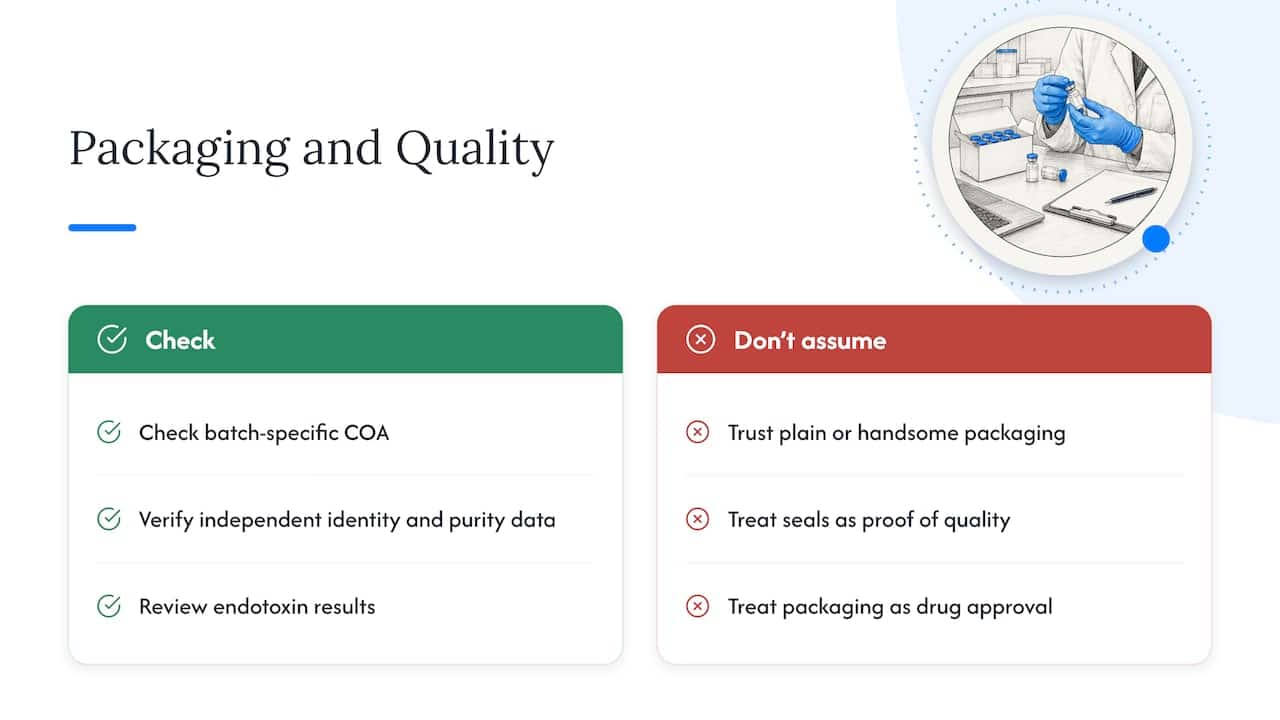
A plain box says nothing about what is in the vial. Neither does a handsome case, a tamper seal or an official-looking label. Quality is shown by documents: a batch-specific Certificate of Analysis, identity and purity data from an independent lab, and endotoxin results. Every lot we sell is third-party batch tested for purity and identity and comes with a Certificate of Analysis and endotoxin data. Our research peptides playbook shows what to check on a COA.
There is also a regulatory point. The FDA states that, with rare exceptions, new human drugs and biological products must be approved before they are marketed, offered for sale or shipped in interstate commerce, and that companies must demonstrate safety, effectiveness and manufacturing quality for the intended use. Packaging, discreet or not, cannot stand in for that. A research-use-only vial is a laboratory material. It is not a medicine, it has not been evaluated for human use, and it should not be used on people or animals. If you want background on why some peptides are sold with that label, this overview of research use only peptide labeling is a reasonable starting point. For anyone with a medical need, the right route is a licensed clinician and an FDA-approved prescription product.
Athletes and testing programs should also know that some peptides are restricted in competition. Our checklist for peptides banned in sports is written for U.S. labs that need to keep that data straight.
Our perspective
We think discretion and transparency belong together. Plain outer packaging protects the privacy of researchers, whether they work in a university core facility, a contract lab or a home research space. It should never be the only thing a buyer knows about a shipment.
That is why every lot we sell is third-party batch tested for purity and identity, and why each one comes with a Certificate of Analysis and endotoxin data. The box can be plain. The paperwork should be thorough.
We also see how often storage causes more trouble than shipping. A vial that is upright, labeled, dark and in a steady spot in the refrigerator is far more likely to behave as expected than one rolling around a door shelf. So we point researchers to good laboratory practice first and accessories second, and we are here 24/7 when a question comes up about a lot, a shipment or storage.
Everything we sell is for laboratory research use only.
Data Peptides
Stocking your bench
If you are setting up a tidy, protected storage system, we carry peptide research supplies alongside our lab-grade peptides. Our catalog spans weight loss, muscle growth, recovery and anti-aging research categories, and you can browse everything in our shop. Orders ship discreetly from our U.S. facility, each with a lot-specific Certificate of Analysis, for laboratory research use only.
For wider lab practice, including documentation and handling standards, see our peptide laboratory standards guide.
A quick checklist for receiving a shipment
When the box arrives, a few minutes of routine pays off.
- Inspect the outer shipper for damage before opening, and photograph anything unusual.
- Check that each vial’s seal and cap are intact and that the lot number matches the paperwork.
- Compare the lot number with the Certificate of Analysis.
- Move vials into the case and refrigerator promptly if the label calls for it.
- Log the date, lot and storage location.
- If the package sat in a hot vehicle, a mailbox or a warm room for long, record the conditions and treat it as a possible excursion.
This routine takes less time than rummaging for a lost vial later, and it builds the record you need if a result is ever questioned.
FAQ
Does discreet packaging mean the peptide is higher quality?
No. Discreet packaging is about privacy and protection during shipping and storage. Quality is shown by third-party testing, a Certificate of Analysis and endotoxin data for the specific lot.
Will a peptide vial case keep my vials cold?
No. A hard-shell case organizes and protects vials but is not a cooling device. Use it on a middle shelf toward the back of the refrigerator, away from the door, or pair it with a separate cold source for transport.
How should I label vials kept in a shared refrigerator?
Label the case and each vial with the product, lot number, date received and the owner or project. Keep food and drink out of any laboratory refrigerator, and follow your facility’s SOPs.
What should I do if a vial got warm in transit?
Document the temperature and how long the exposure lasted, review the labeled storage range and any stability information, and base your decision on that record. If the shipment came from us, contact support with the lot number.
Can I use research-use-only peptides on myself?
No. They are sold for laboratory research and are not approved for human or animal use. Medical questions belong with a licensed clinician.
Sources
- Peptide Packaging: A Buyer’s Guide to Containers, Cold Chain and more
- Research peptide packaging: vials, caps, seals, boxes
- Peptide Cases: 2026 Buyer’s Guide
- The Pepkase Vial Case
- Peptide Vial Protection guide
- NIBSC: Peptide Storage
- CDC Laboratory Onboarding Workbook
- USP: Risks and Mitigation Strategies for the Storage and Handling of Medicines
- FDA: Is It Really ‘FDA Approved’?
- Research use only peptide labeling overview