

Peptide sterility testing checks whether a sample contains viable microorganisms. In the United States the reference method is USP <71>. A lab transfers the sample into growth media, either by membrane filtration or by direct inoculation. It then incubates the media for at least 14 days and looks for turbidity. No growth means the sample passed. Growth means it failed, unless the lab can show the test itself was invalid.
That is the short version. The rest of this guide covers how the two methods differ, what the workflow includes, how to read a result, what a lab charges, and what a pass does and does not tell you about a vial on your bench. Everything here is written for laboratory research use only.
TL;DR
- A sterility test looks for viable microorganisms. USP <71> describes two methods: membrane filtration (preferred for filterable products) and direct inoculation.
- The test needs at least 14 days of incubation. Turbidity means growth and a failed result, unless the test is shown to be invalid.
- A method-suitability study comes first. It proves the peptide itself does not suppress microbial growth and hide contamination.
- Sterility, endotoxin, identity and purity are separate questions. A passing result on one says nothing about the others.
- A standalone USP <71> test from one US lab is listed at $300, so read a certificate of analysis for what was actually tested.
Table of Contents
- What a sterility test actually measures
- The two main methods
- The workflow, step by step
- How long it takes and how results are read
- What a pass proves, and what it does not
- What peptide sterility testing costs
- How to read a certificate of analysis for sterility
- Our perspective
- Choosing documented material for your lab
- FAQ
- Sources
What a sterility test actually measures
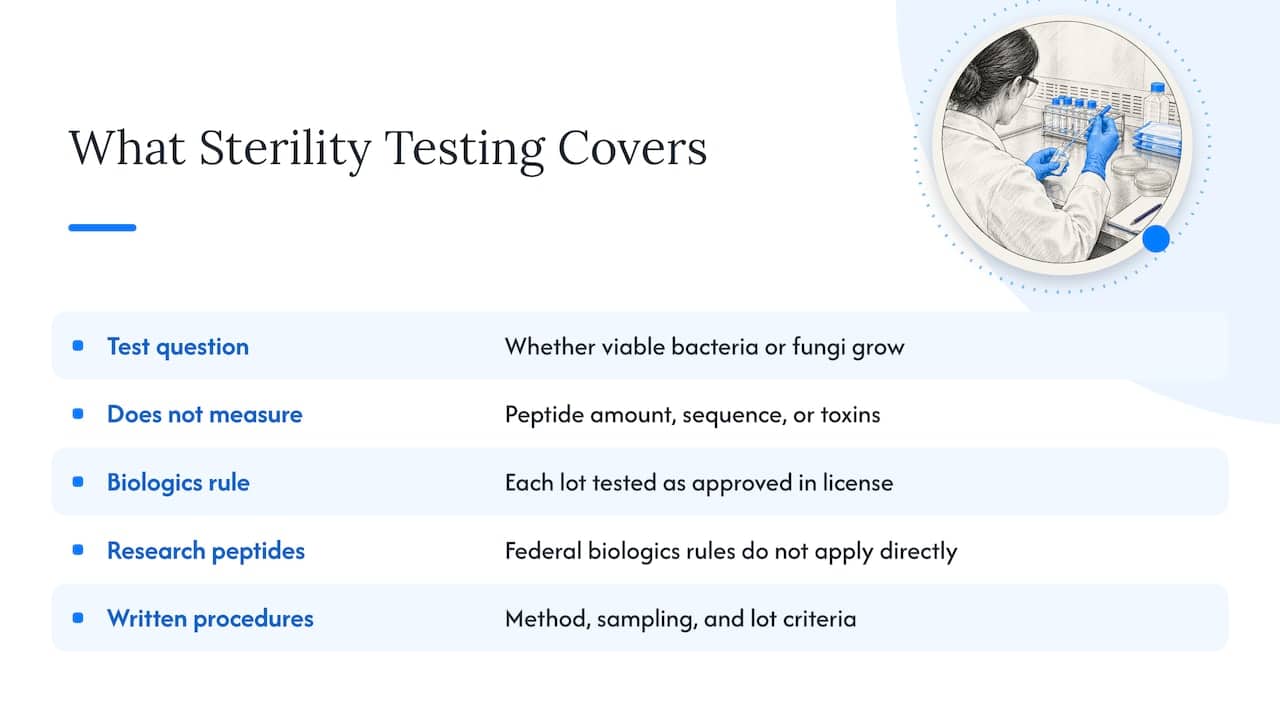
A sterility test answers one narrow question: did any viable bacteria or fungi grow from this sample, under these conditions, within this period? It does not measure how much peptide is present, whether the sequence is right, or whether the material carries bacterial toxins.
The regulatory framing is worth knowing. Federal rules for biological products require manufacturers to test each lot for sterility as approved in the license application. Research peptides are not licensed biologics, so those rules do not apply to them directly. But USP <71> is the standard vocabulary labs use when they say “sterility tested,” so it is the right yardstick for reading any research-grade document.
USP also expects written procedures. The chapter text calls for a described test method, a sampling method and lot acceptance or rejection criteria, so results stay consistent from one run to the next.
The two main methods
USP <71> describes two primary approaches. According to the FDA Pharmaceutical Microbiology Manual, membrane filtration is the preferred method for filterable products. It is more sensitive and it can rinse away antimicrobial inhibitors. Direct inoculation is used when filtration is not feasible.
| Membrane filtration | Direct inoculation | |
|---|---|---|
| How it works | The sample is passed through a filter that traps microorganisms. The filter is then rinsed and placed in media. | The sample is added straight into tubes or bottles of growth media. |
| When it is used | Products that can be filtered; the preferred route | Products where filtration is not practical |
| Main strength | Higher sensitivity; inhibitors can be washed off the filter | Simple, with fewer handling steps |
| Main risk | More handling if the setup is open | The product can dilute poorly and suppress growth in the media |
Trade coverage of contract testing notes that direct inoculation may be chosen for products such as polymer injectable depots, where filtering is not suitable. The same source describes closed-system, single-use filtration devices as best practice in GMP sterility work, because they lower the chance of outside contamination and invalid runs.
Most lyophilized research peptides dissolve cleanly, which makes them candidates for filtration. The lab decides, and the decision belongs in the method record.
The workflow, step by step
A credible sterility test is more than dropping a sample in broth. The FDA manual lays out the sequence, and each step protects the result from a false pass or a false fail.
- Write and validate the procedure. The lab works from a written, validated SOP.
- Run growth promotion on each media batch. The media must be shown to support growth of known organisms. If it cannot, a “no growth” result means nothing.
- Complete a method-suitability study. This confirms the peptide does not inhibit microbial growth. The FDA calls it a prerequisite: without it, antimicrobial effects from the product could cause false negatives.
- Transfer the sample aseptically. Done by filtration or direct inoculation, ideally in a controlled environment.
- Incubate for 14 days. The media are inspected during and at the end of this period.
- Subculture if needed. If turbidity appears and may be caused by the peptide itself, material is moved to fresh media for an additional four days to see whether real growth follows.
- Record and interpret. The lab reports pass, fail or invalid, with the method and media used.
Why method suitability matters for peptides
Some peptides, preservatives and buffers have mild antimicrobial effects at the concentrations tested. If those effects are not neutralized, a contaminated sample can look clean. USP’s own guidance acknowledges that when inhibition cannot be fully neutralized, testing proceeds under conditions that support recovery of most challenge organisms, and the test may not detect every species. That is a real boundary on what the result means, and a good reason to ask which method and which neutralization approach produced it.
How long it takes and how results are read
Plan on at least two weeks from sample receipt to a final result, and longer if the lab queue is full or a subculture is needed. The 14-day incubation is built into the method and cannot be shortened by paying more.
Results fall into three outcomes:
- Pass. No turbidity or growth was observed across the incubation period.
- Fail. Growth was observed. Under USP <71>, the product does not comply unless it can be clearly shown that the test was invalid for causes unrelated to the product.
- Invalid. Facility monitoring showed a fault, or a review found a procedural fault. The test is repeated with the same number of units.
A failure triggers an investigation into whether the organism came from the lab environment or from the batch. Ask for the investigation outcome, not only the headline word.
What a pass proves, and what it does not
A pass establishes that, under those test conditions and with that sample volume, nothing grew within the incubation window. That is valuable, and it is also specific. Three points help you read it correctly.
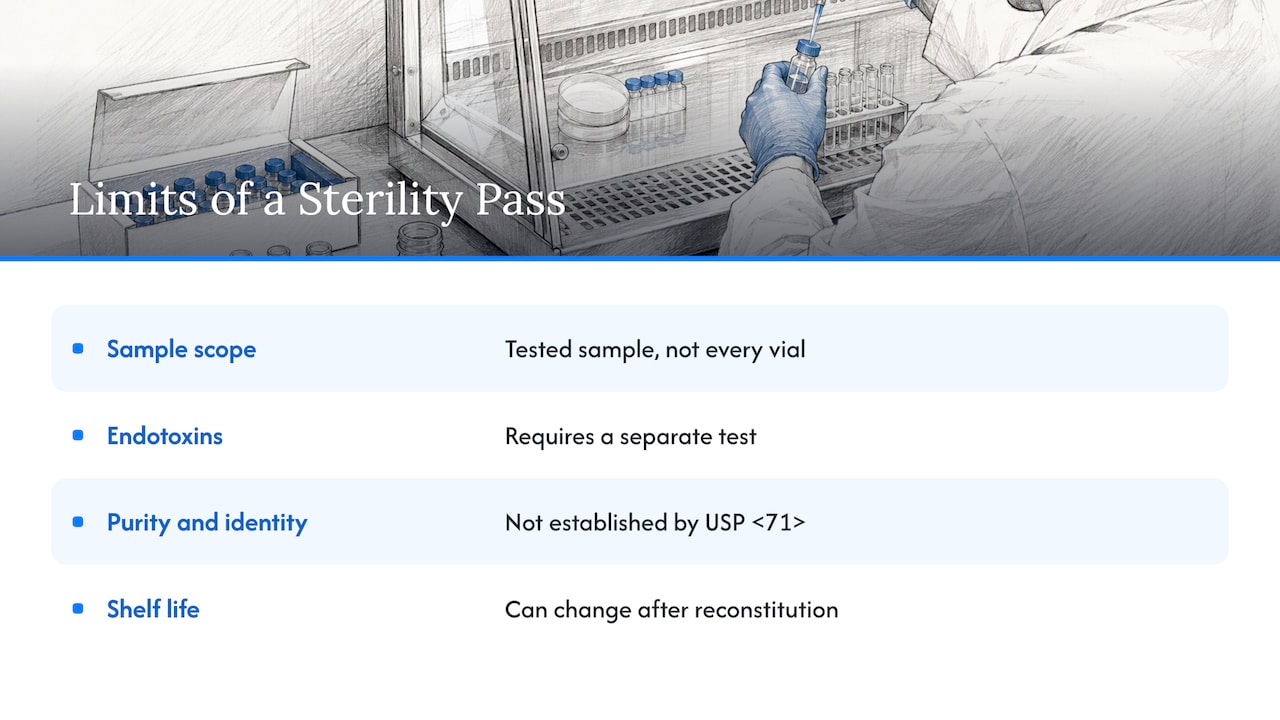
It describes the sample, not every vial. Sterility testing samples a lot. It is a confirmatory check, and sterility itself depends on how the material was made and filled. That is why the manufacturing environment and filtration steps matter as much as the final assay. Our guide to what a 0.22 µm sterile filter does explains the upstream half of that picture.
It is not an endotoxin result. Sterility testing under USP <71> looks for living organisms. Endotoxins are fragments of bacterial cell walls that can remain after the organisms are gone, and they are measured with a separate test. A lot can pass one and fail the other, so a certificate should name each test it reports.
It is not purity or identity. HPLC purity, mass-spectrometry identity and content assays answer different questions. Our walkthrough on how researchers assess peptide impurities covers the chemistry side, and the research peptides playbook shows how the pieces fit into a sourcing decision.
It is not a shelf-life statement. Once a vial is reconstituted and punctured, sterility can change with handling. We explain the distinction in peptide shelf life for labs, and the storage side in peptide storage temperature.
What peptide sterility testing costs
Prices vary by lab, by sample count and by whether sterility is bundled with other assays. As one published reference point, a US analytical lab lists USP <71> sterility at $150 as an upgrade to a higher testing tier, or $300 as a standalone test. Treat that as a 2026 snapshot and confirm current pricing and turnaround directly with any lab you consider.
When comparing quotes, look past the headline number:
- Does the price cover method suitability, or only the test run?
- Is the method membrane filtration or direct inoculation?
- How many samples or units are included?
- Is the report issued with the lot number and incubation dates?
- Is the lab accredited, and does it follow USP <71> or an alternative such as a PCR screen?
That last point deserves emphasis. PCR screens and total aerobic microbial counts are not USP <71> sterility tests, because they answer different questions. They can be useful screens, but they should not be labeled as sterility results.
How to read a certificate of analysis for sterility
When a supplier shows sterility data, run through these checks before relying on it:
- Is the method named? “USP <71>” is a method. “Sterile tested” is a phrase.
- Is it tied to your lot? The lot number on the report must match the vial.
- Who ran it? An independent laboratory report carries more weight than an unsigned summary.
- Are the dates there? A 14-day test should show start and end dates.
- Are other tests listed separately? Purity, identity, endotoxin and sterility should each appear with their own result.
- Is the sample plan stated? You want to know how much material was tested.
If a document skips these details, ask the supplier for them. A transparent supplier will have the answers on file.
Our perspective
We sell research peptides, and we think sterility is the claim most often blurred in this market. Purity gets a percentage, so people remember it. Sterility is a pass/fail result that comes from a process, and it deserves the same attention.
Our approach is documentation. Every lot we offer is third-party batch tested for purity and identity, with a Certificate of Analysis and endotoxin data. We publish that paperwork because researchers should be able to read what was tested rather than take a label on faith.
We also keep the scope clear. Our products are for laboratory research use only. Handling after the vial leaves our US facility, including reconstitution, filtration, storage and aseptic technique, is part of your lab’s own controls, and we support our customers with 24/7 help on their orders and documentation.
If you are building a sourcing checklist, put sterility, endotoxin, identity and purity on separate lines, and ask each supplier to show evidence for each. That standard is the one we hold ourselves to.
Data Peptides
Choosing documented material for your lab
If you are sourcing for laboratory work, start with a supplier whose paperwork you can actually read. Our full research catalog covers weight loss, muscle growth, recovery, anti-aging, libido and ancillary categories, all sold for laboratory research use only with batch documentation and fast, discreet US shipping. You can also read how we think about lab standards and best practices and the stability testing protocols that sit alongside sterility.
FAQ
How do you test peptides for sterility?
A lab transfers a sample into growth media by membrane filtration or direct inoculation, then incubates for at least 14 days under USP <71>. It first runs growth-promotion and method-suitability checks so the result is reliable. Clear media at the end is a pass.
What are the two methods of sterility testing?
The two methods are membrane filtration and direct inoculation. Filtration is preferred for filterable products because it is more sensitive and removes inhibitors. Direct inoculation is used when filtration is not feasible.
Does a sterility pass mean the peptide is free of endotoxin?
No. Sterility testing looks for viable microorganisms, while endotoxin testing measures bacterial cell-wall components. They are separate tests with separate results, so check that each appears on the certificate.
How much does sterility testing cost?
One published US lab price list shows USP <71> at $300 standalone or $150 as a tier upgrade, as of 2026. Costs differ by lab and sample count, so get a written quote that states the method and whether method suitability is included.
Can I use PCR instead of a USP <71> test?
PCR and microbial count tests answer different questions and are not USP <71> sterility tests. They can screen for contamination, but a report should not call them sterility testing.
Sources
- FDA Pharmaceutical Microbiology Manual
- 21 CFR 610.12, Sterility (eCFR)
- USP <71> Sterility Tests
- USP FAQs: Microbiology
- Considerations for sterility test methods (Outsourced Pharma)
- Peptide testing pricing (2026)