
“Light sensitive peptides” means two different things, and the right answer depends on which one you are after. The first is ordinary peptides that can degrade when exposed to UV or visible light, which is a storage and handling question. The second is engineered photoresponsive peptides that scientists deliberately build to switch, cleave or assemble when illuminated, which is a materials and chemical biology question. This guide covers both, with the practical steps a lab can use today.
TL;DR
- Some peptides are photolabile, mainly those containing aromatic residues. Tryptophan is the most vulnerable common residue, so sequence matters.
- Light is only one stressor. Heat, moisture and oxygen matter just as much, so a cold, dark, dry location is the practical default.
- Photoresponsive peptides are a separate research field. Azobenzene and similar groups let researchers control structure and function with light.
- ICH Q1B gives a formal framework for photostability testing, with defined light doses you can adapt to a research protocol.
- Documentation counts. A Certificate of Analysis for each lot gives you a baseline to compare against after any storage or light exposure.
Table of Contents
- Two meanings of “light sensitive”
- Are peptides sensitive to light?
- How much light is too much?
- Practical handling for light-sensitive peptides
- Testing photostability in your own lab
- What are photoresponsive peptides?
- What about light and peptide biology in published studies?
- Perspective
- Sourcing peptides with the paperwork to back them up
- A quick checklist before you start
- FAQ
- Sources
Two meanings of “light sensitive”
Search results for this phrase are split. Some pages describe peptides that degrade when left on a bench or in a sunny window. Others describe peptides built with light-triggered parts, such as photoswitches and photocleavable groups. Mixing the two leads to confusion, so keep them apart in your head:
| Photolabile peptides | Photoresponsive peptides | |
|---|---|---|
| What it is | A standard peptide that can be damaged by light | A peptide engineered to react to light on purpose |
| Light role | Unwanted stressor | Intended trigger |
| Typical concern | Oxidation, loss of purity and activity | Switching, cleavage, assembly, release |
| Lab response | Protect from light, control temperature, document | Choose wavelength, dose and timing carefully |
Are peptides sensitive to light?
Some are, and the answer depends on sequence. UV and visible radiation can excite aromatic side chains, and tryptophan is the most photolabile of the common residues. A peptide rich in tryptophan deserves more caution than one built mostly from aliphatic residues.
There is a nuance worth knowing. A 2022 academic review notes that the individual amino acid building blocks of proteins contain no chromophores that absorb visible light. Tryptophan, tyrosine, histidine and cystine show at most negligible UVA absorbance on their own. The same review points out that visible and UVA light are the dominant components of exposure during formulation, storage and administration. In practice, this means damage often happens through indirect routes, for example when other components in a solution absorb light and generate reactive species that then oxidize the peptide.
For a working lab, the takeaway is simple:
- Read the sequence. Note tryptophan, tyrosine, histidine, methionine and cysteine content.
- Treat solutions as more exposed than dry powder.
- Assume light, heat and oxygen act together rather than separately.
Why a peptide’s form changes the risk
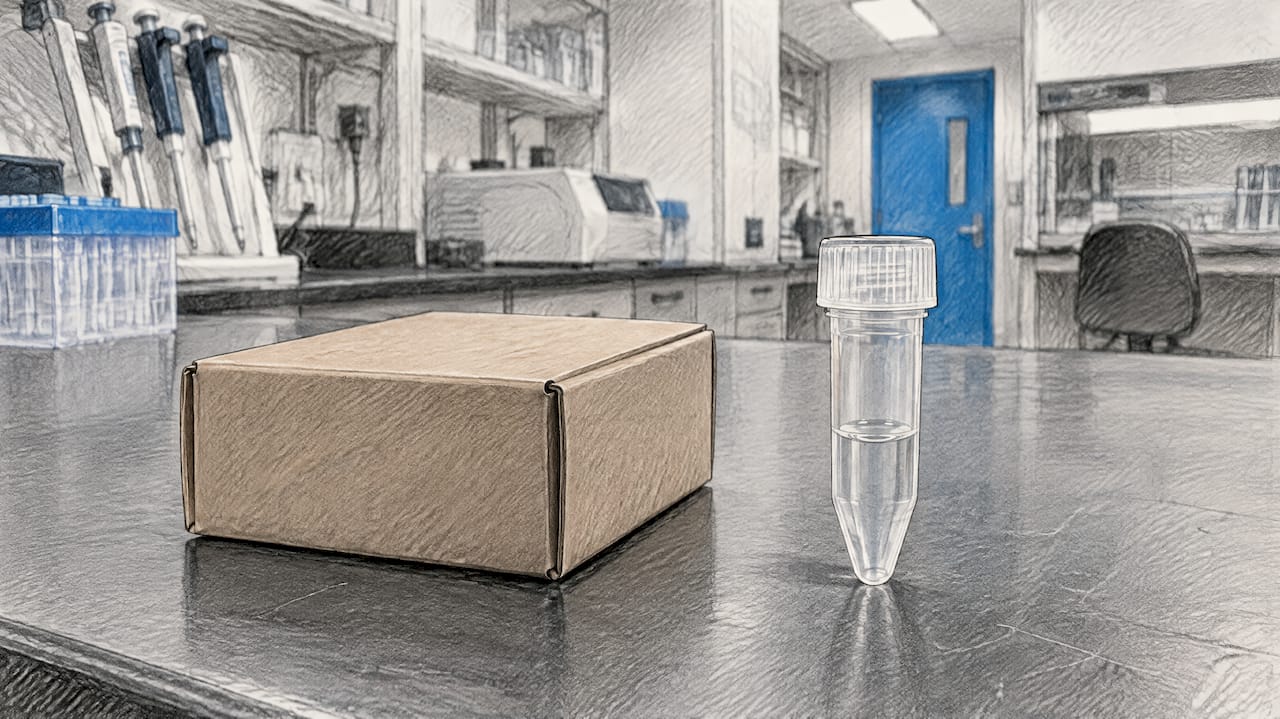
A lyophilized powder in an amber or opaque vial inside a closed box sees very little light. The same peptide dissolved in a clear tube on a bench under overhead lighting is a different story. Reconstitution also adds water, which brings hydrolysis and microbial questions into play. Our guide on keeping lyophilized peptides cold and dry covers the dry-state basics, and our piece on peptide storage temperature explains how chemical stability and sterility are separate questions.
How much light is too much?
The most useful yardstick comes from pharmaceutical regulation. The ICH Q1B guideline on photostability testing says confirmatory samples should receive at least 1.2 million lux hours of illumination and 200 watt hours per square meter of integrated near-ultraviolet energy. It describes two ways to deliver that light. Option 1 uses a source similar to the D65/ID65 emission standard. Option 2 exposes the same sample to a cool white fluorescent lamp and a near-UV fluorescent lamp with a spectral distribution from 320 to 400 nm.
Those are deliberately demanding test doses. They are meant to reveal whether a product is photosensitive, not to describe normal handling. The 2022 review mentioned above puts it in context: indoor clinical lighting provides typically 400 to 10,000 lux of visible light and 17 W/m² of UVA. A one-hour exposure at those levels delivers about 8.5% of the 200 Wh/m² UV dose recommended for photostability testing.
What this means for you:
- A few minutes under normal room lighting while you weigh or reconstitute is a very small dose compared with formal test conditions.
- Hours or days in a bright window, or under strong lamps, add up.
- If a peptide is critical to a long experiment, a formal or semi-formal light challenge tells you more than guesswork does.
Practical handling for light-sensitive peptides
No single rule fits every sequence, but this routine works for most research settings.
Storage
- Keep vials in their original packaging, inside a closed box or drawer, in a cold and dark location.
- Use amber or opaque containers for solutions. If you only have clear tubes, wrap them in foil.
- Avoid storing near windows, under fluorescent fixtures, or beside heat sources.
- Label each tube with the lot number and the date it was opened or reconstituted.
Working at the bench
- Prepare solutions promptly, then return stock to storage.
- Dim the lights or work away from direct sun when handling a tryptophan-rich sequence.
- Aliquot into single-use volumes so one stock tube is not repeatedly exposed to light and room temperature.
- Keep a simple log of how long each tube stayed out.
Shelf life is not just a light question
It is tempting to blame light for any loss of activity, but temperature, moisture, freeze-thaw cycles and microbial growth all play roles. If you are trying to work out how long a reconstituted solution stays usable, read our explanation of why the 28-day rule is about sterility, not chemistry.
Testing photostability in your own lab
If a project depends on a peptide staying intact, a small stability study is worth the time. Our overview of peptide stability testing with ICH-style protocols goes deeper, and the outline below gives the general shape.
- Baseline. Start from the lot’s Certificate of Analysis and run your own purity check by HPLC or LC-MS before exposure.
- Define conditions. Choose a light source and dose. ICH Q1B Option 1 or Option 2 provides defined targets if you want to follow the formal approach.
- Include a dark control. Wrap an identical sample in foil and keep it beside the exposed one so heat effects can be separated from light effects.
- Expose. Deliver the planned dose, tracking lux hours and UV energy with a calibrated meter or actinometer.
- Re-analyze. Compare purity, identity and any degradation products against baseline and against the dark control.
- Record. Write down the container type, solvent, concentration, temperature and light source so the result can be repeated.
The dark control is the step people skip most often, and it is the one that makes the result interpretable.
What are photoresponsive peptides?
On the other side of the keyword sit peptides designed around light. A 2023 review describes how introducing photoresponsive units into peptides allows remote control of their structure and function in space and time. Light is a clean, tunable and less invasive trigger, as a 2026 perspective on supramolecular polymers puts it, which is why the field has grown quickly.
The same review sorts the mechanisms into a few families:
- Photochromic (photoisomerization). Photochromic units can reversibly change peptide structure and self-assembly. Azobenzene is the classic example: it switches under UV light and returns under visible light or heat.
- Photocleavable. These units irreversibly control function through light-induced cleavage or deprotection, often used as a “cage” that is removed on demand.
- Photocrosslinking. Light forms bonds that stabilize assemblies.
Wavelengths used in research
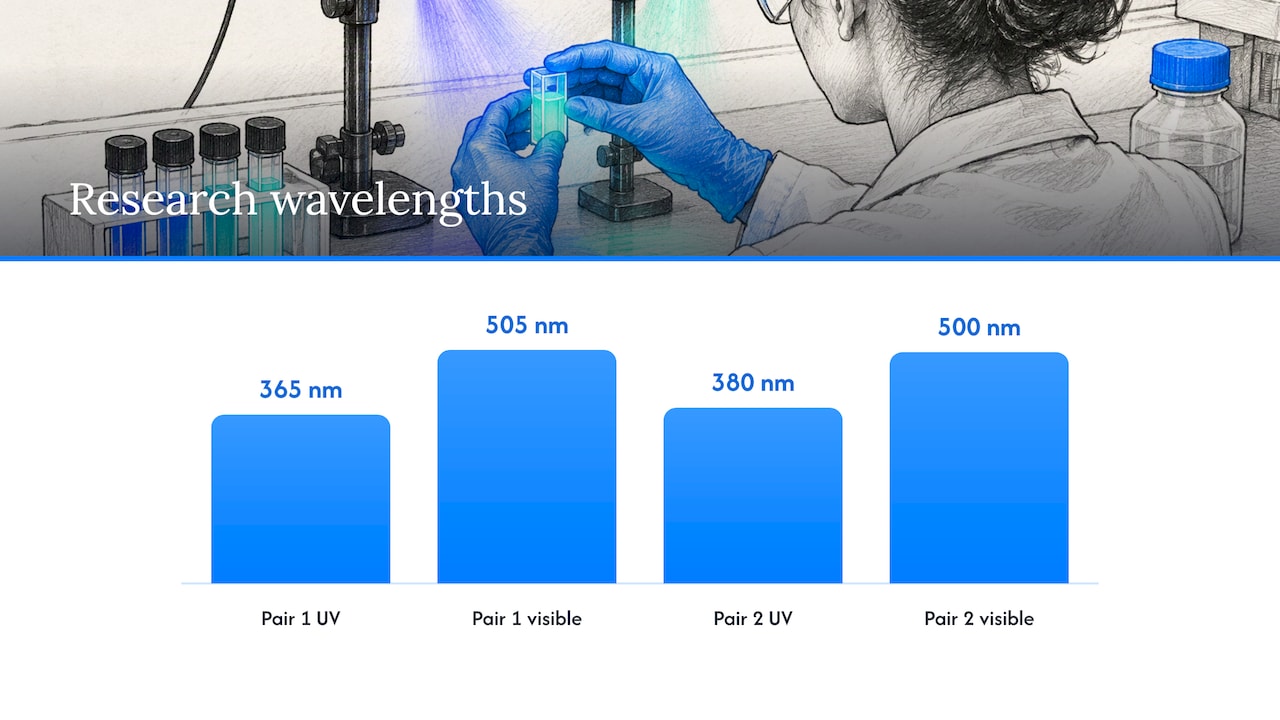
The wavelength is part of the design. Reported systems include azobenzene-type switching under UV, and paired wavelengths such as 365 and 505 nm or 380 and 500 nm, according to the 2023 review. UV-responsive hydrogels are one example: a peptide hydrogel built from an Nvoc-protected diphenylalanine disassembles under UV irradiation in published work, though you should read the original paper for conditions. Newer designs push toward visible light, which is gentler for biological samples.
What it has been used for
Reported applications include smart drug delivery, molecular robots, artificial cells and self-assembling supramolecular materials. Two recent examples show the range:
- Visible light at 505 nm triggered peptide nanofibre formation in living cells, with irradiation time controlling assembly states and dynamics.
- In a UK study, a polymersome carrier protected a photosensitizing peptide called RB-K2 from degradation, and with light activation it suppressed melanoma tumor growth in mice without systemic toxicity.
These are preclinical and laboratory results. They show what light control makes possible in a research setting.
What about light and peptide biology in published studies?
People often ask whether light can influence peptide-related outcomes. A few published studies touch on it from different angles, and they are not interchangeable.
- A 2021 Nature Communications study used a smart-watch-programmed green-light gene switch to control expression of human GLP-1 in diabetic mice. Over 12 days, treated animals showed increased circulating hGLP-1, lower fasting blood glucose and reduced body weight gain compared with non-illuminated controls.
- A 2021 double-blind randomized trial of 60 people aged 40 to 80 wearing a photobiomodulation patch for a week reported a significant increase in blood GHK-Cu concentration in the active group compared with control.
These are different technologies, a genetic switch in mice and a patch worn by people, and neither is a statement about handling peptides from a vial. If GHK-Cu is your interest, our write-up of GHK-Cu research for lab scientists covers the compound itself.
Perspective
How we think about light and peptide quality
We see light sensitivity as one more reason to treat documentation as part of the product. A peptide is only useful to a research group if the material in the vial matches what the label says, and it should still match after it has moved through storage, shipping and the bench.
That is why we publish third-party batch testing for purity and identity, with a Certificate of Analysis and endotoxin data for every lot. A lot-specific baseline gives you something concrete to compare against if you ever want to check how a handling step affected your material.
Our approach to handling is deliberately simple. Our orders ship fast and discreetly from our US facility, and we encourage researchers to move material into cold, dark, dry storage as soon as it arrives. If you have questions about a specific sequence, our support team is available 24/7. Everything we sell is for laboratory research use only.
Data Peptides
Sourcing peptides with the paperwork to back them up
For any stability work, the starting material matters. We offer lab-grade research peptides across weight loss, muscle growth, recovery, anti-aging, libido and ancillary categories, each batch tested by a third party and supplied with a Certificate of Analysis. If your project involves repair or recovery models, you can browse the recovery peptides for research or read what researchers should verify first on a recovery peptide. All products are for laboratory research only, not for human or animal consumption.
A quick checklist before you start
- Do you know the sequence and which residues are most likely to react to light?
- Is the peptide stored dry, cold and dark, with the lot number recorded?
- Are working solutions in amber or foil-wrapped containers?
- Have you aliquoted to avoid repeated exposure?
- Do you have a baseline from the lot’s Certificate of Analysis?
- If the result matters, have you run a dark control alongside the exposed sample?
FAQ
Are peptides sensitive to light?
Some are. Peptides with aromatic residues, especially tryptophan, are the most prone to light-driven changes. Others are quite stable. Because heat and moisture also cause loss, keeping peptides cold, dark and dry is a safe default for any sequence.
Do I need amber vials for every peptide?
Not necessarily for dry powder stored inside a closed box, but opaque or amber containers are inexpensive protection, especially for solutions and for tryptophan-rich sequences. If amber glass is not available, wrapping the tube in foil does a similar job.
What is the difference between a photolabile and a photoresponsive peptide?
A photolabile peptide is a standard peptide that light can damage. A photoresponsive peptide is engineered with a photoswitch or photocleavable group so that light deliberately changes its structure or activity. They call for opposite handling: avoid light for the first, control light precisely for the second.
How do I test whether my peptide is photostable?
Expose a sample to a defined light dose and keep a foil-wrapped dark control next to it. ICH Q1B suggests at least 1.2 million lux hours and 200 Wh/m² of near-UV energy for confirmatory testing. Compare purity and identity against your starting baseline afterward.
Sources
- CEI-MS-20: Photostability assessment of light-sensitive peptides
- Advanced Oxidation Processes in Pharmaceutical Formulations (PMC, 2022)
- ICH Q1B: Stability Testing, Photostability of New Drug Substances and Products
- Photoresponsive peptide materials: Spatiotemporal control (PMC, 2023)
- Photocontrol of biorelated supramolecular polymer materials (Polymer Journal, 2026)
- Intracellular assembly of supramolecular peptide nanofibres (Nature Synthesis, 2025)
- Polymersomal delivery enhances third-generation photosensitizer peptide RB-K2 (RSC, 2025)
- Smart-watch-programmed green-light-operated percutaneous control of gene expression (Nature Communications, 2021)
- Double-Blind Testing of the LifeWave X39 Patch (IMROJ, 2021)