

Subcutaneous (SubQ) delivery places a peptide in the fat layer under the skin and usually gives slower, steadier absorption. Intramuscular (IM) delivery places it in muscle, which has more blood flow, so it can produce a faster and sometimes higher peak. That is the general pattern. The published data show it holds for some molecules, not for others, and for most peptides discussed online no head-to-head human comparison exists.
This guide explains the difference between the two routes, what the studies found, and how researchers think about route when they design protocols. It is educational and written for laboratory research context. Our products are sold for laboratory research use only, not for human or animal consumption. If a clinician has prescribed you a peptide medicine, follow the label and your prescriber, not a general article.
TL;DR
- SubQ goes into the fatty layer under the skin and tends toward slower, more sustained absorption. IM goes into muscle and tends toward a faster peak.
- Faster is not the same as more. In several studies, total exposure was similar across routes even when peak timing or height differed.
- For FDA-approved peptide drugs, the label sets the route, site and schedule. Many of them are subcutaneous only.
- For most research peptides, no controlled SubQ vs IM comparison has been published, so route claims in forums are not evidence.
- Route is a design variable. Document it, keep it consistent across a study, and verify the material with a Certificate of Analysis.
Table of Contents
- How the two routes differ
- What published studies found
- Is intramuscular more effective?
- Why most peptides are given subcutaneously
- When intramuscular is used
- What happens when the route is wrong
- Route as a research design variable
- Perspective
- Where to go next
- FAQ
- Sources
How the two routes differ
The difference starts with anatomy. The subcutaneous layer is fat and connective tissue sitting between the skin and the muscle. Muscle is richer in blood vessels. A compound deposited in muscle therefore has more capillary surface to enter, which is the usual explanation for faster uptake.
A review of drug administration in people with obesity, published in the American Journal of Health-System Pharmacy, frames the choice as a pharmacokinetic decision rather than an arbitrary one: SubQ is typically preferred when a slower, more sustained response is wanted, as with insulin, while IM is typically preferred when faster absorption helps, as with vaccines that need a quick antibody response.
| Factor | Subcutaneous (SubQ) | Intramuscular (IM) |
|---|---|---|
| Tissue | Fat layer under the skin | Skeletal muscle |
| Blood supply | Lower | Higher |
| Typical absorption pattern | Slower, steadier | Faster, earlier peak |
| Typical volume handled | Smaller | Larger |
| Needle depth | Shallow | Deeper |
| Usual use with peptides | The common route | Specific cases only |
The table describes tendencies. Individual molecules can behave differently, and the next section shows how.
What published studies found
The evidence is a patchwork of molecule-specific studies. Three of them show why no single rule works.
Growth hormone: similar results by either route
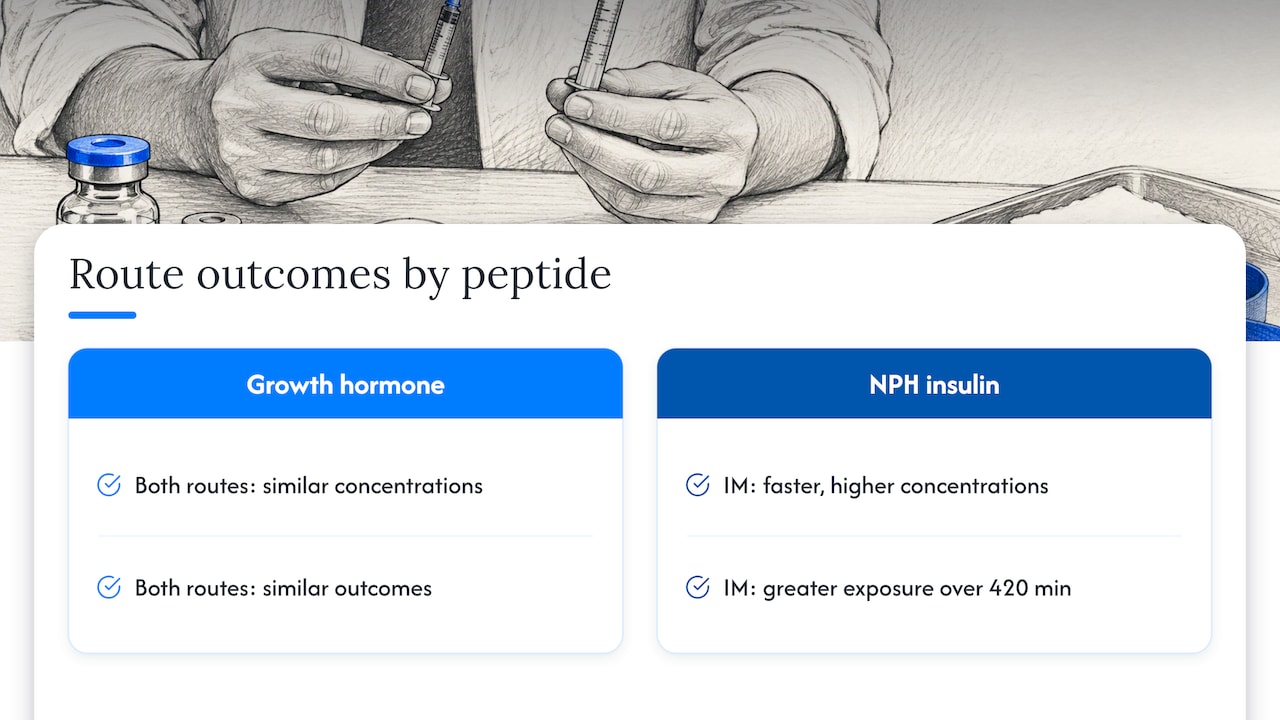
A 1982 study compared SubQ and IM human growth hormone in patients with GH deficiency. Peak and integrated plasma concentrations, peak timing at about 2 hours, and height velocity after treatment were similar after both routes. Over the following months, patients accepted the subcutaneous route overwhelmingly, with less pain and less noncompliance. For this peptide hormone, the route changed the experience more than the pharmacology.
NPH insulin: faster and larger exposure with IM
A 1991 study in seven healthy volunteers measured isophane (NPH) insulin after SubQ and IM injection. Insulin concentrations rose more rapidly after IM injection, were significantly higher by 60 minutes, and the area under the curve over 420 minutes was greater. Here the textbook rule held, and the difference was large. It is also a reminder that insulin is a formulated product with a suspension designed for a particular use, not a generic peptide in solution.
Injection site matters even within the subcutaneous route
A 2021 survey of clinical pharmacokinetic data for 18 peptides and small proteins given subcutaneously at different sites found that 9 of 18 showed injection-site-dependent pharmacokinetics. Peptides that were absorbed quickly, cleared quickly or bound little to plasma protein were the most sensitive to where they were injected. The authors point to regional differences in local blood flow and pre-systemic breakdown as likely contributors.
Taken together, these studies say three things:
- Route can change the shape of the concentration curve (time to peak, height of peak) without changing the total much.
- For some molecules route barely matters, and for others it matters a lot.
- Even the exact SubQ site can shift results for fast-absorbed peptides.
Is intramuscular more effective?
Not as a general statement. “More effective” depends on what the endpoint is. If a compound has an acute, dose-related effect, a higher and earlier peak could change what you observe. If the endpoint depends on total exposure over days, or the compound works through a sustained signal, a faster peak may add little.
The growth hormone data above are a good example: similar concentrations and similar outcomes by both routes. The insulin data show the opposite. No study of one peptide should be assumed to carry over to another with a different size, charge or formulation.
This is the main reason careful researchers treat a sentence like “IM is stronger” with caution. It is a hypothesis about a specific molecule and preparation, not a law.
Why most peptides are given subcutaneously
Subcutaneous administration is the standard route for the large majority of peptide drugs that have a regulatory label. A few practical reasons explain why:
- Small volumes. Most peptide products are potent at low doses, so a small subcutaneous depot is enough.
- Tolerability. The shallow needle is less painful, which supports consistent use over long studies and treatment courses. The growth hormone study above recorded exactly this.
- Smoother exposure. Slower absorption can avoid sharp peaks that matter for compounds with dose-related side effects.
- Lower tissue risk. Subcutaneous placement avoids deep structures.
The FDA label for tesamorelin (EGRIFTA), for example, specifies a subcutaneous injection into the abdomen once daily, with sites rotated and no injection into scar tissue, bruises or the navel. Labels like this fix the dose, site and schedule. That is the right standard for any approved medicine: the route on the label is the route, and a patient should not swap it based on something read online.
Online protocols that mention intramuscular use for research peptides are mostly community-reported. We would not treat them as sourced guidance.
When intramuscular is used
IM has real uses in pharmacology. Vaccines are the best-known case. Oil-based depot preparations are another, because a viscous, larger-volume product suits muscle better than the fat layer. Some labels allow either route and say which is preferable at larger volumes.
The common thread is that formulation decides. A water-soluble peptide in a small volume and an oil-based depot are different products with different logic. Choosing IM “because muscle absorbs faster” without a reason tied to the compound is the weak version of the argument.
What happens when the route is wrong
An approved product is designed for its labeled route. Given the wrong way, it can be absorbed faster or slower than intended, and local effects change. The FDA labels for several peptide medicines tell patients not to inject into muscle, which is a direct signal that route is part of the product design.
There is also a tissue-safety side to deep injections in general. A peer-reviewed review of 19 cases of necrotizing soft tissue infection after intramuscular injections noted that these infections carry a worse clinical outcome than those from other entry routes. Infections after injection are rare but serious, which is why sterile technique matters for every parenteral route. Anyone who develops spreading redness, heat, severe pain, fever or swelling after an injection of any kind needs urgent medical care, not home management.
Route as a research design variable
For laboratory work, route is one more variable that has to be controlled and written down. A few principles keep results interpretable:
- Pick one route per arm and hold it. Mixing routes inside a study confuses time-to-peak data.
- Match the route to the question. If you are studying acute response, peak timing matters and route belongs in the hypothesis. If you are studying a sustained effect, a slower route may be the cleaner model.
- Record the site. Given the 2021 finding that site can shift absorption for fast-absorbed peptides, a fixed and documented site reduces noise.
- Control volume and concentration. The same dose in a different volume can behave differently in tissue.
- Do not generalize across molecules. A result for one peptide, such as the FSH or growth hormone data, is not a result for another.
- Rotate sites in long studies, and log it. Repeated placement in the same spot can damage tissue and distort data.
Handling matters as much as route. Reconstitution, storage and dilution all affect what reaches the tissue. A structured peptide protocol and handling guide is a good model for how to document a procedure step by step, from preparation to record keeping.
Identity and purity sit underneath all of it. If the material is not what the label says, route comparisons are meaningless. That is why we publish batch-level Certificates of Analysis, and why we suggest reading one before any protocol is finalized. Our guide to what researchers should verify first walks through the checks.
Perspective
Route questions are really data-quality questions. A SubQ vs IM comparison only tells you something if the peptide in the vial is what the label says, at the purity the label says, in every lot. That is the part we control, and it is where we put our effort.
Every product we offer for laboratory research is third-party batch tested for purity and identity, and each lot comes with a Certificate of Analysis and endotoxin data. We state a 99%+ purity standard because researchers designing route-dependent studies need a stable baseline. When absorption curves are the thing you are measuring, an impure or inconsistent batch is a confounder you cannot afford.
We also keep our own scope clear. Our peptides are for laboratory research use only. We do not give dosing or injection instructions for people or animals, and we point anyone on a prescribed medicine back to the label and their prescriber. What we can do is give researchers documentation they can trust, fast and discreet US shipping, and a support team available around the clock when a question about a lot or a document comes up.
Data Peptides
Where to go next
If you are building a protocol, the sensible order is to define the question, choose the route that fits it, then source documented material. Our shop lists research peptides by category, including weight loss, muscle growth, recovery, anti-aging, libido and ancillaries, each backed by third-party testing and Certificates of Analysis for laboratory research use. For background on how peptides are grouped and studied, our overview of medical peptides and the research guide to the best peptides are useful starting points. If you work on the growth hormone axis, GHRH vs GHS covers design choices for trials, and our piece on oral peptide bioavailability explains why delivery route changes exposure so much.
FAQ
Should peptides be injected subcutaneously or intramuscularly?
For an approved medicine, whichever the label and your prescriber specify. Most peptide drugs with an FDA label are subcutaneous. For laboratory research, the choice is a protocol decision tied to the question, the formulation and published data on that specific molecule.
Is intramuscular more effective than subcutaneous?
Not as a rule. A 1982 growth hormone study found similar concentrations and outcomes by both routes, while a 1991 insulin study found faster and higher exposure with IM. Effectiveness depends on the molecule, the formulation and the endpoint.
Which is faster, IM or SubQ?
IM is usually faster because muscle has more blood flow, and some studies confirm it. But the size of the gap varies by compound, and for some peptides the two routes look alike. Faster absorption does not mean more total exposure.
What happens if the wrong route is used?
The product may be absorbed faster or slower than designed, and local irritation can change. Several approved peptide medicines tell patients not to inject into muscle. Anyone who gives a medicine by the wrong route should contact their pharmacist or prescriber, and seek urgent care for signs of infection such as spreading redness, fever or severe pain.
Sources
- Implications of obesity for drug administration and dosing (American Journal of Health-System Pharmacy, 2022)
- A comparison of subcutaneous and intramuscular growth hormone (Russo and Moore, 1982)
- Different absorption of isophane (NPH) insulin from subcutaneous and intramuscular sites (1991)
- Impact of injection sites on clinical pharmacokinetics of subcutaneously administered peptides and proteins (2021)
- EGRIFTA (tesamorelin) FDA prescribing information
- Necrotizing soft tissue fasciitis after intramuscular injections (PMC, 2018)