

Most peptides applied to skin stay in the outermost layers. Lab studies show that small, fat-friendly peptides can enter the stratum corneum, and that carriers, chemical modification and devices can push more of them in. Deep delivery to the dermis is much harder to demonstrate. This guide covers what determines penetration, what the measurements say, and how to read absorption claims with a researcher’s eye.
TL;DR
- Skin is built to keep molecules out. Peptides above roughly 500 Da generally struggle to cross the stratum corneum.
- In one human skin study, only 0.22% of an applied peptide dose reached the stratum corneum, 0.01% reached the epidermis, and none was detected in the dermis.
- Liposomes, lipid conjugation, solvents, nanoparticles and iontophoresis can raise delivery, but results depend on the peptide and the model.
- Few clinical trials test topical peptides, so absorption data and visible skin results are not the same thing.
- Cosmetic peptide safety reviews in the US cover specific sequences and concentrations. They do not cover every peptide in every format.
Table of Contents
- Why skin resists peptides
- What decides whether a peptide gets through
- How far peptides actually travel: measured numbers
- Ways researchers try to improve delivery
- Penetration is not the same as results
- Safety of topical peptides and penetration enhancers
- How to evaluate a penetration claim
- Our perspective
- Sourcing peptides for skin research
- FAQ
- Sources
Why skin resists peptides
The stratum corneum is the top layer of the epidermis. It is a dense arrangement of flattened cells and lipids, and it exists to block water loss and keep foreign molecules out. A peptide has to cross that layer before it can reach living cells.
Peptides make the job harder in three ways. They are often larger than typical small-molecule drugs, many carry charge, and many dissolve well in water rather than in skin lipids. A review of cosmeceutical delivery describes the “500 Dalton rule”: compounds above that molecular weight struggle to penetrate normal stratum corneum, while smaller ones permeate more readily. It names large actives such as peptides and proteins as a specific hurdle.
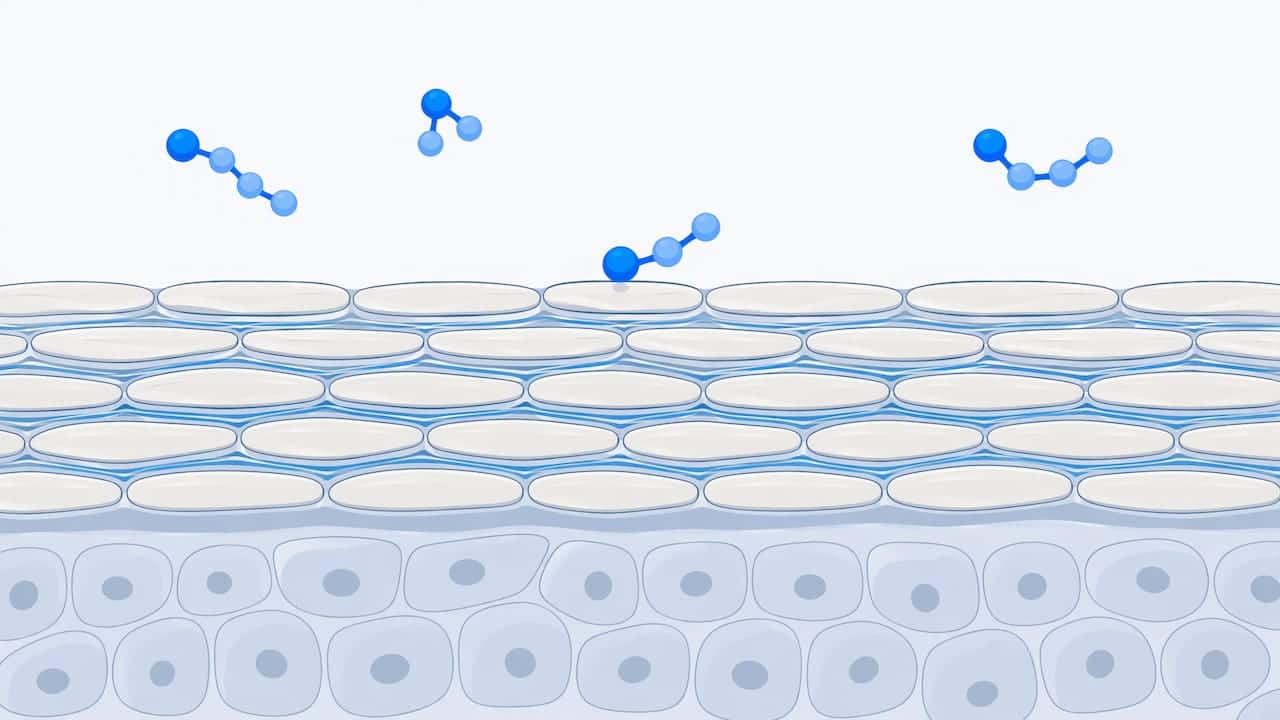
That is why a marketing line such as “peptides are small enough to go through the skin” needs context. Small compared with a protein is not the same as small enough for passive diffusion. Many popular cosmetic peptides, once you add up their amino acids, sit near or above the 500 Da line.
What decides whether a peptide gets through
Pintea et al. (2025) state that permeability depends on several factors together:
- the physicochemical properties of the peptide
- the integrity and thickness of the stratum corneum
- the area of application
- the duration of contact
- the properties of the formulation
The same review lists the properties of an ideal passive candidate: molecular weight under 500 Da, a log P between 1 and 3, few polar centers, moderate solubility above 1 mg/mL, and a melting point under 200 °C. Log P is a measure of how fat-loving a molecule is. A value of 1 to 3 means it is balanced between water and oil, which suits the layered structure of skin.
Some practical readings of that list:
- Size matters first. Dipeptides and tripeptides sit closer to the threshold than hexapeptides or longer chains.
- Fat-friendliness matters second. A very water-soluble peptide tends to stay on the surface. A very oily one can get stuck in the lipid layers.
- The skin itself changes the answer. Damaged, thin or hydrated skin behaves differently from intact skin, which is why research models matter. Human cadaver skin, porcine skin and engineered skin do not give identical numbers.
- Contact time and area count. A rinse-off product and a leave-on product expose skin to the peptide very differently.
How far peptides actually travel: measured numbers
The cleanest answer to “how deep” comes from in vitro work on human skin. Kraeling et al. (2015) applied a 10% acetyl hexapeptide-8 oil-in-water emulsion to human cadaver skin for 24 hours. They found 0.22% of the applied dose in the stratum corneum and 0.01% in the epidermis. Nothing was detected in the dermis or in the fluid collected beneath the skin.
That is a small fraction, and it shows why researchers separate three ideas that marketing often blends:
- On the skin: the peptide sits on the surface or in the product film.
- In the skin: the peptide is retained in the stratum corneum or epidermis.
- Through the skin: the peptide reaches the dermis or the receptor fluid in a test cell.
Most topical peptide data show the first two. Evidence for the third is rarer. A safety assessment of pentapeptide-4 ingredients from the Cosmetic Ingredient Review (CIR) Expert Panel also notes limited percutaneous absorption in vitro for those sequences.
The theory behind the product category, as Ash et al. (2024) describe it, is that a peptide combined with a lipophilic carrier can cross the barrier. Once past it, the peptide would act in the dermis, for example by raising collagen production, inhibiting collagenase or supporting wound healing. The penetration step is the one the model depends on, and it is the step that needs the most careful measurement.
Ways researchers try to improve delivery
Because passive diffusion is limited, formulation science has built a toolbox. Each approach changes the outcome in a different way.
| Approach | How it is meant to work | What the research shows |
|---|---|---|
| Lipid conjugation or amino acid substitution | Makes the peptide more fat-friendly | Described as a way to raise permeability in reviews of bioactive peptides |
| Liposomes | Lipid vesicles that carry the peptide into upper skin layers | A CSF tripeptide in liposomes was retained in the epidermis at 4.65 ± 1.81 μg/cm² but not quantified in the receptor solution (Dymek et al., 2025) |
| Solvent systems | Alter how the peptide partitions into skin | In the same study, the peptide in a 50% Transcutol solution reached the highest retention, 18.07 ± 5.25 μg/cm² |
| Solid lipid nanoparticles with cell-penetrating peptides | Use receptor-mediated uptake to carry cargo | Laminin-332-functionalized particles showed concentration-dependent cargo delivery in porcine skin (Kang et al., 2025) |
| Iontophoresis | A mild electric current drives charged molecules | Raised peptide permeability coefficients by about 7 to 27 times, with electroosmosis as the main driver (Krishnan et al., 2013) |
Two points stand out from the liposome result. First, “retained in the epidermis” and “delivered through the skin” are different outcomes, and a good study reports both. Second, the best carrier for retention was a solvent system, not the vesicle. Carrier choice is peptide-specific, so a result for one sequence does not transfer to another.
A note on cell-penetrating peptides
The phrase “cell-penetrating peptide” refers to a class of short sequences designed to carry other cargo across membranes. It is a different idea from an ordinary cosmetic peptide. In the nanoparticle work above, the cell-penetrating peptide is part of the delivery vehicle. When you read a paper or a product page, check which role the peptide plays: cargo, carrier or both.
Penetration is not the same as results
A peptide can reach the epidermis and still not change anything you can measure. The reverse is also possible: a skin-care benefit can come from the moisturizing base, not the peptide. That is why trial design matters.
Robinson et al. (2005) ran a 12-week, double-blind, placebo-controlled split-face study with 93 women aged 35 to 55. Palmitoyl pentapeptide at 3 ppm in a moisturizer improved wrinkles and fine lines versus placebo, by both instrument-based and expert-grader image analysis. It is a useful example of how a well-controlled design separates the active from the base.
The wider picture is more modest. A 2024 systematic review found that three of the assessed studies reported improvement in fine lines and wrinkles, two in elasticity and viscoelasticity, and three in skin texture, with no negative side effects observed in participants. The same authors noted that a search of Clinicaltrials.gov on October 2, 2023 for “topical peptide” turned up only two clinical trials of topical peptide formulations for cosmetic purposes.
A 2026 meta-analysis of 19 randomized trials with 1,341 participants found that peptides improved hydration and brightness and modestly reduced wrinkles (MD = 0.27, p = 0.04). The wrinkle benefit was largely driven by oral polypeptides. Only two of the 19 studies tested topical formulations, which the authors say limits definitive conclusions about the topical route.
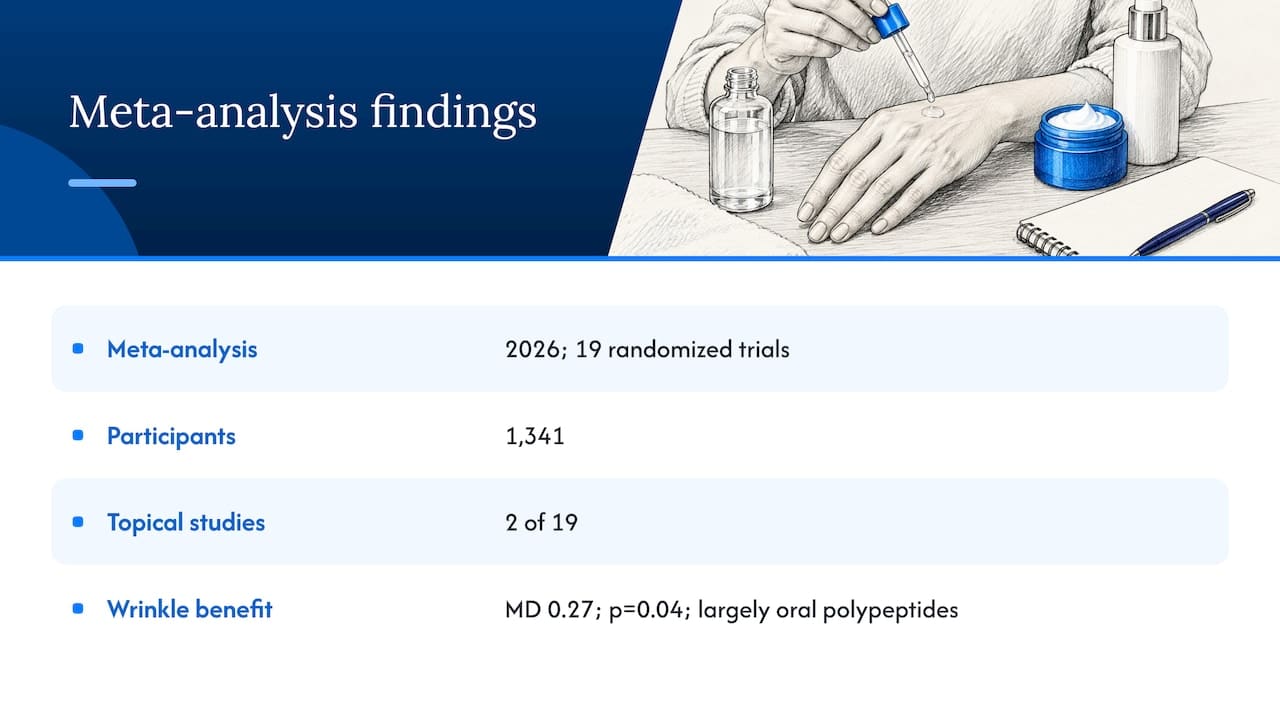
The takeaway for a researcher: topical peptide work is an active field with a thin clinical base. Penetration studies and outcome studies answer different questions, and both are needed.
Safety of topical peptides and penetration enhancers
Peptides break down through normal enzyme pathways, which gives them a short half-life. The 2024 review describes them as very safe therapeutics for that reason, with little potential for long-lasting negative effects.
In the US, the CIR Expert Panel evaluates cosmetic ingredients. It has concluded that Myristoyl Pentapeptide-4, Palmitoyl Pentapeptide-4 and Pentapeptide-4 are safe in cosmetics at present practices of use and concentration, noting limited absorption in vitro and negative genotoxicity studies. An earlier CIR assessment from 2014 reached the same type of conclusion for Tripeptide-1, Hexapeptide-12 and Palmitoyl Tetrapeptide-7, noting typical use concentrations below 10 ppm.
Two cautions follow from how these conclusions are worded:
- They apply to named ingredients at the concentrations used in cosmetics. They do not transfer to a different peptide, a higher dose or a different route.
- Penetration enhancers, solvents and devices are separate ingredients with their own safety profiles. If you plan to work with skin models and enhancers, review the data on the enhancer itself. Anyone with skin conditions or concerns about a product should see a dermatologist.
How to evaluate a penetration claim
The FDA explains that under the Modernization of Cosmetics Regulation Act of 2022 it does not pre-approve cosmetic products or ingredients. Companies are responsible for marketing safe, properly labeled products, and the responsible person must keep records that support adequate substantiation of safety. In practice, a claim about absorption is not reviewed by a regulator before it appears on a label or web page.
That puts the work of reading claims on you. A short checklist:
- Find the model. Was it human skin, pig skin, a reconstructed skin model or cells in a dish? Cells in a dish skip the barrier entirely.
- Find the compartment. Look for the stratum corneum, epidermis, dermis and receptor fluid, each reported separately.
- Look for percentages and units. A statement such as “penetrates deeply” with no amount is not data.
- Check the vehicle. The same peptide behaves differently in a water gel, an emulsion and a solvent system.
- Separate penetration from outcome. Ask whether a controlled trial with a placebo base exists.
- Check the molecule. Molecular weight and log P tell you whether passive entry is plausible at all.
The same discipline applies to the materials you work with in the lab. Identity and purity set the baseline for every result, because an impure sample changes both the permeation numbers and the safety picture. A batch-specific Certificate of Analysis with identity and purity data is the minimum documentation for any experiment.
Our perspective
We see the same pattern in questions from researchers: the first question is “does it penetrate?”, and the real question is “how much, where, and compared with what?” Penetration is a quantity, and the studies above show it is a small one for passive diffusion. That is exactly why careful experimental design matters.
We build our catalog around the needs of laboratory research. Every product is third-party batch tested for purity and identity, and each lot comes with a Certificate of Analysis and endotoxin data. For a permeation study, that documentation lets you start from a known material and attribute differences to your vehicle, model or enhancer, not to an unknown in the vial.
Our anti-aging category brings together the short-chain sequences that appear most often in skin research. If you are reading up on specific sequences, our research pages on Hexapeptide-9, Tetrapeptide 30 and Dipeptide 2 set out their mechanisms and the literature around them. Our products are for laboratory research use only, and we ship fast and discreetly from our US facility, with support available 24/7.
Data Peptides
Sourcing peptides for skin research
If your project involves permeation models, formulation work or in vitro skin assays, you can browse anti-aging peptides for research or the full shop. Each product is third-party batch tested, with a Certificate of Analysis and endotoxin data for every lot, and is sold for laboratory research use only. Our guide to matching assay tier to COA checks walks through what to verify before you order.
FAQ
Can peptides in a cream reach the dermis?
Lab data suggest it is difficult. In a human skin study of acetyl hexapeptide-8, small amounts reached the stratum corneum and epidermis, and none was detected in the dermis. Delivery systems can raise retention in upper layers, but reaching the dermis is rarely shown.
What is the 500 Dalton rule?
It is a rule of thumb that molecules heavier than about 500 Da struggle to cross normal stratum corneum, while lighter ones pass more readily. Many peptides exceed that size, which is why chemical modification, carriers or devices are studied.
Do liposomes make peptides penetrate better?
They can help retention in the epidermis. In one ex vivo study, a liposomal tripeptide was retained in the epidermis but not detected in the receptor fluid. A solvent system retained more of the same peptide, so the best carrier depends on the peptide and the goal.
Are topical peptides safe?
For specific cosmetic peptides at typical use concentrations, the CIR Expert Panel has concluded they are safe, noting limited absorption. That conclusion covers named ingredients at cosmetic levels only. Anyone with a skin condition or a reaction should talk to a dermatologist.
How can I tell if an absorption claim is credible?
Look for the skin model, the amounts in each skin layer and the vehicle used. Then check whether a placebo-controlled trial links penetration to a visible outcome. Claims without numbers or a named study are not evidence.
Sources
- Kraeling et al. (2015), in vitro skin penetration of acetyl hexapeptide-8
- Pintea et al. (2025), peptides as emerging candidates
- Enhancing dermal absorption of cosmeceuticals, Journal of Cosmetic Dermatology
- Krishnan et al. (2013), iontophoretic skin permeation of peptides
- Dymek et al. (2025), tripeptide-loaded liposomes
- Kang et al. (2025), cell-penetrating peptide-engineered solid lipid nanoparticles
- Ash et al. (2024), topical peptides systematic review
- Robinson et al. (2005), topical palmitoyl pentapeptide
- Nukaly et al. (2026), oral and topical peptides for skin aging
- CIR safety assessment of pentapeptide-4 ingredients (2024)
- CIR safety assessment of Tripeptide-1, Hexapeptide-12 and related ingredients (2014)
- FDA, Cosmetics and U.S. Law