

A pegylated peptide is a peptide with one or more chains of polyethylene glycol (PEG), a repeating polymer, covalently attached to it. The attachment makes the molecule larger and better shielded. It is usually done to slow the rapid breakdown and kidney clearance that limit how long a plain peptide stays in circulation. This overview covers the chemistry, what changes, which FDA-approved drugs use it, and what to check when a PEGylated form appears in your research literature. We handle peptides for laboratory research use only, so the overview stays at that level: mechanism, evidence and documentation.
TL;DR
- PEGylation is the covalent attachment of PEG chains to a peptide or protein. Its main job is to increase size and shield the molecule, which slows renal clearance and enzymatic breakdown.
- Therapeutic PEG chains typically run from 3 to 60 kDa, and chain length strongly shapes how long the conjugate lasts.
- As of 2024, 38 PEGylated drugs have been FDA-approved, from Adagen in 1990 to Plegridy in 2014 and beyond. They are prescription medicines for specific diseases.
- A PEGylated peptide is a different molecule from its native form, so results for one do not automatically carry over to the other.
- For any research peptide, a batch-specific Certificate of Analysis (COA) is the document that confirms what is in the vial.
Table of Contents
- What PEGylation actually is
- The problem PEGylation is built to solve
- How PEG extends a peptide’s life
- Why chain length matters
- A lab example: dimerized blocking peptide
- How the PEG is attached
- What FDA-approved PEGylated drugs show
- Safety points researchers should know
- Reading claims about PEGylated research peptides
- Our perspective
- Where to start if you are sourcing research peptides
- FAQ
- Sources
What PEGylation actually is
Polyethylene glycol is a linear polymer built by adding ethylene oxide to water or ethylene glycol. Its formula is a chain of repeating CH2CH2O units capped by hydroxyl groups. According to a 2024 Frontiers in Pharmacology review, the terminal hydroxyl group has low reactivity and must be activated before it can bond to a peptide. Monomethoxy PEG (mPEG), which has one end capped with a methyl group, is commonly used for protein and peptide modification because it prevents unwanted crosslinking between molecules.
The approach is old by pharmaceutical standards. A 2011 chapter in Methods in Molecular Biology describes PEGylation as the leading drug delivery approach for proteins, one that began almost 40 years ago. Its listed advantages are a longer half-life in the body, reduced or abolished immunogenicity (the tendency to trigger an immune response) and reduced aggregation.
Peptides are short chains of amino acids, and they show up in many forms, from collagen peptides in nutrition to research compounds in the lab. What makes peptides attractive in research is also their weakness in the body: they are small, so they are broken down and cleared quickly.
The problem PEGylation is built to solve
Harris and Chess, writing in Nature Reviews Drug Discovery, list the standard shortcomings of protein and peptide drugs. They are degraded by proteolytic enzymes (enzymes that cut proteins), cleared quickly by the kidneys, able to provoke neutralizing antibodies, and short-lived in circulation. Attaching PEG chains addresses these by increasing molecular mass and shielding the peptide from those enzymes, which improves its pharmacokinetics, meaning how the body absorbs, distributes and eliminates it.
The effect of a short half-life is easy to see in numbers. A 2022 systematic review and meta-analysis of 16 studies found that conjugates extended peptide half-life from 0.1 hours to 33.57 hours. Different conjugation strategies performed differently. Glycosaminoglycan conjugation gave the largest increase, fatty-acid acylation also extended half-life significantly, and PEG chain length likely affected how well PEGylation worked.
How PEG extends a peptide’s life
Two mechanisms do most of the work.
Size. Each ethylene oxide unit binds two to three water molecules, so PEG behaves in solution as if it were far bigger than its nominal weight. The Frontiers review notes that salmon calcitonin modified with PEG5000 measured about 259 kDa in solution against an actual 84 kDa. The kidney’s filter lets small molecules through, so a conjugate that acts big is filtered out more slowly. Lawrence and Price, in a 2016 review of PEGylation and protein stability, attribute the longer serum half-life to PEG’s large hydrodynamic radius, which blocks filtration through glomerular pores.
Shielding. The same PEG cloud sterically blocks proteases and antibodies from reaching the peptide. The Frontiers review gives an example: PEGylation of asparaginase eliminated its antigenicity.
There is a trade-off, and researchers see it quickly in the bench data. Lawrence and Price note that the conjugate is often less active in vitro than the plain protein because PEG limits access for binding partners. The longer half-life compensates, allowing less frequent dosing in therapeutic use.
Why chain length matters
The chain’s molecular weight changes where and how fast the conjugate is cleared. A 2025 review on PEGylated proteins and molecular weight summarizes it this way:
| PEG size | Clearance behavior |
|---|---|
| Under 6 kDa | Passes through glomerular pores with unrestricted renal ultrafiltration |
| 8 to 30 kDa | Snakes through the glomeruli, so elimination is slower |
| Over 30 kDa | Cleared much more slowly, primarily by biliary excretion |
The same review cites animal data in which a 3 kDa PEG had a half-life of 18 minutes while a 190 kDa PEG lasted 24 hours. Therapeutic linear and branched PEGs usually fall between 3 and 60 kDa, according to the Frontiers review.
Size is not the only lever. In the review’s example of pegunigalsidase alfa, used for Fabry disease, small 2 kDa PEG chains link two enzyme subunits into a dimer. Its elimination half-life is about 80 hours against 2 hours or less for the non-pegylated version, a bigger jump than PEG alone would predict. The review attributes it to both PEGylation and dimerization.
A lab example: dimerized blocking peptide
A 2022 study by Seo and colleagues shows what the numbers look like for a research peptide. For a dimerized TBP-blocking peptide, PEGylation improved metabolic stability 2.5-fold in human liver microsomes and 5-fold in mouse liver microsomes. After 30 minutes, 75% of the PEGylated peptide was intact against 30% of the native one. In mice, terminal half-life rose about 2.54-fold, from 1.01 to 2.57 hours, exposure (AUC) rose about 116-fold, and clearance fell from 409 L/kg/hr to 3.06 L/kg/hr.
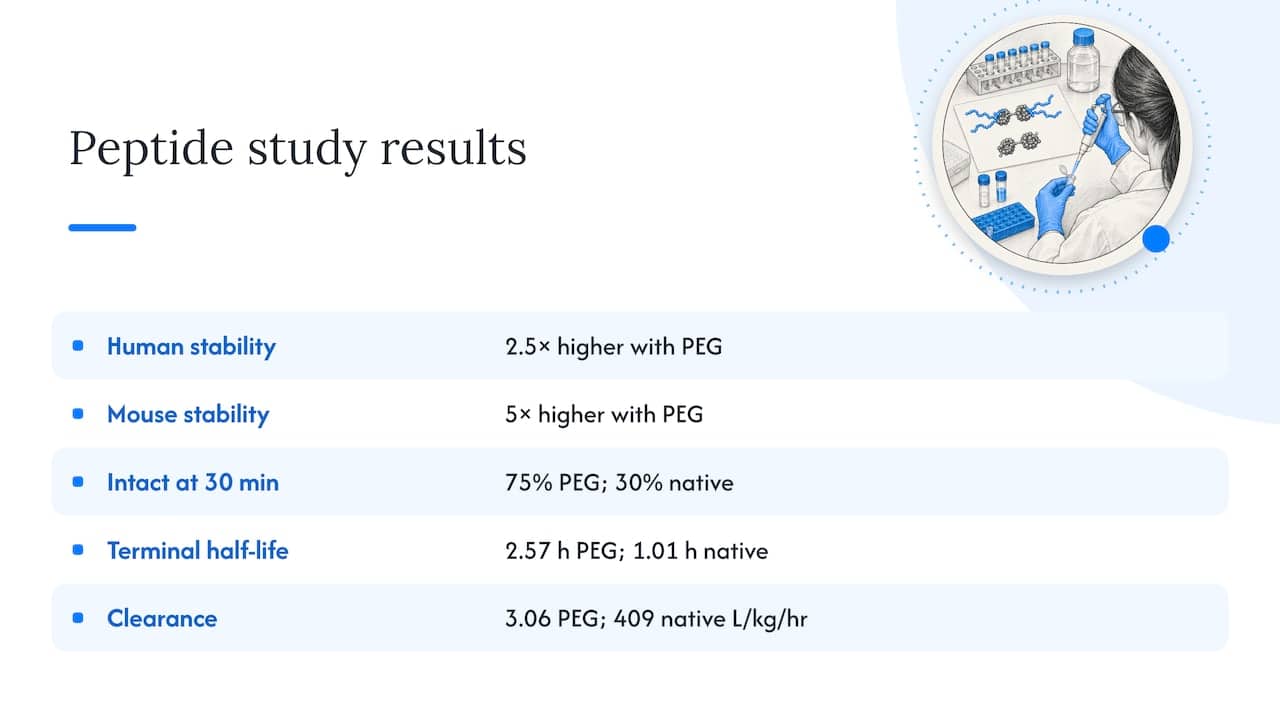
The lesson for a researcher is that the result belongs to that peptide, that PEG and that linkage. It is evidence that PEGylation can change a specific peptide’s behavior, not a general promise.
How the PEG is attached
Chemistry choices decide what the final molecule looks like. Common points to consider:
- The attachment site. Activated PEG can be directed at the N-terminus, at lysine side chains or at cysteine thiols. Pegfilgrastim, for instance, is a 20 kDa PEG conjugated to the N-terminus of filgrastim, as described in a 2023 review of protein and peptide conjugates. Pegasys, by contrast, links PEG to lysine through an amide bond, according to a review in the journal Cytokines.
- The linker chemistry. A 2025 study by Wu and colleagues on a PEG-scaffolded peptide conjugate compared maleimide-thiol and DBCO-azide linkers and found distinct biodistribution and clearance for the same peptide. The linker is part of the molecule’s identity.
- Linear or branched PEG. Branched structures carry more mass on a single attachment point, which can change shielding and clearance.
- Heterogeneity. The 2023 review notes that PEG is polydisperse, meaning a given batch contains chains of varying length, because it is made by ring-opening polymerization of ethylene oxide. Multi-site chemistry can also create isomers that reduce specific activity.
That is why characterization matters. A PEGylated product should be described by the PEG size, the attachment site, the linker and the degree of PEGylation, not just by the peptide’s name.
What FDA-approved PEGylated drugs show
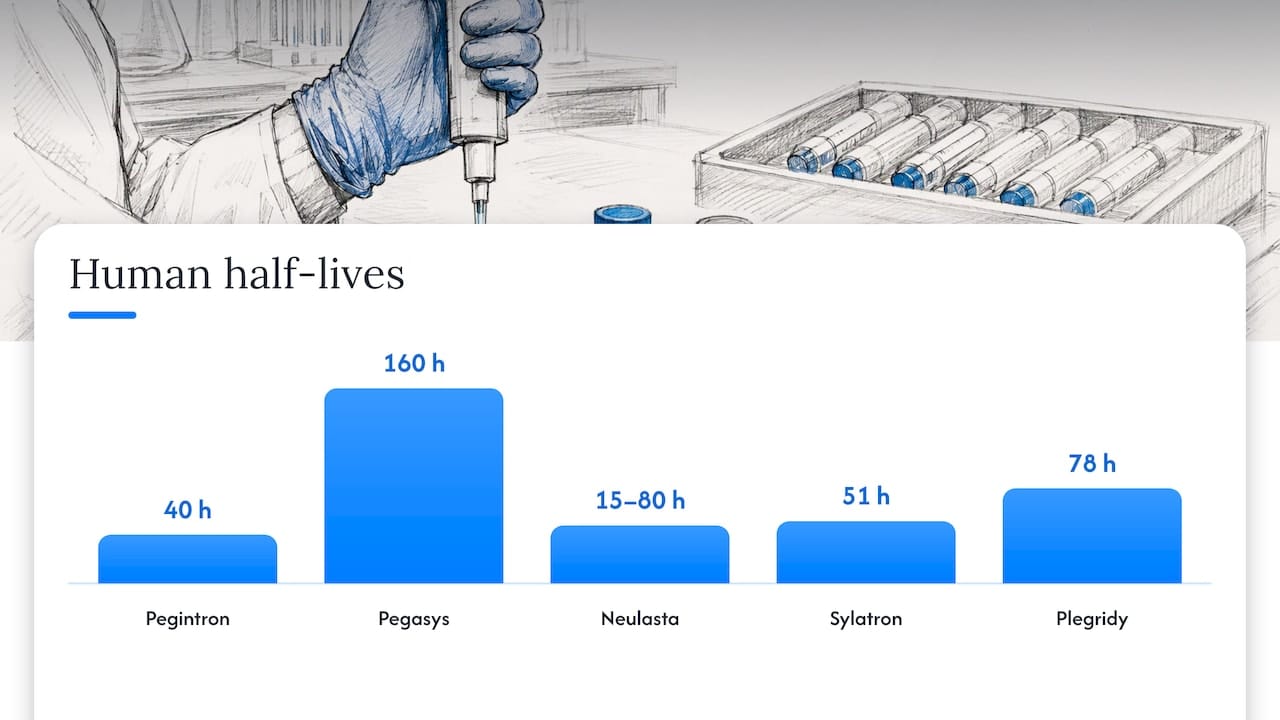
The clinical record is long. The 2023 conjugate review says the first PEGylated protein, Adagen (PEGylated bovine adenosine deaminase with 5 kDa PEG), was approved in 1990, which gives PEG conjugates more than 30 years of clinical experience. A 2025 Langmuir review counts 38 FDA-approved PEGylated drugs as of 2024, including lipids, peptides, proteins and nanoparticles, and tabulates the human half-lives of several:
| Drug | Approved | Use | Human half-life |
|---|---|---|---|
| Adagen | 1990 | Severe combined immunodeficiency | 3 to 6 days |
| Oncaspar (pegaspargase) | 1994 | Acute lymphoblastic leukemia | 5.8 days |
| Pegintron | 2001 | Chronic hepatitis C | 40 hours |
| Pegasys | 2002 | Chronic hepatitis B and C | 160 hours |
| Neulasta | 2002 | Stimulating white cell production | 15 to 80 hours |
| Sylatron | 2011 | Melanoma | 51 hours |
| Plegridy | 2014 | Multiple sclerosis | 78 hours |
Pegfilgrastim is the cleanest illustration. In the 2023 review, attaching a 20 kDa PEG extended serum half-life from a median 3.5 to 3.8 hours for filgrastim to 42 hours. That allows one dose per chemotherapy cycle. In a breast cancer comparison, 72.4% of pegfilgrastim patients received their intended dose on time against 58% on filgrastim.
These are prescription medicines, each developed, tested and approved for one defined indication. They are a reference for how the technology behaves, not a template for any other peptide.
Safety points researchers should know
PEGylation carries its own considerations, and the literature is specific about them. The 2023 review lists three:
- Polydispersity, discussed above, which affects batch consistency.
- Lack of biodegradability. Capping the achievable half-life extension is the renal filtration limit near 50 kDa, and the review notes vacuole accumulation at 40 kDa.
- Immunogenicity. Reported hypersensitivity reactions include anaphylaxis and infusion reactions. The review reports that up to 72% of people may carry pre-existing anti-PEG antibodies, with prevalence varying by assay. In a Phase 2 trial of pegylated uricase (pegloticase), 41% of patients developed high-titer anti-PEG antibodies, with lower drug concentrations and poor response.
Any person with a medical question about a PEGylated medicine should take it to their physician or pharmacist. Research peptides are not medicines, and nothing here is guidance for human or animal use.
Reading claims about PEGylated research peptides
The most common source of confusion for readers in sports, anti-aging and weight management is assuming that a longer-lasting peptide is a better-proven one. Half-life is one property. Whether a given peptide has been studied for a given outcome is a separate question, and PEGylation does not answer it.
A useful example is PEG-MGF. Much of the published work on mechano growth factor was done with the native form, and the PEGylated version has a different size, stability and clearance profile. We covered that gap in our write-up of PEG-MGF research, and our MGF peptide overview covers the native molecule.
PEGylation is also not the only way to extend half-life. The 2022 meta-analysis compared several conjugation strategies, and we have written about albumin-binding peptides as another route. If you are comparing approaches, compare them on the same endpoints: half-life, activity retained, and what was measured in which model.
A short checklist for any peptide you source
- Confirm the exact molecule: sequence, PEG size and attachment site if it is a conjugate.
- Ask for a batch-specific COA that shows purity and identity, not a generic one.
- Look for endotoxin data, which matters if the material goes anywhere near cell culture.
- Check that the COA lot number matches the vial in your hands.
- Store and reconstitute as the documentation specifies.
Our own Anti Aging Peptides guide goes through four COA checks in more detail, and our guide to what researchers should verify first applies the same habit to recovery research.
Our perspective
PEGylation is a good reminder that in peptide research the details of the molecule decide the result. Size, linker, attachment site and purity all change what a peptide does, so the name on the label is never enough.
That is why we build our catalog around documentation. Every lot we sell is third-party batch tested for purity and identity, with a Certificate of Analysis and endotoxin data for each lot. Our peptides are lab-grade, with 99%+ purity, and sold for laboratory research use only.
We think researchers are better served when a supplier makes the paperwork easy to read and easy to match to a vial. Orders ship fast and discreetly from our US facility, and our 24/7 support team is there for questions about a purchase.
Data Peptides
Where to start if you are sourcing research peptides
If your work calls for peptides in weight management, muscle, recovery or anti-aging research, our shop lists each category with the COA documentation described above. You can go straight to muscle growth, recovery or anti-aging research peptides, all supplied for laboratory use only.
FAQ
What does PEGylation do to a peptide?
It attaches PEG chains that enlarge the molecule and shield it from enzymes. Renal filtration is slowed, so the peptide typically stays in circulation longer. Solubility and stability can improve as well, according to the Frontiers and PMC reviews cited above.
Is a PEGylated peptide the same as the native peptide?
No. The conjugate has a different size, different clearance and often different in vitro activity, since PEG can limit access to the binding site. Findings from the native peptide should not be assumed to apply to the PEGylated form, or the other way around.
Which PEG size is used?
Therapeutic PEGs usually range from 3 to 60 kDa. Chains under 6 kDa are filtered freely by the kidney, while chains over 30 kDa are cleared much more slowly. The best size depends on the peptide and the goal.
Are PEGylated drugs approved in the United States?
Yes. As of 2024, 38 PEGylated drugs had been FDA-approved, starting with Adagen in 1990. Each is a prescription medicine for a defined condition, such as leukemia, hepatitis or multiple sclerosis.
Does PEGylation prove a peptide works for weight loss, muscle or anti-aging?
No. PEGylation changes how long a molecule lasts, not what has been studied about it. Approved PEGylated drugs have specific, tested indications. Research peptides from us are supplied for laboratory use only.
Sources
- Frontiers in Pharmacology (2024): research progress on the PEGylation of therapeutic proteins and peptides
- Mero et al., Methods in Molecular Biology (2011): covalent conjugation of PEG to proteins
- Harris and Chess, Nature Reviews Drug Discovery (2003): effect of pegylation on pharmaceuticals
- Wijesinghe et al. (2022): conjugates for use in peptide therapeutics
- Lawrence and Price (2016): how PEGylation influences protein conformational stability
- Fornasari (2025): PEGylated proteins and molecular weight
- Seo et al. (2022): PEGylation of a dimerized blocking peptide
- Wu et al. (2025): impact of conjugation chemistry on pharmacokinetics
- Holz et al. (2023): a review of protein- and peptide-based chemical conjugates
- Zhu et al. (2025): strategies to enhance protein delivery
- Cytokines review (2016): peginterferon alfa-2a