
Oxidation is largely preventable if you control four things: which residues your sequence contains, how much oxygen and metal contact the peptide sees, how cold and dry you keep it, and whether the oxidation you measure is real or created by your own method. Start with a lot that arrives with batch-level documentation, because you cannot track oxidation you cannot baseline. Every lot we supply for laboratory research comes with a Certificate of Analysis and endotoxin data, so your first injection has something to be compared against.
This guide is written for laboratory research use only. It covers the chemistry, the handling routine and the analytical traps.
TL;DR
- Methionine, tryptophan and cysteine are the usual weak points. Aromatic and sulfur-containing residues are preferential oxidation targets, and any sequence containing them needs extra care.
- Keep peptides lyophilized, cold, dry and dark. Reconstitute only what you need, aliquot for single use and limit air exposure.
- Use inert gas (argon or nitrogen) for sensitive sequences and avoid repeated freeze-thaw cycles.
- Some “oxidation” appears during LC-MS itself. Confirm it is real before you change your storage routine.
- Start with a lot that has a Certificate of Analysis, so you have a purity baseline to compare against.
Table of Contents
- What oxidation does to a peptide
- Read your sequence first
- Preventing oxidation during synthesis and cleavage
- Storage: the part that matters most
- Working with solutions
- A bench routine you can adopt
- Is it real oxidation or an artifact?
- Match the measures to your experiment
- Starting from a documented lot
- Our perspective
- FAQ
- Sources
What oxidation does to a peptide
Oxidation is a chemical change to a side chain, most often the addition of oxygen. It changes mass, polarity, folding and sometimes activity, so the peptide you weigh out is no longer the peptide you think you are testing.
All amino acids can in principle be oxidized, but not equally. A 2014 review on peptide developability identifies methionine and tryptophan as the most susceptible. Oxidizing methionine to methionine sulfoxide adds a dipole and creates a new chiral center at the sulfur atom. That alters how the peptide behaves in chromatography and in assays.
The consequences can go beyond a small mass shift. A 2015 synthesis review notes that the methionine oxidation state can influence chain aggregation and final solubility. It also notes that an air and water medium alone can be enough to oxidize methionine in vitro. In other words, a peptide sitting in solution on the bench is already at risk.
Why is oxidation harder to control than other degradation? A 2026 mechanistic review points out that the oxidants present in a formulation are frequently unknown. They change with composition and impurities, and metal-catalyzed oxidation depends on redox-active metals binding to particular sites. So prevention is about removing the ingredients oxidation needs: oxygen, peroxides, metals, light and time.
Read your sequence first
Prevention starts before the vial is opened. Count the residues.
| Residue | Typical vulnerability | What it means at the bench |
|---|---|---|
| Methionine (Met) | Converts to sulfoxide, mass shift of +16 Da | Highest priority for oxygen control and for artifact checks in LC-MS |
| Tryptophan (Trp) | Oxidizes, and can be light sensitive | Protect from light, use amber tubes |
| Cysteine (Cys) | Oxidizes readily, often faster with peroxyl radicals than with hydrogen peroxide | Oxygen-free conditions, avoid alkaline pH |
| Other residues | Susceptible under stress | Standard cold, dry storage is usually enough |
The MS-assay guidance goes further: when designing targeted assay peptides, avoid cysteine, methionine and tryptophan where you can, because they may be modified by oxidation. If you cannot avoid them, you plan around them.
For sequences you design yourself, the developability review describes replacing an oxidation-prone methionine with the hydrophobic isostere norleucine. It also recommends assessing oxidation liabilities experimentally early on. In its ShK example, stability testing at different temperatures and pH led to by-product analysis and stabilizing design changes. This is a design choice for custom sequences, not a handling step.
Preventing oxidation during synthesis and cleavage
If you make your own peptides, oxidation can be baked in before storage even begins. The Rentier et al. review recommends:
- Run synthesis under nitrogen. In their model tetradecapeptide, synthesis without N2 produced 30% oxidized peptide in the crude product.
- Cleave with 1 to 3% 1,2-ethanedithiol as a scavenger.
- Avoid reagents that contain peroxides.
If you buy finished peptides instead, this stage is already behind you. Your job is to hold the purity you received, and to check the Certificate of Analysis for purity and identity data on the exact lot in your freezer.
Storage: the part that matters most
Most oxidation in a working lab happens in storage and handling, so this is where routine pays off. The MS-assay guidance says long-term storage beyond six months works best when peptides are lyophilized (freeze-dried) and held at -20 to -80 °C. Freeze-dried peptide removes the water in which most oxidation chemistry runs.
Our guide to keeping lyophilized peptides cold and dry covers the powder stage in more detail. In short:
- Temperature. Store dried peptide at -20 °C or colder, away from bright light, with a desiccant. Freeze-dried peptides can remain stable for years and are always more stable than the same peptide in solution, according to the tutorial review cited in the guidance.
- Light. Use amber or dark tubes for sequences that are photochemically sensitive, tryptophan-containing ones in particular.
- Oxygen. For sensitive sequences, blanket the storage tube with argon or nitrogen. Keep vial headspace small and open vials as rarely as you can.
- Moisture. Let a cold vial come to room temperature before opening it. Opening it cold invites condensation, which brings water and dissolved oxygen into the powder.
Temperature also interacts with sterility questions, which are a different problem from chemical oxidation. We separate the two in our pages on storage temperature and peptide shelf life, because a rule designed to keep a solution sterile is not a statement about its chemistry.
Stability study conditions
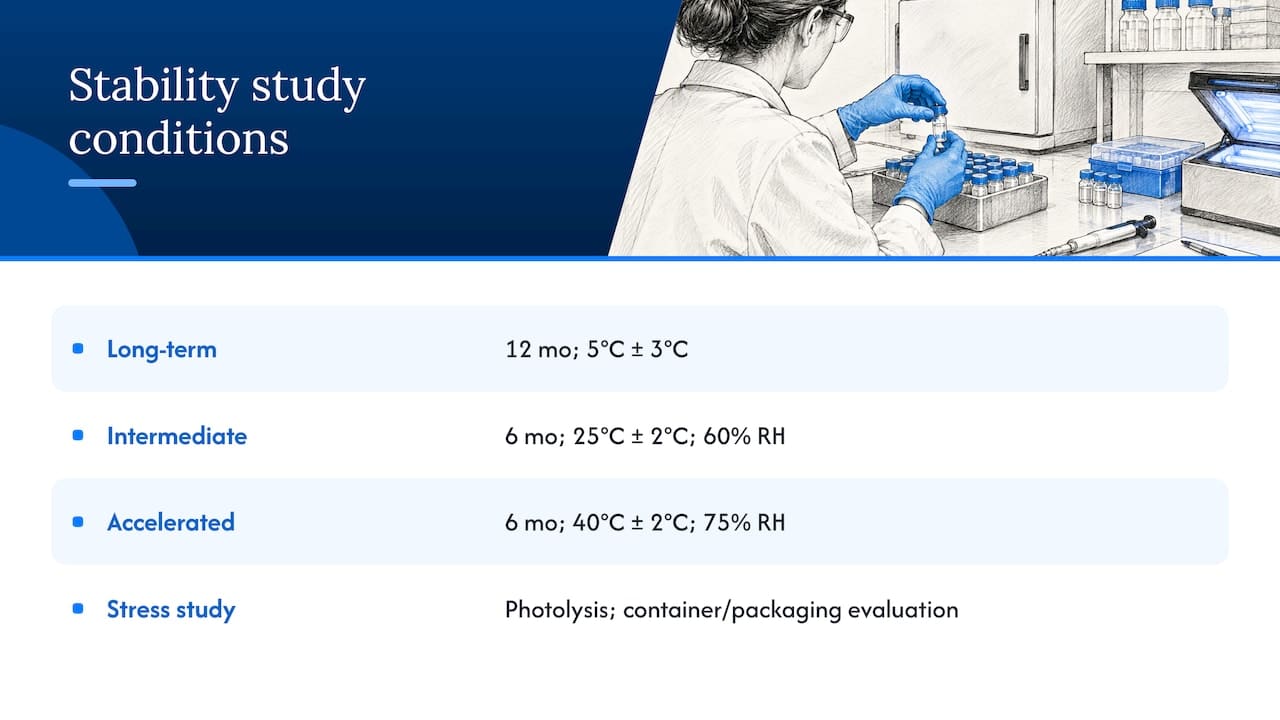
If you need a formal stability picture, a 2025 review of regulatory guidelines summarizes the ICH Q1A(R2) conditions. Long-term testing runs 12 months at 5 °C ± 3 °C. Intermediate testing runs 6 months at 25 °C ± 2 °C and 60% relative humidity. Accelerated testing runs 6 months at 40 °C ± 2 °C and 75% relative humidity. Stress studies include photolysis and container and packaging evaluation. Our overview of peptide stability testing explains how to set these up for lab use.
Working with solutions
Once a peptide is in solution, the clock speeds up. The same guidance gives a practical routine for reconstituted material:
- Freeze reconstituted stocks (0.5 to 2 nmol/µL) at -70 °C or colder in sealed tubes.
- Use working solutions (1 to 100 pmol/µL) within three months.
- Make single-use aliquots and avoid multiple freeze-thaw cycles.
- Dilute calibrators from stock as close to the time of use as you can, adding by weight.
- During a run, keep samples at 4 °C. The tutorial review reports that angiotensin peptides in methanol went from 30 hours of stability at room temperature to 4 days at 4 °C.
Two more details matter. First, pH: the Millipore advice summarized in the guidance is to avoid pH above 8, and our page on peptide pH stability shows how pH shapes degradation. Second, solvent. Sparge solvents with nitrogen or argon for at least 20 minutes before use. Match the solvent to the sequence, since a poor match speeds degradation. Our six-step solvent SOP walks through that decision.
Oxidation and contamination often show up together in lab records, because both come from repeated handling. Clean technique reduces both, so see our guides to aseptic technique and contamination prevention.
A bench routine you can adopt
- Check the sequence. Mark every Met, Trp and Cys, and decide whether the peptide needs inert gas, amber tubes or both.
- Receive and log. Record the lot number and keep the Certificate of Analysis with your notebook entry.
- Store dry. Put the lyophilized vial at -20 °C or colder with a desiccant, away from light.
- Warm before opening. Let it reach room temperature in a closed container.
- Dissolve with prepared solvent. Use sparged solvent at a suitable pH, and make only what the experiment needs.
- Aliquot immediately. Use small, single-use tubes with minimal headspace, backfill with argon or nitrogen for sensitive sequences, and freeze.
- Thaw once. Never refreeze a thawed aliquot.
- Run cold. Keep autosampler trays at 4 °C and limit time in the queue.
- Compare against baseline. Any new +16 Da peak needs checking against the lot data, and against the artifact checks below.
Is it real oxidation or an artifact?
This is the question that saves researchers the most time. You can store a peptide perfectly and still see oxidation in your data, because your method may be creating it.
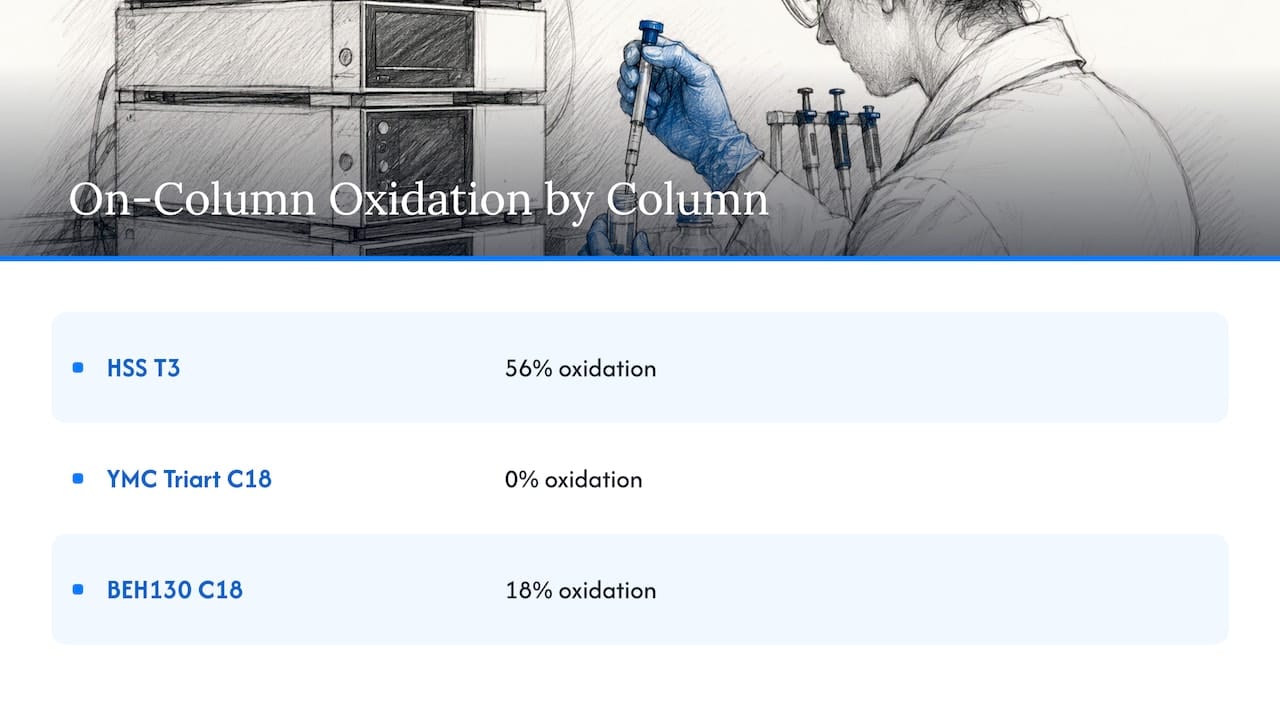
On-column oxidation. A 2021 study on LC setup-dependent artifacts describes oxidation occurring during the chromatography run. The oxidized peak is broad and elutes between the peak for peptide oxidized in solution and the native peak. The effect depended heavily on the column: 56% on-column oxidation on an HSS T3 column set that was a year old with a 180-minute method, versus 0% on a YMC Triart C18 and 18% on a BEH130 C18. A methionine-containing peptide can serve as a quality-control standard for column status.
Metal ions and mobile phase. A 2026 study of artificial oxidation found that flushing the LC flow path with mobile phase containing EDTA significantly reduced on-column methionine oxidation. The authors link it to metal ions from corrosion driven by a 0.1% TFA mobile phase (about pH 1.9). They also note that the broad on-column peak can mislead automated peak integration, so look at the integration by eye.
Consumables and light. The same study followed apparent methionine oxidation over seven years. It rose by up to about fivefold and was tied to a particular bag of microcentrifuge tubes. Fluorescent light exposure was suspected, but the cause was not identified. Keep lot records for tubes, too, and note which bag you used.
Confirming identity. In LC-MS, oxidized forms appear as +16 Da (one oxygen) or +32 Da (two). A 2023 melanoma antigen peptide study found three additional oxidized forms this way, two at +16 Da and one at +32 Da. CID fragmentation confirmed that methionine was the oxidized site. Fragmentation is how you locate the modification rather than just detect it. Our page on LC-MS for peptides lists what to check in setup.
When you see an oxidized peak, run a freshly prepared sample alongside an aged one. If both show the same level, suspect the method before blaming storage.
Match the measures to your experiment
Not every sequence or study needs every precaution.
| Situation | Priority measures |
|---|---|
| Met, Trp or Cys in the sequence | Inert gas, amber tubes, sparged solvent, single-use aliquots |
| No sensitive residues, short project | Cold, dry storage and low freeze-thaw count are usually the main controls |
| Storage beyond 6 months | Keep lyophilized at -20 to -80 °C, reconstitute only on demand |
| Quantitative LC-MS work | Cold autosampler, column QC peptide, EDTA flush check, fresh calibrators |
| Formal stability data | ICH-style long-term, intermediate and accelerated conditions |
The developability review’s advice applies across all of these: measure your oxidation liabilities early, instead of assuming them.
Starting from a documented lot
Handling can only protect what you start with. If a vial arrives already partly oxidized, no storage routine fixes that. For that reason, we publish batch-level documentation: all of our products are third-party batch tested for purity and identity, with a Certificate of Analysis and endotoxin data for every lot. Our research peptides are for laboratory use only, and orders ship quickly and discreetly from our US facility, with 24/7 support on every purchase. You can browse the full range in the Data Peptides shop, or go straight to a research category such as recovery, anti-aging or muscle growth.
Our perspective
We think oxidation control is a documentation problem as much as a chemistry problem. The chemistry is well described: sulfur-containing and aromatic residues are the weak points, and oxygen, metals, light and time do the damage. What labs often lack is a record that lets them say when a +16 Da peak first appeared and whether it came with the vial or from the bench.
That is why we put Certificates of Analysis and endotoxin data with every lot, and why every product is third-party batch tested for purity and identity. A baseline you can trust turns an ambiguous chromatogram into a clear decision.
Our advice to researchers is simple. Keep lyophilized material cold and dry, aliquot early, record lot numbers for peptides and consumables alike, and check your LC-MS method before you blame your freezer. Our guides on storage, stability and solvents are written to support that routine, and our support team is there around the clock if a question comes up about a lot you hold.
Data Peptides
FAQ
Which amino acids oxidize most easily in a peptide?
Methionine and tryptophan are the most susceptible according to a peer-reviewed developability review, and cysteine is also vulnerable. Aromatic and sulfur-containing residues are the preferential targets. If your sequence contains these, plan for inert gas, light protection and single-use aliquots.
How should lyophilized peptides be stored to limit oxidation?
Keep them dry at -20 °C or colder, away from bright light and with a desiccant. For stocks held longer than six months, -20 to -80 °C is the recommended range in published MS-assay guidance. Let the vial warm to room temperature before you open it, so that condensation does not enter the powder.
Does freezing a reconstituted peptide solution stop oxidation?
Freezing slows it considerably, but it does not remove oxygen already dissolved in the solution. Freeze single-use aliquots at -70 °C or colder in sealed tubes, and avoid repeated freeze-thaw cycles. For sensitive sequences, add an argon or nitrogen blanket in the tube.
Why do I see oxidized peaks in LC-MS if my storage was careful?
The oxidation may be created during analysis. Published work shows that column age, method length and metal ions from the TFA mobile phase can all drive on-column methionine oxidation, and that the resulting broad peak can fool automated integration. Compare a fresh sample against an aged one, and check the column with a methionine-containing QC peptide.
Sources
- Recommendations for the generation, quantification, storage and handling of peptides used for MS-based assays (PMC)
- Early engineering approaches to improve peptide developability (PMC)
- Mechanistic insight into the oxidative degradation of proteins and peptides (PMC)
- Protein oxidation and peroxidation (PMC)
- Methionine sulfoxide- and sulfone-containing peptide synthesis (ResearchGate)
- Regulatory guidelines for the analysis of therapeutic peptides and proteins (PMC)
- Liquid chromatography setup-dependent artefactual oxidation (UMONS)
- Artificial oxidation: a major challenge (MDPI, 2026)
- Methionine oxidation selectively enhances T cell reactivity (PMC)