

No single federal “peptide shipping law” exists. What governs a shipment is what the product is, what it is labeled and sold for, and which carrier moves it. Research peptides ship within the United States as laboratory materials, with accurate labeling, batch documentation and honest packaging. At Data Peptides, every lot comes with a Certificate of Analysis and endotoxin data, and orders ship from our US facility, so the paperwork a compliant shipment needs is already in the box.
This guide covers the rules that matter for domestic orders, what “discreet” can and cannot mean, how long delivery usually takes, and what to check before you order.
TL;DR
- Our peptides are sold for laboratory research use only, not for human or animal consumption or medical treatment. That intended use is the foundation of a compliant shipment.
- Federal drug law, not a shipping statute, drives most of the rules. Unapproved drugs cannot be sold or shipped across state lines for use in people.
- USPS holds the mailer responsible for packaging, accurate content identification and any hazardous-materials requirements. Discreet packaging cannot hide contents from carriers.
- Domestic ground delivery typically takes a few business days after fulfillment. Address accuracy, weekends and seasonal volume move that number.
- Before ordering, confirm lot-specific Certificates of Analysis, endotoxin data, research-use labeling and a US shipping origin.
Table of Contents
- Why shipping rules for peptides are really drug-law rules
- What changed recently in federal policy
- What carriers require
- What “discreet shipping” does and does not mean
- How long peptide shipping takes
- State-level considerations
- A pre-order checklist for researchers
- Where to order
- Our perspective
- FAQ
- Sources
Why shipping rules for peptides are really drug-law rules
Carriers do not keep a list of banned peptides. Instead, a shipment is lawful or not depending on the regulatory category of what is inside and the purpose it is sold for.
Under 21 U.S.C. § 355(a), as explained in a 2026 legal guide for peptide companies, an unapproved drug may not be shipped or sold across state lines for use in people, which includes any online sale. The same guide sorts products into three groups: injectable peptides marketed for recovery, longevity or fat loss are unapproved drugs; semaglutide and tirzepatide are approved drugs, with pharmacy versions treated as compounded drugs; and collagen peptides in supplements or copper peptides in skincare sit outside the drug rules.
That is why the line our business draws is so firm. We sell lab-grade peptides for research applications, and our customers are scientific researchers, research organizations, fitness professionals and hobbyists working in laboratory settings. Our products are not offered for direct human or animal consumption or medical treatment. If you want the longer legal background, our guide on whether peptides are legal for research in the U.S. goes deeper.
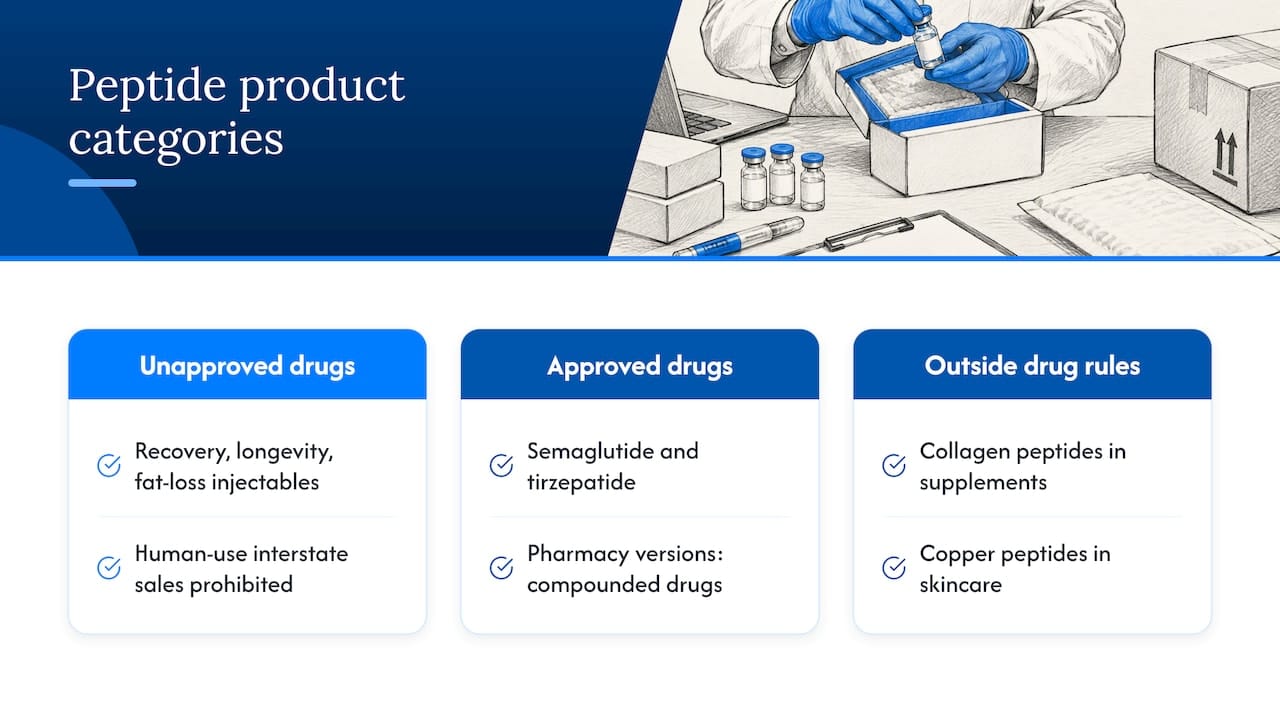
How intended use changes classification
Intended use, product claims and molecular characteristics all affect how a peptide is classified. A compound marketed with therapeutic claims is treated very differently from one documented as a research material. For a plain-language look at how these distinctions play out in a neighboring category, see this overview of peptide regulatory classification differences.
The practical lesson for a researcher: the label, the product page, the Certificate of Analysis and the invoice should all tell the same research-use story.
What changed recently in federal policy
Policy has moved in 2026, and it is easy to misread. In a Federal Register notice dated October 30, 2026, HHS announced a draft enforcement discretion policy. Under it, HHS does not intend to take enforcement action against state-licensed pharmacies, federal facilities or licensed physicians compounding drug products from peptide bulk substances listed in an appendix, while the 503A bulks list is developed through rulemaking. The notice says the policy does not establish rights and does not bind HHS or the public.
Morgan Lewis’s November 2026 analysis adds the detail: the policy covers only BPC-157, Epitalon, KPV, MOTS-c, Semax and TB-500. Products must contain a single peptide, come from a cGMP-compliant, FDA-registered drug establishment, and be compounded under a valid patient-specific prescription. The same analysis points out that the policy does not change the underlying statutory requirements and can be modified later.
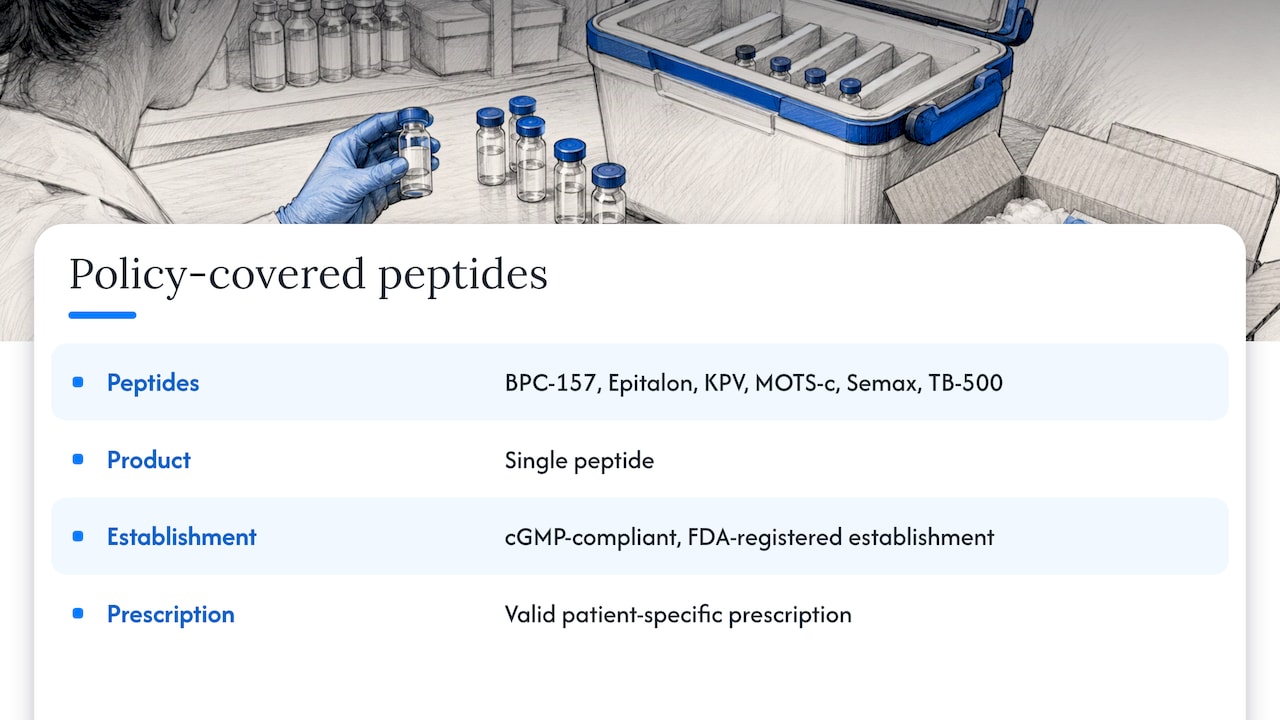
What this means for a researcher ordering for the lab: the policy concerns licensed compounding for patients. It is not a shipping rule for research materials, and it does not turn a research order into a clinical one. It also does not address importing foreign-produced peptides: the same analysis notes that an active ingredient has to be imported for research use or under an IND or approved application, which is one reason domestic sourcing simplifies compliance. Our overview of how peptide imports work for researchers and our note on what the FDA’s peptide policy does and does not change cover the details.
What carriers require
The carrier question most readers ask is whether peptides can go through USPS. The answer depends on the contents and how they are packaged, and USPS puts the responsibility on the sender.
USPS Publication 52 (August 2026) covers hazardous, restricted and perishable mail. For hazardous materials, mailers must supply information such as a safety data sheet, composition and packaging details so mailability can be determined. HAZMAT sent by Priority Mail or Priority Mail Express must be eligible for air transportation and packaged per the publication’s Appendix C instructions. Materials prohibited by Department of Transportation rules are always prohibited on air.
USPS’s shipping restrictions page says every customer is responsible for reviewing Publication 52, complying with Postal Service regulations and US law, and packing securely. It also states that HAZMAT packages must be separated from other packages and presented in a container marked “HAZMAT,” with a $7.50 handling fee for Priority Mail and Priority Mail Express and no extra fee for Ground Advantage. Fees change, so confirm the figure on that page when you ship.
Two takeaways:
- Whoever packs the box owns the compliance. That is a good reason to buy from a supplier that ships from a US facility with documentation prepared in advance, rather than reshipping materials yourself.
- Lyophilized (freeze-dried) research peptides are generally shipped as dry powder in sealed vials. Your own institution’s receiving rules, such as who may sign for chemical or biological materials, are a second layer worth knowing before the box arrives.
What “discreet shipping” does and does not mean
Discreet shipping is a privacy feature. It means a plain outer box, no product names or marketing on the exterior, and a return address that does not advertise what is inside. Neighbors, roommates and mailroom staff do not need to know your purchase history, and that is a reasonable thing to want.
It is not concealment from the carrier. Under USPS Publication 52, except for certain restricted matter, contents must be clearly identified on the address side of the mailpiece, and required federal markings must appear there in non-smearable material. So a properly compliant shipment is private in appearance and still accurate on paper. We ship discreetly from our US facility, and the documentation that travels with an order is built for exactly that balance.
Be wary of any seller who promises packaging that “hides” the contents from inspection. That is a promise a legitimate shipper cannot make, and it signals a supply chain that may not carry proper documentation.
How long peptide shipping takes
Delivery time has two parts: handling (how fast the order leaves the facility) and transit (how long the carrier takes).
On transit, USPS Ground Advantage typically takes 2 to 5 business days, with Saturday delivery included and no Sunday delivery. Priority options are faster, and overnight services are faster still. Fast shipping from a US facility matters here because a domestic origin avoids customs review entirely, which is the single largest source of unpredictable delays on imported peptides.
Factors that move the number:
| Factor | Effect on delivery |
|---|---|
| Order cutoff time and weekends | An order placed late Friday usually leaves the next business day |
| Address accuracy | Apartment numbers and suite details prevent carrier exceptions |
| Service level chosen | Ground, Priority and express differ by days |
| Seasonal volume | Holiday weeks add carrier delays |
| Weather and heat | Extreme heat or cold can affect packages in transit |
For lyophilized peptides, transit of a few days is routine, but avoid letting a package sit on a hot porch or in an unheated mailroom. Choose a delivery address where someone can receive it the day it arrives, and refrigerate or freeze vials according to the storage guidance for your protocol once they are in hand.
State-level considerations
Federal law sets the main framework, and states add their own controlled-substance statutes. Florida is an example: under its Chapter 893 statutes, section 893.13 makes it a felony to sell, manufacture or deliver a controlled substance, and analog provisions extend to substances substantially similar to listed ones. Most research peptides are not controlled substances, but state law, state pharmacy boards and your own institution’s policies can all matter. If your lab is in a state with unusual chemical rules, check with your compliance office before ordering. For questions about a specific compound in your state, a licensed attorney is the right person to consult.
A pre-order checklist for researchers
Before any order, confirm these points. Each one makes the shipment easier to receive, document and defend.
- Research-use labeling. Vials and paperwork should state laboratory research use only.
- A Certificate of Analysis for the lot you receive. Check that the lot number on the vial matches the document, and that it reports purity and identity results from third-party testing.
- Endotoxin data. Our lots include it alongside the CoA, which matters if your assays are sensitive to contamination.
- US shipping origin. Domestic fulfillment keeps transit short and avoids import paperwork. Our page on US-made peptide quality standards explains what to look for.
- Clear carrier tracking and a delivery plan. Know who will sign for the package and where it will be stored.
- Reachable support. If a package is delayed or a document is missing, you want an answer fast. Our support team is available 24/7 for all purchases.
Our buying guide for peptides walks through quality and compliance in more depth, and our research peptides playbook covers purity benchmarks.
Where to order
If you are ready to source materials, the Data Peptides shop lists research peptides by category: weight loss, muscle growth, recovery, anti-aging, libido and ancillary supplies. Every product is third-party batch tested for purity and identity, and orders ship fast and discreetly from our US facility, strictly for laboratory research use.
Our perspective
Shipping compliance is a documentation problem before it is a logistics problem. When a package arrives with a lot-matched Certificate of Analysis, endotoxin data, honest research-use labeling and a domestic return address, everyone downstream, from the mailroom to the lab manager, can see what it is and where it came from.
That is how we built our process. Every lot is third-party batch tested for purity and identity, the paperwork is ready before the box is sealed, and orders ship fast from our US facility in discreet packaging. Privacy and transparency are not opposites: the outside of the box is plain, and the inside is fully documented.
Our customers are researchers, research organizations, fitness professionals and hobbyists working in laboratory settings. We sell for laboratory research use only, and we back each order with a support team that answers around the clock.
Data Peptides
FAQ
Are peptides legal to ship within the United States?
Research materials can be shipped domestically when they are labeled for laboratory research use, accurately documented and packed to carrier rules. Federal law bars shipping unapproved drugs across state lines for use in people, so research-use-only sale and use is the basis for everything we do.
Can I send peptides through USPS?
USPS allows mailing subject to Publication 52, which makes the sender responsible for packaging, identifying contents and meeting any hazardous-materials requirements. Check the current text and fees on the USPS restrictions page before you ship, and ask your own compliance office if the materials are going between institutions.
How long does peptide shipping take in the US?
Ground delivery typically takes 2 to 5 business days after the order leaves the facility, and faster services shorten that. Weekends, holidays, address errors and severe weather can add time, so order ahead of when you need the material.
What does discreet shipping mean?
It means a plain outer package with no product names or branding, so your order stays private. It does not mean the carrier cannot see what the shipment is: contents must still be identified correctly on the mailpiece, and our packages are documented accordingly.
Sources
- Legal guide to peptide startups, Buzko Legal (2026)
- Federal Register notice, HHS enforcement discretion policy (October 30, 2026)
- HHS Opens the Door to Compounding Certain Unapproved Peptides, Morgan Lewis (2026)
- USPS Publication 52, Hazardous, Restricted, and Perishable Mail (August 2026)
- USPS Publication 52, content identification provisions
- USPS Shipping Restrictions and HAZMAT
- 2026 Florida Statutes, Chapter 893.13
- USPS Ground Advantage guide, Pitney Bowes