

There is no single endotoxin limit that covers every peptide. The limit depends on how a product is used, how much is given and by what route, so the numbers you see online (5 EU/kg, 0.2 EU/kg, 100 EU/mL) come from different contexts and are not interchangeable. For a researcher, the practical question is simpler: does the lot in your hands come with a measured endotoxin result that matches the lot number on the vial? That is how we handle it at Data Peptides, where every lot ships with a Certificate of Analysis and endotoxin data for research-use-only peptides.
This guide explains what endotoxin is, where the well-known limits come from, how the calculation works, and how to read a result without over-reading it.
TL;DR
- Endotoxins are fragments of bacterial cell walls. They can end up in peptides during production and can skew cell-based and immunological experiments.
- FDA’s reference threshold for injectable drugs is K = 5 EU/kg body weight per hour, with a stricter 0.2 EU/kg for intrathecal products. These are pharmaceutical release limits, not research-peptide specifications.
- The limit is a ratio (K/M): threshold dose divided by the maximum dose. Change the dose or route and the limit changes.
- A useful endotoxin result is tied to a specific lot, a named method and a stated unit (EU/mL, EU/mg or EU per vial).
- Our peptides are sold for laboratory research use only, with third-party batch testing and lot-level Certificates of Analysis.
Table of Contents
- What endotoxin is and how it gets into a peptide
- Where the commonly quoted limits come from
- Choosing a working endotoxin target for research
- How endotoxin is tested, and what a result can establish
- Why this matters for your data
- Where Data Peptides fits
- FAQ
- Sources
What endotoxin is and how it gets into a peptide
Endotoxins are lipopolysaccharides from the outer membrane of Gram-negative bacteria. They are released when those bacteria die, which is why a vial can be sterile today and still carry endotoxin from an earlier contamination event. A 2020 review in Biotechnology and Bioengineering explains that endotoxins are major contributors to the pyrogenic response (fever-inducing reaction) from contaminated pharmaceuticals, and can enter a product through water, excipients, media, equipment and containers. The same review stresses monitoring raw materials and in-process intermediates, plus testing at final release.
For research peptides, the older academic literature makes the same point from the bench side. A tutorial on microbial cell-wall contaminants in peptides notes that these products are easily introduced into peptides made under standard laboratory conditions, can provoke cytokine induction and broad physiological responses, and can therefore create artifacts in peptide research.
That last point is the one that matters to you if you are running experiments. An unexpected signal in an immune-cell assay may come from the contaminant and not from the peptide you are studying.
Endotoxin is not the same as sterility
Sterility testing asks whether living organisms grow. Endotoxin testing asks whether bacterial debris is present. They answer different questions, and a lot can pass one and not the other. If you want the sterility side, our explainer on how USP sterility testing works and what it proves covers it.
Where the commonly quoted limits come from
Most endotoxin numbers you will find in search results trace back to US Pharmacopeia chapter <85> (the Bacterial Endotoxins Test) and FDA guidance on injectable drug products. They are release limits for medicines made under pharmaceutical controls. They are useful as a yardstick for understanding magnitude, and they are not a promise about any research product.
| Context | Reference limit | Source |
|---|---|---|
| Parenteral drugs, routes other than intrathecal | K = 5 EU/kg body weight/hour | FDA, Bacterial Endotoxins Specification, Points to Consider |
| Intrathecal drugs | K = 0.2 EU/kg body weight/hour | Same document |
| Dosing by body surface area | 100 EU/m²/hour | Same document |
| Devices contacting cardiovascular or lymphatic system | 0.5 EU/mL or 20 EU/device | FDA, Pyrogen and Endotoxins Testing Q&A, March 2026 |
| Devices contacting cerebrospinal fluid | 0.06 EU/mL or 2.15 EU/device | Same guidance |
An EU, or endotoxin unit, is a measure of biological activity, not weight. That is why a result in EU/mL cannot be converted to a mass without knowing which endotoxin standard was used.
Why the limit moves: the K/M calculation
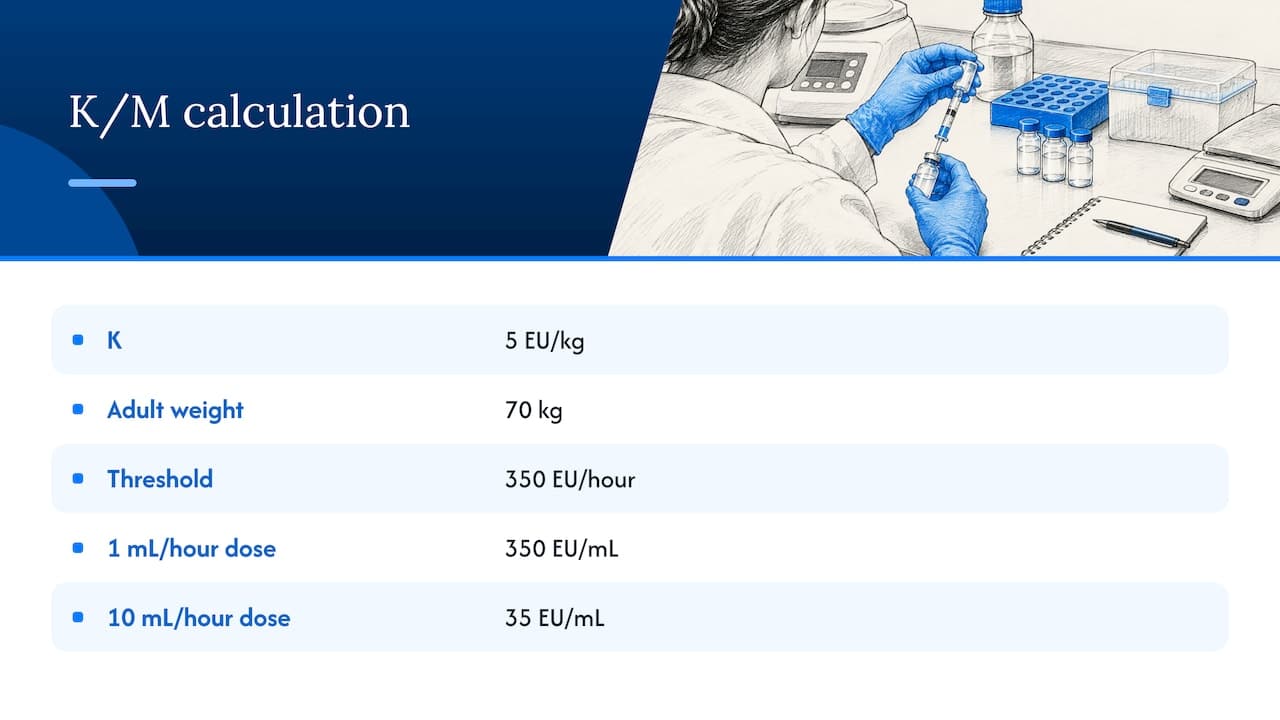
FDA’s inspection guide explains that endotoxin effects depend on both the amount of endotoxin in the product and the patient’s dose, so the limit is expressed as K/M. K is the threshold pyrogenic dose, about 5.0 EU/kg for parenteral products. M is the maximum dose given in a single hour.
A worked example shows the logic. FDA’s points-to-consider document says the Office of Pharmaceutical Quality uses 70 kg as the standard adult weight for these calculations. At 5 EU/kg, a 70 kg adult’s threshold is 350 EU per hour. If a product’s maximum hourly dose is 1 mL, the limit is 350 EU/mL. If the maximum dose is 10 mL, the limit drops to 35 EU/mL. Same threshold, different limit, because the dose changed.
The same document notes that products co-packaged with other components should not collectively exceed the limit, and recommends CDC weight-for-age charts for pediatric patients. For intrathecal use alongside other agents, FDA’s oncology guidance says the combined exposure from all drugs should not exceed 0.2 USP-EU per kg per hour, and that compendial limits are upper limits where stricter ones may be warranted.
The 2026 update to know about
In March 2026, FDA issued the second edition of its Pyrogen and Endotoxins Testing: Questions and Answers guidance. It covers USP <85>, USP <161> for devices and AAMI ST72, and describes gel-clot, photometric and kinetic methods. Two points are worth knowing:
- The old limit table from the 1987 guidance (Appendix E) is declared out of date. Limits should be set by the calculation methods in the USP or AAMI standards.
- For multi-component parenteral products, the overall limit must not exceed the USP <85> threshold, whatever the individual component limits are.
The guidance describes itself as nonbinding current thinking, not a set of enforceable requirements. USP also added chapter <86> in USP-NF 2025 Issue 1, covering endotoxin testing with recombinant reagents that are not derived from animals, so the set of accepted techniques is widening.
Choosing a working endotoxin target for research
Here the honest answer is that it depends on your assay. A cell-free binding study tolerates far more endotoxin than a macrophage or T-cell culture, where trace amounts can drive cytokine release. Work through these questions before you pick a number:
- What system will receive the peptide? Immune cells, primary cells and sensitive reporter lines react at much lower endotoxin levels than chemical or structural assays.
- What final concentration will the peptide reach in the well or vial? Endotoxin delivered scales with how much peptide you add. A result per mg lets you calculate exposure at your working concentration; a result per vial lets you do it only if you know the fill.
- What other reagents add endotoxin? Water, media, serum and plasticware all contribute, as the Biotechnology and Bioengineering review notes. Your budget is the sum, not the peptide alone, which mirrors FDA’s principle that combined components must stay under the overall threshold.
- What does your protocol or lab SOP already specify? If your institution sets a cell-culture reagent limit, use it and compare the COA against it.
Then do the arithmetic. If your assay tolerates 0.1 EU/mL total and you dose the peptide at 1 mg/mL, a result of 5 EU/mg would add 5 EU/mL, far above your budget. A result of 0.01 EU/mg would add 0.01 EU/mL, well inside it. The unit on the certificate decides whether this check is possible at all.
How endotoxin is tested, and what a result can establish
The standard approach is the bacterial endotoxins test in USP <85>, built on the gel-clot, photometric or kinetic methods. FDA’s March 2026 guidance allows alternative assays when they are validated under USP <1225> and shown to give equivalent or better results, but in a dispute the final decision rests on the compendial gel-clot method.
The same guidance sets out retest logic that is useful to understand when you read a certificate:
- A failure below the maximum valid dilution (MVD) can be retested at a greater dilution, not exceeding the MVD.
- An out-of-specification result at the MVD, not attributable to testing error, means the lot is rejected.
- Pooling is generally accepted for small-volume parenterals (100 mL or less), with a proportionally adjusted MVD.
The MVD is the highest dilution at which the test can still detect the limit, which matters because peptides can interfere with the assay at low dilutions.
What a certificate can and cannot tell you
A certificate of analysis establishes that a specific lot was tested by a specific method and returned a specific value. It does not say anything about a different lot, so the lot number on the vial should match the lot number on the document. Check these five things on any endotoxin result:
- The lot or batch number matches your vial.
- The method is named (gel-clot, kinetic chromogenic, or another validated method).
- The unit is stated (EU/mL, EU/mg or EU per vial) along with the sample concentration tested.
- The result is a number or a clear threshold, not just a pass mark.
- The test date and the testing laboratory are shown.
We built a full walk-through of this process in Lot Match First: reading peptide endotoxin COAs. If your concern is what happens after the vial arrives, our lab handling guide to peptide contamination prevention covers reconstitution water, vials and storage, which are the places where endotoxin is most often added back.
Why this matters for your data
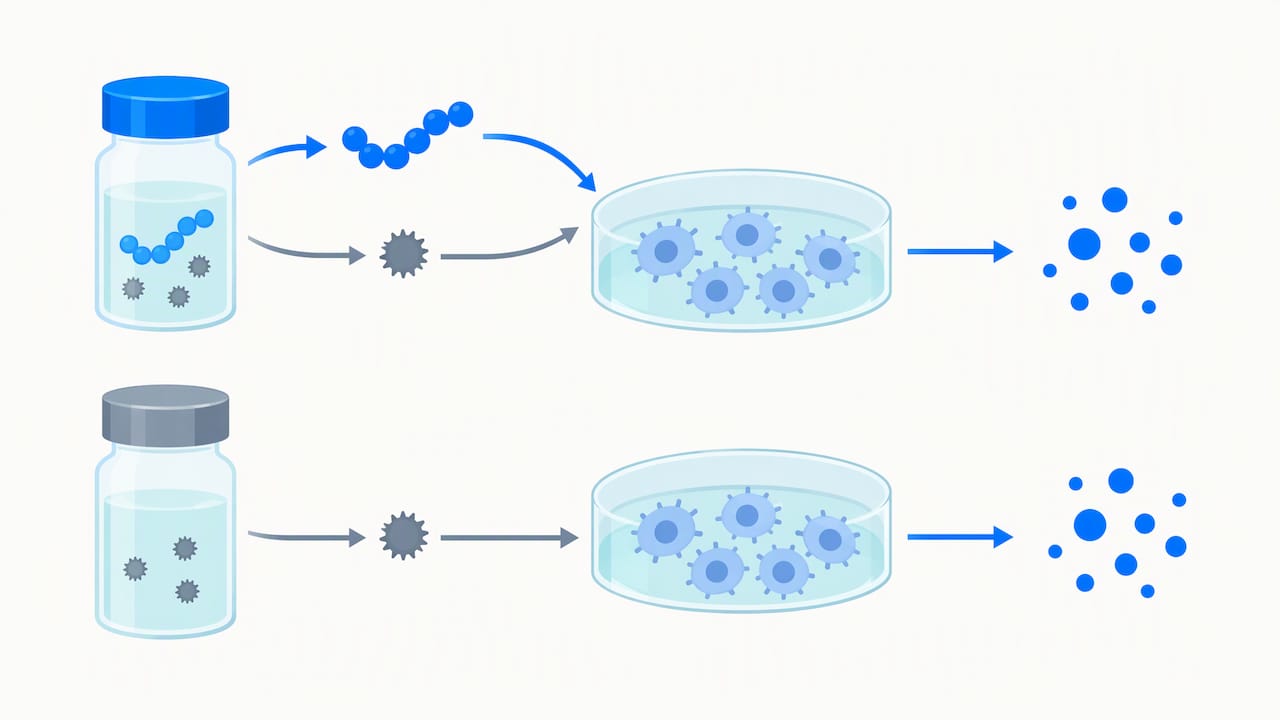
In a research setting, endotoxin is a confounder. It can raise cytokine signals, change cell behavior and make a negative control look active. When a result will not replicate, a contaminated reagent is one of the first things a careful lab rules out. The academic literature has flagged this for peptides specifically for decades, which is why lot-level endotoxin data is more than paperwork: it is part of the evidence that a result belongs to the peptide.
The same logic applies to people who buy peptides for investigation across different interests, whether the study concerns recovery, metabolic pathways or aging biology. In each case, the experiment is only as clean as its reagents. Our research pages for recovery peptides and anti-aging peptides describe what to verify on each COA before a lot goes into a protocol.
Where Data Peptides fits
Our peptides are sold for laboratory research use only, not for human or animal consumption or medical treatment. Every lot is third-party batch tested for purity and identity, and we provide Certificates of Analysis with endotoxin data for each lot. Orders ship fast and discreetly from our US facility, and our support team is available 24/7 for questions about a purchase or a document.
If you are ready to source, start with the full research catalog and match each lot number to its certificate before it enters your workflow.
Our perspective
Researchers tell us the same thing in different words: they do not want a number, they want a number they can trace. An endotoxin value only helps when it is attached to the lot in your freezer, measured by a method you can name, in a unit you can calculate with.
That is why we publish documentation at the lot level. Endotoxin data sits alongside purity and identity results, so one certificate lets you check the lot, the method and the value in one place. Pharmaceutical limits such as the 5 EU/kg threshold are useful reference points for understanding scale, but a research lab works to its own assay budget, and lot-specific data is what lets you do that arithmetic.
We keep our products to laboratory research use only, and we back each purchase with 24/7 support, so a question about a certificate never waits for office hours.
Data Peptides
FAQ
What is the acceptable endotoxin level for peptides?
There is no universal figure. For injectable pharmaceuticals, FDA’s reference is K = 5 EU/kg body weight per hour, which gives 350 EU per hour for a 70 kg adult, and 0.2 EU/kg for intrathecal products. For research use, the right level depends on your assay and the final concentration of peptide in it.
What is the endotoxin limit for injectable drugs in the US?
Under FDA’s points-to-consider document and USP <85>, K is 5 EU/kg/hour for routes other than intrathecal, 0.2 EU/kg/hour intrathecal, and 100 EU/m²/hour for dosing by body surface area. The actual product limit is K divided by the maximum dose, so it varies by product.
What does EU/mL mean on a certificate?
EU stands for endotoxin unit, a measure of biological activity rather than weight. EU/mL is the activity per milliliter of the tested sample, so you also need the sample concentration to work out how much endotoxin your experiment receives.
Is a sterile peptide automatically low in endotoxin?
No. Endotoxin is left behind by bacteria that have died, so a lot can be free of living organisms and still carry it. That is why sterility and endotoxin are reported as separate results.
Are Data Peptides products for human use?
No. Our peptides are sold for laboratory research use only, and not for human or animal consumption or medical treatment.
Sources
- Microbial cell-wall contaminants in peptides: a potential source of artifacts (PubMed)
- Current technologies to endotoxin detection and removal for pharmaceuticals (Biotechnology and Bioengineering, 2020)
- FDA: The Bacterial Endotoxins Specification, Points to Consider
- FDA: Bacterial Endotoxins/Pyrogens inspection technical guide
- FDA: Pyrogen and Endotoxins Testing: Questions and Answers (March 2026)
- FDA: Setting Endotoxin Limits During Development of Investigational Oncology Drugs and Biological Products
- USP-NF: Guidelines for Bacterial Endotoxins Testing <1085>