
For laboratory research, lyophilized (freeze-dried) peptides are the more stable format. Removing the water slows the chemistry that degrades a peptide, so the powder keeps its identity and purity through shipping and months of cold storage. Liquid peptides are a pre-dissolved solution: convenient on day one, but they depend far more on temperature, pH and handling. Which one you choose should follow how long you need to store the material and how much documentation you can see for the lot in your hands.
All Data Peptides products are sold for laboratory research use only, and every lot comes with a Certificate of Analysis and endotoxin data. That documentation matters in either format, because format only protects a peptide that was pure when it was made.
TL;DR
- Lyophilized peptides are freeze-dried powders. Removing water gives the greatest stability for long-term storage and shipping.
- Liquid peptides skip reconstitution, but peptides in solution are more exposed to degradation, so they are for short-term storage and use.
- Stability is sequence-dependent: the amino acids in a peptide, not just the format, decide how fast it degrades.
- Whatever the format, check the batch Certificate of Analysis for identity, purity and endotoxin results.
- Our products are for laboratory research use only, not for human or animal consumption.
Table of Contents
- What the two formats actually are
- Why water is the problem
- Stability and shelf life, with real numbers
- Format comparison at a glance
- Storage rules for each format
- Lyophilized is not automatically bulletproof
- When a liquid format makes sense
- What to verify on any batch
- Research use only, and why it matters
- Our perspective
- Choosing from our range
- FAQ
- Sources
What the two formats actually are
A lyophilized peptide began as a liquid solution that was frozen and then dried under vacuum, so the ice leaves as vapor without the sample being heated much. The result is a dry “cake” or powder in a sealed vial. The FDA’s inspection guide on lyophilization of parenterals lists the advantages as enhanced stability of the dry powder, removal of water without excessive heat, and quick dissolution when the product is reconstituted.
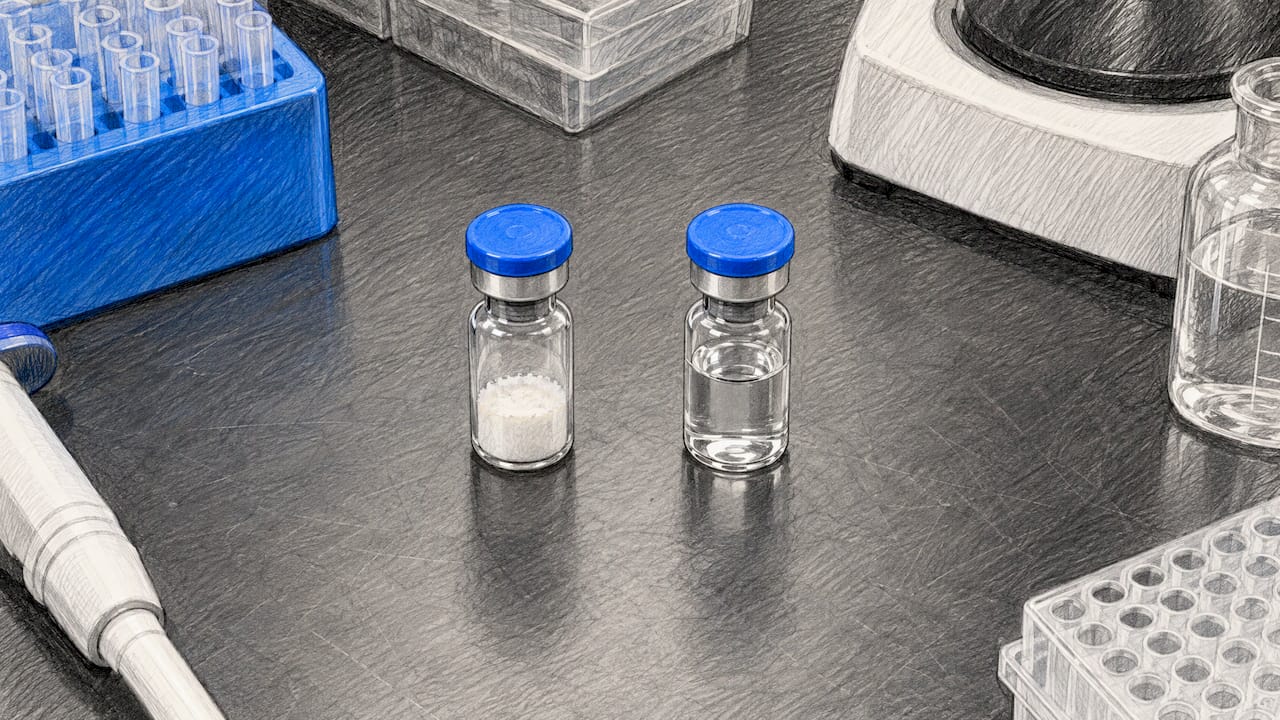
A liquid peptide is already dissolved in a diluent and is ready to measure out. Nothing has to be reconstituted, which removes a handling step and a source of error.
The same FDA guide names the trade-offs of freeze-drying: more handling time, the need for a sterile diluent when you reconstitute, and equipment cost. Those are manufacturing and handling considerations, and they are why a good supplier documents the process rather than just naming the format.
Why water is the problem
Water is the medium in which most peptide degradation happens. The NIH-published CPTAC recommendations on peptide storage list the factors that affect stability: amino acid sequence (cysteine, methionine and tryptophan oxidize; asparagine and glutamine deamidate; aspartic acid can hydrolyze), temperature, pH (they advise avoiding values above 8), oxygen exposure, residual moisture, light, and adsorption to container surfaces.
A dry powder removes most of that reaction medium. A solution keeps every one of those pathways open. This is the core reason lyophilized material is the default for anything stored beyond a short working period.
Stability and shelf life, with real numbers
Published data show the pattern, and also show that the sequence matters.
- Lyophilized storage guidance. The CPTAC table recommends short-term storage (up to 3 months) as a high-concentration liquid at 4 °C or frozen at −20 to −80 °C, medium-term storage (3 months to 1 year) as a frozen concentrated solution, and long-term storage (over 1 year) as lyophilized material at −20 to −80 °C.
- A peptide example. In the FDA’s October 2024 advisory committee briefing, the certificate of analysis for lyophilized kisspeptin-10 recommends 2 °C to 8 °C for under six months and −20 °C beyond six months. The literature it cites reports stability of up to six months refrigerated and one year at −20 °C.
- A protein example. A 2019 study of pegaspargase found the liquid product had an eight-month shelf life because of depegylation, while the lyophilized formulation stayed stable for at least three years in testing, with a 24-month shelf life set at 2 to 8 °C. The authors also found that storing at 25 °C raised residual water uptake and the risk of cake collapse, which supports refrigerated storage.
- Sequence matters. In a 2023 reference-standards paper, gonadorelin lost less than 1% after 34 months at 45 °C, while bivalirudin lost about 4% after 30 months at 4 °C and about 12% after 30 months at 45 °C. Two peptides, two very different stability profiles.
The takeaway: lyophilization generally extends the usable life, but the exact number depends on the peptide, the temperature and the residual moisture in the vial.
Format comparison at a glance
| Factor | Lyophilized | Liquid |
|---|---|---|
| Long-term storage | Best choice, cold and dry | Short-term only |
| Preparation | Reconstitute before use | Ready to measure |
| Handling risk | Reconstitution errors, diluent sterility | Freeze-thaw cycles, pH drift, oxidation |
| Shipping | Powder is robust | Solution is more exposed to temperature swings |
| Best for | Stock held for weeks to years | Immediate, short-window use |
Storage rules for each format
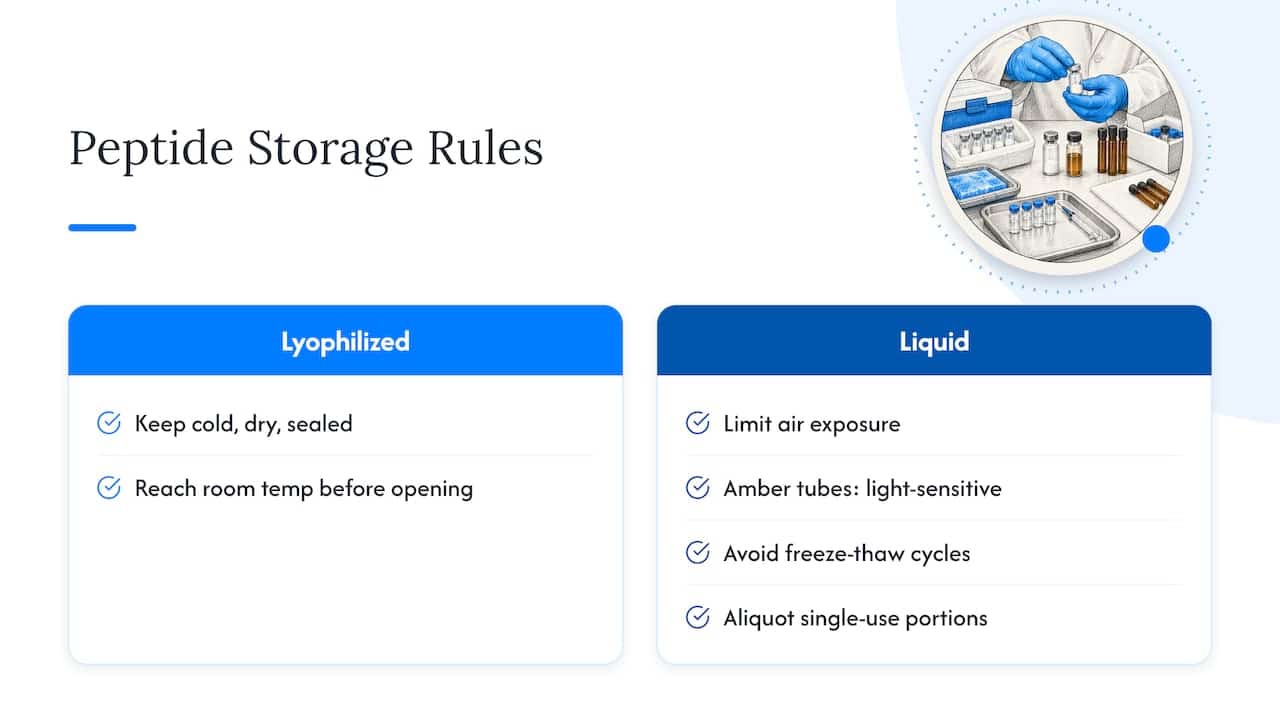
Lyophilized powder. Keep it cold, dry and sealed until you need it. Our guide to keeping lyophilized peptides cold and dry covers the routine, and our piece on peptide storage temperature separates chemical stability from sterility. Allow the vial to reach room temperature before opening so condensation does not add moisture to the powder. Residual moisture and oxygen content are, as the 2023 reference-standards authors note, important quality attributes for lyophilized stability.
Reconstituted or liquid peptide. Once a peptide is in solution, the clock speeds up. The CPTAC guidance advises limiting air exposure, using amber tubes for light-sensitive sequences and avoiding repeated freeze-thaw cycles. Aliquoting into single-use portions is the usual way to avoid cycling. Our peptide shelf life guide explains why the common 28-day rule is a sterility convention rather than a chemical measurement, and our oxidation prevention guide covers the sequences most at risk.
Containers. CPTAC also names non-specific adsorption to vial walls and pipette tips as a major consequence of poor handling, with silanized glass or modified polypropylene recommended. If samples seem to vanish, read about peptide adsorption to plastic.
Lyophilized is not automatically bulletproof
Freeze-drying protects a peptide only when the process and the handling are right. The FDA guide warns that meltback, where the product does not fully sublimate, can cause greater instability and degradation. A 2014 study on a lyophilized antibody found that shipping-like shaking stress produced subvisible particles and turbidity after reconstitution, and that cake collapse and storage temperature affected physical stability.
In practice: inspect the cake on arrival, keep vials upright and cold, and reconstitute gently rather than vortexing. Our reconstitution lab guide walks through the steps.
When a liquid format makes sense
Liquid material suits a bench that will use the whole volume quickly and wants to remove a preparation step. The same caution applies as for any solution: the 2025 regulatory review of therapeutic protein analysis notes that liquid products need stability evaluated across a wide pH range, and that biopharmaceuticals are generally stored at 2 to 8 °C. If your protocol runs for months, a lyophilized stock reconstituted in portions is the more controlled design.
What to verify on any batch
Format is only half the quality story. The FDA briefing points out that peptides are sensitive to formulation, process and environment, and that solid-phase synthesis can leave closely related impurities such as truncated sequences that are hard to quantify without sophisticated methods. That is why a Certificate of Analysis should be specific to the lot.
For a research lot, look for:
- Identity, confirmed by mass spectrometry or another orthogonal method.
- Purity, by HPLC, stated for that batch.
- Endotoxin data, relevant for any sterile work. The HHS testing standard for injectable peptide dosage forms treats bacterial endotoxin testing per USP <85> and bioburden testing as critical quality attributes.
- Peptide content and residual solvents, since a vial’s fill weight is not all active peptide.
- Stability evidence, including reconstitution potency of aged samples, which the FDA guide asks for in lyophilized product testing.
Our guides on peptide stability testing and laboratory standards explain how these checks fit a lab workflow.
Research use only, and why it matters
Research peptides are not approved drugs. In 2026 the HHS issued an enforcement discretion policy on 503A compounding that covers six peptide bulk substances and requires bulk material from an FDA-registered facility with a valid certificate of analysis. The policy text also says it is meant to discourage widespread use of certain research-use-only peptides from foreign manufacturers. That is a compounding policy for licensed pharmacies and prescribers, not a route for individuals.
The FDA briefing also raises immunogenicity concerns for injectable peptides. Anyone with a health question about a peptide should talk to a physician. Our materials are supplied for laboratory research only and are not for human or animal consumption.
Our perspective
We sell lyophilized research peptides because the format keeps the material closest to what left the lab. Every lot is third-party batch tested for purity and identity, with a Certificate of Analysis and endotoxin data.
Format is a storage decision, but documentation is a trust decision. A freeze-dried vial with no lot-specific data tells a researcher little. A vial with a lot-specific Certificate of Analysis tells them what they are working with before the first experiment.
That is the standard we build around: transparent testing, fast and discreet shipping from our US facility, and a 24/7 support team for questions about your order.
Data Peptides
Choosing from our range
If your protocol needs stock you can hold and reconstitute as needed, browse our research peptide catalog, organized by category including weight loss, muscle growth, recovery and anti-aging research. Each product ships with the batch documentation described above, and the ancillaries category covers supplies for lab handling. For the research context behind each category, see our peptide products overview.
FAQ
Do I refrigerate lyophilized peptides?
Yes, for anything beyond short-term holding. Published guidance for one lyophilized peptide recommends 2 to 8 °C for under six months and −20 °C for longer, and general guidance favors −20 to −80 °C for storage over a year. Keep the vial sealed and dry.
Are liquid peptides as stable as lyophilized ones?
Generally no. Water enables oxidation, deamidation and hydrolysis, so solutions are recommended for short-term storage. A study of one protein product found the lyophilized form kept stable for years while the liquid form lasted months.
Does freeze-drying change the peptide?
It is designed not to. In the pegaspargase study, the authors concluded that lyophilization improved stability without altering physicochemical properties. Proper process control and storage are what preserve that result.
How do I limit degradation after reconstitution?
Work at a controlled pH, limit air and light exposure, and aliquot into single-use portions to avoid repeated freeze-thaw cycles. Use low-adsorption vessels such as silanized glass or modified polypropylene.
Which should I choose for a long project?
Lyophilized stock, reconstituted in portions as needed. It gives the longest storage life and the most control over each preparation.
Sources
- FDA: Lyophilization of Parenterals inspection guide (1993)
- FDA: October 29, 2024 Pharmacy Compounding Advisory Committee briefing
- CPTAC/NIH: Recommendations for peptide generation, quantification and storage (2016)
- Reference Standards to Support Quality of Synthetic Peptide Therapeutics (2023)
- Development of a Lyophilized Formulation of Pegaspargase (2019)
- Physical Stability of a Lyophilized IgG1 mAb (2014)
- Regulatory Guidelines for the Analysis of Therapeutic Proteins (2025)
- HHS Enforcement Discretion Policy Regarding 503A peptides, Appendix B (2026)