

Intranasal peptide research asks whether a peptide given through the nose can reach the brain or the bloodstream without injection. Published work shows the route is real and measurable. It also shows that results depend heavily on the peptide, the dose, the device and the species studied. The most useful thing you can do is read the studies carefully and work only with material whose identity and purity are documented lot by lot. That is how we approach it at Data Peptides, where every lot ships with a Certificate of Analysis for laboratory research use.
TL;DR
- Intranasal delivery is studied because the nose offers a route to the brain through the olfactory and trigeminal nerves, and it avoids first-pass metabolism in the liver.
- A 2002 human study showed three neuropeptides reaching cerebrospinal fluid within 30 minutes of intranasal administration.
- Human trial results are mixed and often weaker than animal data, so study design, species and dose matter when you interpret a paper.
- Bioavailability of marketed nasal peptides is generally low, which makes accurate dosing and verified purity central to any experiment.
- Our products are sold for laboratory research use only, with batch testing, Certificates of Analysis and endotoxin data for every lot.
Table of Contents
- Why researchers study the nasal route
- What has been studied, and what was measured
- How strong is the evidence in humans?
- Bioavailability: the number that shapes every protocol
- Safety and regulatory context
- Choosing a peptide source for intranasal studies
- Our perspective
- Where to start in our catalog
- FAQ
- Sources
Why researchers study the nasal route
Most peptides break down in the gut and cannot cross the blood-brain barrier, the tightly regulated lining of blood vessels that keeps most molecules out of brain tissue. The nose offers a different path. A 2022 peer-reviewed review by Bose, Ehrlich and Salton describes how intranasal peptides can bypass that barrier through anatomical gaps in the olfactory epithelium and travel along olfactory and trigeminal nerve pathways. From there they are distributed through cerebrospinal fluid (CSF) and the spaces around blood vessels. Peptides may also enter systemic circulation while avoiding hepatic first-pass metabolism, meaning the liver does not break them down before they circulate.
The FDA’s 2022 presentation on nasal products makes the same general point: the nasal route suits drugs with poor gastrointestinal stability, such as peptides, and offers potential direct central nervous system delivery through the olfactory region.
The 2002 human study that anchored the field
In a 2002 Nature Neuroscience study, Born and colleagues gave melanocortin(4-10), vasopressin and insulin intranasally to human volunteers. All three reached cerebrospinal fluid within 30 minutes, without first showing up in the bloodstream. That paper is still the reference point for the “sniffing neuropeptides” concept, and it explains why so many later studies chose the nose.
What has been studied, and what was measured
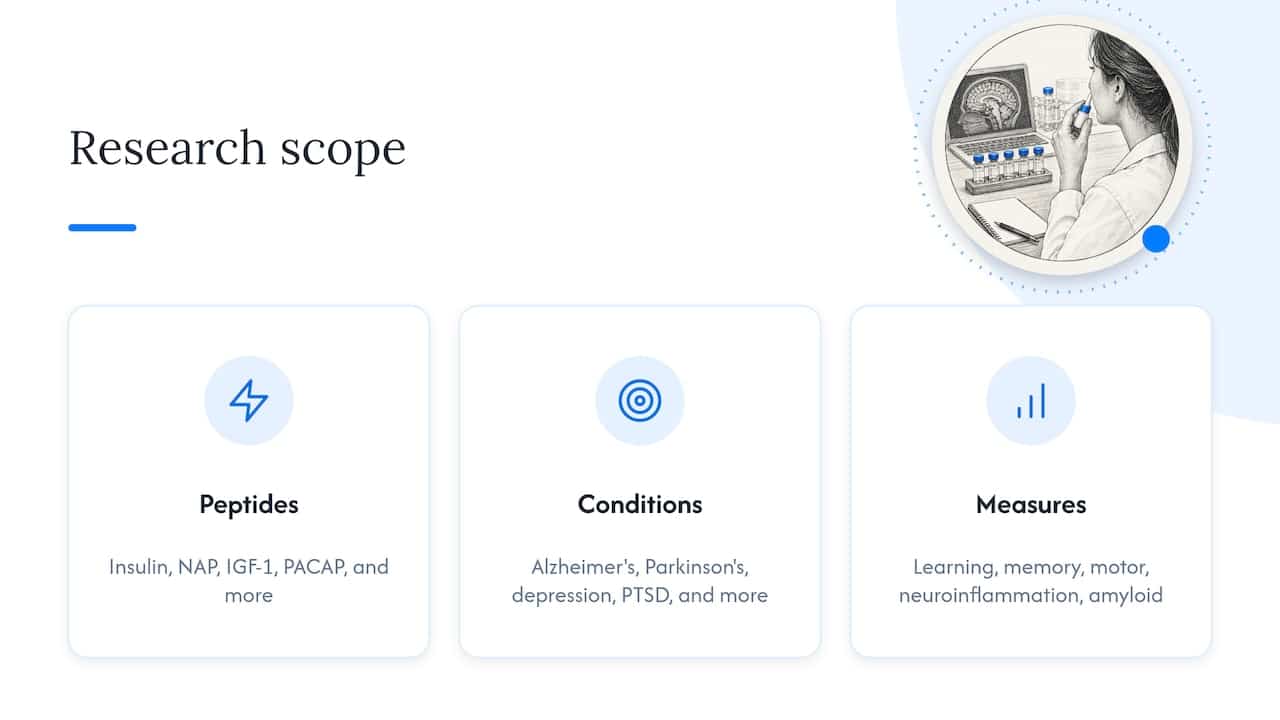
The 2022 review by Bose and colleagues covers about a dozen intranasal peptides in preclinical and clinical development. They include insulin, NAP (davunetide), IGF-1, PACAP, neuropeptide Y, oxytocin, GLP-1 agonists, EPO and GDNF. The conditions studied include Alzheimer’s disease, Parkinson’s disease, depression, PTSD, schizophrenia and autism. Outcomes described in the literature include learning and memory, motor responses, neuroinflammation and amyloid deposition.
A 2025 crossover trial by Mills and colleagues looked at the reproductive axis instead of the brain. Intranasal kisspeptin-54 at 12.8 nmol/kg rapidly stimulated luteinising hormone release in healthy men, healthy women and patients with hypothalamic amenorrhoea, and no participant reported side effects or adverse events. It was a randomized, double-blinded, placebo-controlled study. It shows that intranasal peptides can produce a measurable endocrine signal in humans. Researchers working on kisspeptin pathways can see our kisspeptin research product, supplied for laboratory use only.
If your interest is the central nervous system more broadly, our overview of brain peptide research mechanisms and applications covers the pathways in more detail.
How strong is the evidence in humans?
This is where careful reading pays off. Animal and cell work often looks more dramatic than human trials, and several of the human results are mixed.
| Study area | What was reported |
|---|---|
| Intranasal insulin, mild cognitive impairment and Alzheimer’s | A 12-month trial found no cognitive or functional benefit versus placebo; intranasal glulisine was well tolerated in 35 participants without positive effects on cognition, function or mood. |
| Intranasal insulin, hospital delirium | A 2025 randomized trial reported a shorter hospital stay, 7.9 versus 12.9 days (p=0.014), as summarized in a 2026 neuropharmacology review. |
| Intranasal oxytocin, schizophrenia | A major randomized trial of high-dose oxytocin plus social skills training found no significant benefit over placebo on primary social outcomes (same 2026 review). |
| Intranasal oxytocin, autism | A 12-week trial at 16-24 IU daily showed modest improvements in secondary symptoms, with placebo response often above 30% (same review). |
| Intranasal kisspeptin | Robust luteinising hormone stimulation in healthy volunteers and patients (Mills et al., 2025). |
Three lessons come out of this table.
Acute and chronic effects can differ. The 2026 review notes that acute preclinical effects are often not replicated in chronic human trials. In male prairie voles, long-term developmental oxytocin administration reduced adult partner-preference formation by 25 to 40%, which the authors link to receptor desensitization. Dosing schedule is a variable, not a detail.
Species anatomy matters. The same review points out that rodent nasal anatomy differs fundamentally from human anatomy, so deposition efficiencies achieved in rats are rarely reproduced in humans with standard sprays.
The route of action is still debated. In many studies, high systemic levels appear alongside brain levels. That makes it hard to separate direct nose-to-brain transport from absorption that then crosses the blood-brain barrier. Yao and Kendrick’s 2022 review of oxytocin and vasopressin reaches a similar conclusion: effects on social cognition may come from direct brain penetration, from peripheral circulation, or from vagal stimulation.
One more gap is worth building into your study design. Bose and colleagues observe that most intranasal CNS peptide studies lack statistically meaningful numbers of females, and note that the NIH has required funded studies to account for sex as a biological variable since 2016.
If you are reading this because you want a treatment for yourself rather than a laboratory material, that is a question for a physician. Supervised peptide therapy options exist in clinical settings, and our products are not for human or animal consumption.
Bioavailability: the number that shapes every protocol
A 2018 analysis in Expert Opinion on Drug Delivery by Al Bakri found that most marketed intranasal peptide formulations have human bioavailability generally below 5%. The same work notes that peptides up to 6,000 daltons have been delivered across human nasal mucosa, and that absorption involves both paracellular routes (between cells) and endocytotic routes (through cells).
What this means for a researcher:
- A small difference in concentration, pH, excipients or droplet size can change how much compound is absorbed, so these need to be recorded and held constant.
- Because so little reaches its target, an impure or degraded batch can swamp the signal you are trying to measure.
- Dose limits are real. Campbell and colleagues note that nasal peptide therapeutics need special nonclinical safety considerations, including determining exposure in the context of the maximum feasible dose, because intranasal volume is limited.
Low bioavailability does not mean a compound is useless. Our own piece on why under 1% oral bioavailability can still work walks through how researchers think about low absorption and what it implies for assay design.
Safety and regulatory context
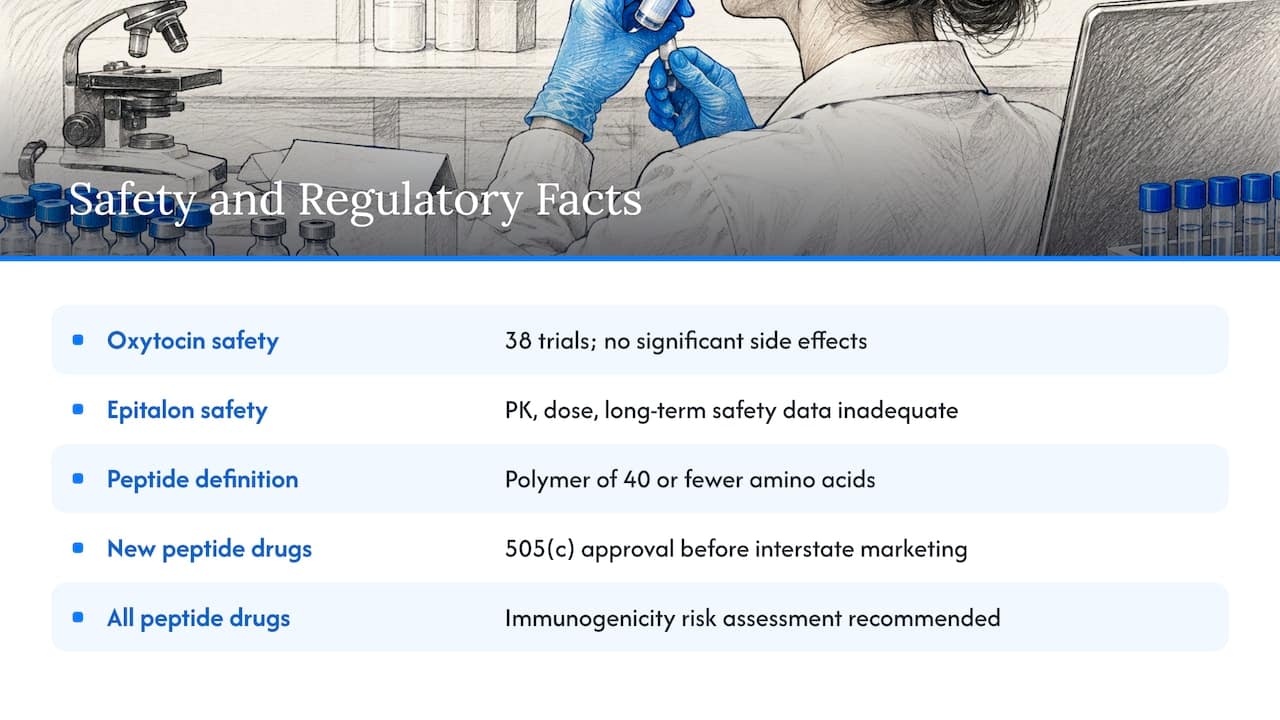
Peptide safety data are uneven. The safety record for intranasal oxytocin is relatively strong: Yao and Kendrick cite a systematic review of 38 randomized trials of single-dose intranasal oxytocin from 1990 to 2010 that found no evidence of significant side effects. For other peptides the picture is thinner. A 2026 narrative review of epitalon reports that FDA briefing materials recommended against adding it to the 503A Bulks List, and that pharmacokinetic, dose-ranging and long-term safety data remain inadequate.
On the regulatory side, the FDA’s December 2023 draft guidance on peptide drug products defines a peptide as a polymer of 40 or fewer amino acids. It says qualifying new peptide drugs must be approved under section 505© before interstate marketing, and it recommends an immunogenicity risk assessment for all peptide drug products. Nasal biologics have no dedicated guideline: a 2025 report on a 2023 industry workshop notes that developers apply general chemistry, manufacturing and controls principles and bioequivalence considerations drawn from existing FDA and EMA guidance.
For laboratory work, this has a practical consequence. Research materials are for laboratory use only, and handling, storage and record keeping fall on you. Our guide to peptide lab safety, handling, storage and documentation covers the routine, and our note on peptide import into the US explains what the rules mean when material crosses a border.
Choosing a peptide source for intranasal studies
Intranasal work raises the bar for material quality. Absorption is low, volumes are small and endpoints are sensitive, so contamination or mislabeled content shows up in your data. These are the questions to put to any supplier:
- Is there a batch-specific Certificate of Analysis? A COA is a lot-level document. It should tie to the lot number on the vial you hold, not to a generic product.
- Does it report both purity and identity? Purity is usually shown by high-performance liquid chromatography (HPLC), which separates the sample into components. Identity is usually shown by mass spectrometry, which checks that the molecular mass matches the expected peptide. A purity percentage alone does not confirm what the peptide is.
- Is endotoxin data available? Endotoxins are bacterial fragments that can trigger inflammatory responses in cell and animal models. For anything applied to mucosal tissue they matter.
- Is the testing independent? Third-party results are more useful for your own records than a statement from the producer.
- Can you reach someone when the data look wrong? A question about a lot should get an answer the same day.
At Data Peptides, all products are third-party batch tested for purity and identity, with Certificates of Analysis and endotoxin data for every lot. Orders ship fast and discreetly from our US facility, and our support team is available 24/7. For related guidance on documentation, see our checklist on four COA checks for anti-aging peptides, which applies equally to other categories.
Our perspective
Intranasal research is a good example of why documentation matters more than marketing. The route is hard on a compound: bioavailability is low, volumes are tiny and the published human results are mixed. When a study shows no effect, the first question should be whether the experiment was designed well, and that question only has an answer if you know what was in the vial.
That is why we build our catalog around verification. Every lot is third-party batch tested for purity and identity, and every lot comes with a Certificate of Analysis and endotoxin data. We sell lab-grade peptides at 99%+ purity for laboratory research use only, across weight loss, muscle growth, recovery, anti-aging and libido categories, plus ancillary supplies.
Researchers should expect to see their lot number on the paperwork, a clear statement of what was tested and a team ready to answer questions at any hour. We designed our service around that expectation, so the compound is one less variable in your study.
Data Peptides
Where to start in our catalog
Research categories on our site include weight loss, muscle growth, recovery, anti-aging and libido, along with ancillary supplies. Browse them all in the Data Peptides shop. Every product is sold for laboratory research only, with a Certificate of Analysis for each lot.
FAQ
How effective are peptide nasal sprays?
It depends on the peptide and the outcome. Human trials of intranasal insulin in Alzheimer’s and of oxytocin in schizophrenia reported no significant benefit on primary outcomes, while a 2025 kisspeptin study showed a clear hormonal response. Bioavailability for most marketed nasal peptides is generally below 5%, so results are highly formulation dependent.
How do intranasal peptides reach the brain?
Researchers propose that they cross gaps in the olfactory epithelium and travel along olfactory and trigeminal nerve pathways into cerebrospinal fluid. Some peptide may also enter the bloodstream and cross the blood-brain barrier from there. Studies have not fully separated these routes.
What does a Certificate of Analysis tell you?
A COA documents the test results for a specific lot. At a minimum you should expect a purity figure, usually from HPLC, and an identity confirmation, usually from mass spectrometry. It also helps to have endotoxin data and the lot number printed on the document.
Can research peptides be used in people?
No. Our peptides are sold for laboratory research use only and are not intended for human or animal consumption or medical treatment. Anyone considering a peptide for a health condition should speak with a physician.
Sources
- Intranasal Peptide Therapeutics: A Promising Avenue (Bose, Ehrlich, Salton, 2022)
- FDA, Nasal Products: Current Landscape and Recent Advancements (2022)
- Sniffing neuropeptides: a transnasal approach to the human brain (Nature Neuroscience, 2002)
- Intranasal kisspeptin administration rapidly stimulates luteinising hormone (Mills et al., 2025)
- Nose-to-Brain Delivery of Therapeutic Peptides as Nasal Formulations (2022)
- Intranasal Drug Delivery in Neuropharmacology (MDPI, 2026)
- Effects of Intranasal Administration of Oxytocin and Vasopressin (Yao and Kendrick, 2022)
- Overview of intranasally delivered peptides (Al Bakri, 2018)
- Drug development of intranasally delivered peptides (PubMed)
- Epitalon and Epithalamin: A Narrative Review (2026)
- FDA, Clinical Pharmacology Considerations for Peptide Drug Products (December 2023)
- Inhalable and Nasal Biologics: Analytical, Formulation, and Regulatory Considerations (2025)